rust-embedded/wg is a coordination repository: issues, RFCs and a team roster, with no code to install
Coordination repository of the embedded devices Working Group
At a glance
- What is it?
- The embedded devices Working Group keeps its issue tracker, RFCs, meeting minutes and team membership here. Crates and tutorials live elsewhere in the rust-embedded organization.
- Who is it for?
- Open this repository when you want to propose a change to embedded Rust crates, find which team owns a crate such as cortex-m-rt or linux-embedded-hal, or join the weekly Tuesday meeting. Do not clone it to learn the language or to get code, because it holds no crates.
- Can I use it commercially?
- Not without permission. GitHub finds no licence file in the repository, and without a licence all rights are reserved by default: you may read the code but not reuse it. Check the README, or ask the authors, before using it.
- Is it still maintained?
- Yes. The repository last received commits 20 days ago.
- What is it written in?
- GitHub does not report a main language for this repository.
Answers come from the project's GitHub data, last synced on November 15, 2026, and from our analysis. They are not legal advice.
Star history
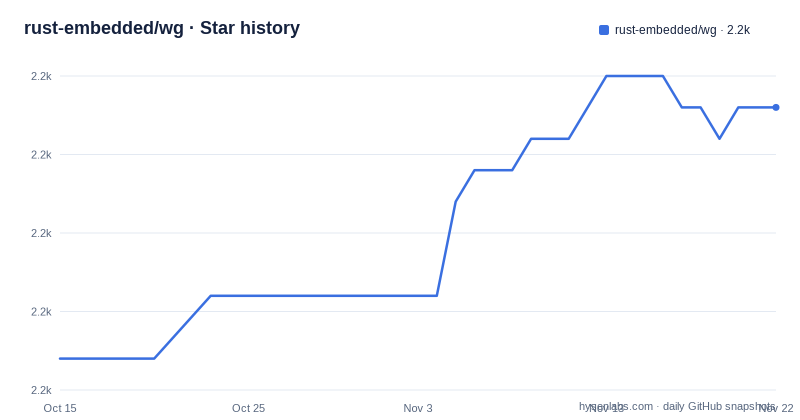
- rust-embedded/wg2,160 ★ · +9
| Repository | 2026-10-15 | 2026-11-15 |
|---|---|---|
| rust-embedded/wg | 2.2k | 2.2k |
9 Stars in the last 31 days, measured from the daily GitHub snapshot. Compare with other projects
Editorial analysis
The repository holds process documents, not crates
Nothing in rust-embedded/wg compiles into a firmware image. The top level contains .github/, assets/, minutes/, ops/, projects/, rfcs/ and surveys/, plus CODE_OF_CONDUCT.md and two templates named 0000-project-template.md and 0000-template.md. GitHub reports no primary language and no licence for it, and there are no tagged releases, so the usual install-and-run questions have no answer here.
The issue tracker is the working surface. The group uses it, in its own wording, to coordinate efforts towards making Rust a great choice for embedded development. A newcomer who arrives hoping to find a getting-started project will land on a long README about governance instead. The README points that audience elsewhere in a bold line near the top: the embedded Rust book at docs.rust-embedded.org/book and the rest of the bookshelf at docs.rust-embedded.org.
The last push to the repository was on 2026-09-27, so the coordination work is still being committed.
Four goals sit under the vision, and only one is about code quality
The vision section lists four aims. The first is to improve the absolute quality of embedded software in the wild, measured by functionality, safety and performance. The second is to improve the productivity of embedded development teams by reducing the tangible and intangible costs of reaching a given level of quality. The third is a better experience for programmers who build for embedded systems. The fourth is to make embedded programming accessible to people who are not already embedded developers.
Two of those four are about people, not about the language: developer experience and accessibility. That explains why the help section tells contributors they may not need previous embedded experience or access to embedded hardware. The group says it will mentor people through bug fixes, features, tests, trying out examples and tutorials, documentation and typo fixes. The work it offers is therefore broader than writing drivers.
RFC threads decide changes, and some are only discussions
Changes to how the group runs, up to major breaking changes in core crates, are preceded by an RFC. The README is careful to say what that means: a discussion thread that may or may not be backed by a proper RFC document, where the pros and cons of a proposal are weighed and alternatives explored. Only after consensus on accepting the proposal does it take effect.
Open RFC threads are found with a GitHub search across the whole organization for open issues carrying the rfc label. The repository's rfcs/ folder holds the written documents. One of them, rfcs/0136-teams.md, defines the teams and carries a section on adding new members plus the rule on what counts as a voting majority.
The practical consequence is that a pull request alone does not settle a question touching a core crate. If you want a breaking change to land in something the group maintains, expect to open or join an RFC thread first and wait for consensus, not just for a reviewer's approval.
The weekly meeting is on Matrix at a fixed European time
A synchronous option sits next to the GitHub threads: a weekly meeting held on Matrix, in the room #rust-embedded:matrix.org. The usual time is Tuesdays at 8pm CET or CEST, so participants in North America or East Asia will find it falls late at night or early in the morning. The agenda is posted in the Matrix channel before each meeting, and anyone may join and give an opinion.
A second use for the meeting: you can nominate an existing GitHub thread for discussion when you think it would benefit from talking it through. The minutes/ directory at the top of the repository is where the group keeps records, though its contents are not part of what the README spells out. A newsletter at rust-embedded.github.io/blog covers community progress for readers who prefer a digest to a live meeting.
The core team drives and moderates these meetings, which makes the Tuesday slot the quickest path to the two people with the casting vote.
Two people hold the casting vote in the core team
The core team has four stated functions: representing the group in meetings with other Rust teams, communicating needs such as language features and core API stabilization to those teams, giving the casting vote on intra-group decisions where no voting majority can be reached, and driving the weekly meetings. Its members are listed as @adamgreig and @therealprof.
The README also describes the group as a bridge between the Rust teams and the embedded community. When you report a gap in the language, the compiler, the tooling, the documentation or the crate ecosystem, the group says it will bring the matter up with the Rust teams or organize the community to build crates or tools to fill the gap.
A two-person core team also means a narrow path for escalation. A dispute that cannot be settled by a voting majority ends with those two, and the README does not describe a procedure for when both are unavailable.
Crates are grouped by team: Arm, embedded Linux, HAL and more
RFC 136 splits the group into teams, and the Organization section of the README maps each team to the crates it owns. The Arm team covers Cortex-A, Cortex-R and Cortex-M microprocessors and microcontrollers. Its project list includes aarch64-cpu, arm-dcc, aarch32-cpu (marked as the new name of cortex-ar), aarch32-rt, cortex-m-rt, cortex-m-semihosting, cortex-m, itm, panic-dcc, panic-itm, panic-semihosting and rust-raspberrypi-OS-tutorials. Twelve members are named, one of whom represents @rust-lang/arm-maintainers.
The embedded Linux team maintains the core of the embedded Linux crate ecosystem: gpio-cdev, gpio-utils, i2cdev, linux-embedded-hal, meta-rust-bin, spidev, sysfs-gpio and sysfs-pwm. It has five named members. A separate HAL team handles shared trait crates, though the README text available here cuts off at that point, so the rest of the roster is not shown.
The rename from cortex-ar to aarch32-cpu is the sort of detail this list is useful for. If an old tutorial or Cargo.toml mentions cortex-ar, the Organization section tells you where it went.
Where to take a problem, and what the group cannot promise
The group offers four entry points: file an issue to report a gap, join an RFC thread, pick up a help wanted issue, or attend the weekly meeting. The README also says you can become a collaborator on a project after consulting the team that owns it, or join a team through the process in RFC 136.
There are limits stated in the text itself. The WG members, in the README's words, only have so much free time, which sets expectations for response times on the issue tracker. No service level, release cadence or support channel for individual crates is promised in this repository. The README also contains a link to a voting majority rule under the older rust-lang-nursery/embedded-wg path, so some links point at a former home of the project.
For questions about one specific crate, go to that crate's own issue tracker under the rust-embedded organization. This repository is for questions about the group, its direction and its gaps.
Editorial conclusion
Open this repository when you want to propose a change to embedded Rust crates, find which team owns a crate such as cortex-m-rt or linux-embedded-hal, or join the weekly Tuesday meeting. Do not clone it to learn the language or to get code, because it holds no crates. Before filing an issue, look up the owning team in the Organization section and check whether an RFC thread already covers the topic.
Frequently asked questions
What is the Rust embedded Working Group repository for?
It is the coordination repository of the embedded devices Working Group. Its issue tracker is used to coordinate efforts towards making Rust a great choice for embedded development.
When does the rust-embedded WG meet?
Weekly on Matrix in #rust-embedded:matrix.org, usually on Tuesdays at 8pm CET or CEST. The agenda is posted in the channel ahead of the meeting and anyone may join.
Where do I start learning embedded Rust?
The README points to the embedded Rust book at docs.rust-embedded.org/book and the wider bookshelf at docs.rust-embedded.org. This repository itself holds no tutorials or crates.
Official sources
Add this badge to your README
If you maintain this project, the badge below links readers to this analysis and shows its maintenance status from the daily GitHub snapshot. Paste the markdown into your README; add ?metric=license or ?metric=stars to the image URL for a different field.

[](https://hysenlabs.com/projects/rust-embedded-wg)Star history chart for your README
[](https://hysenlabs.com/projects/rust-embedded-wg)Was this useful?