rumdl formats, lints and ships as a library, and its two exit code rules decide what a CI gate can catch
Fast Markdown linter and formatter written in Rust
At a glance
- What is it?
- A Rust Markdown linter and formatter distributed through nine package managers, published as a maturin binary with no Python dependencies and built as a cdylib for the editor and web builds. The formatter exits 0 even when it could not fix a violation, which is the detail a CI author has to know about.
- Who is it for?
- rumdl is a good fit for a repository that already keeps Markdown in CI and wants the same rules available in an editor, a language server and a container image without maintaining three configurations. Two things decide whether it fits.
- Can I use it commercially?
- Check first. The repository uses a licence we do not classify automatically, so read its LICENSE file before any commercial use.
- Is it still maintained?
- Yes. The repository last received commits 1 day ago.
- What is it written in?
- Mainly Rust, according to GitHub's language statistics.
Answers come from the project's GitHub data, last synced on November 22, 2026, and from our analysis. They are not legal advice.
Star history
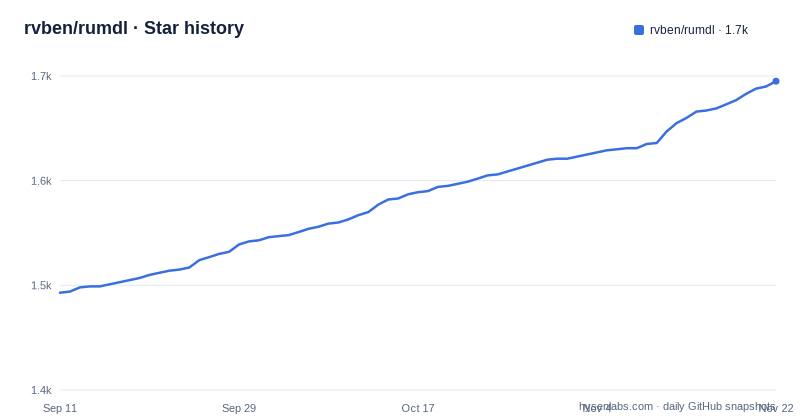
- rvben/rumdl1,695 ★ · +202
| Repository | 2026-09-11 | 2026-11-22 |
|---|---|---|
| rvben/rumdl | 1.5k | 1.7k |
202 Stars in the last 72 days, measured from the daily GitHub snapshot. Compare with other projects
Editorial analysis
fmt exits 0 with violations left behind, check --fix does not
The two write commands report success differently, and the difference is decided in the command comments themselves.
# Format files (exits 0 on success, even if unfixable violations remain)
rumdl fmt .

# Auto-fix and report unfixable violations (exits 0 if all fixed, 1 if violations remain)
rumdl check --fix .
A formatter that rewrites what it can and stays quiet about the rest is a reasonable editor command, and the same command in a pipeline is a gate that cannot fail on content. The check command carries the exit status instead, so a job that wants formatting and a job that wants enforcement need different invocations of the same rule set. The wider surface follows the same pattern, with a non-zero exit code on errors, a `config` subcommand that prints the effective settings, and a `rule` subcommand for a single rule. Anyone wiring this into a pipeline has to decide which of the two commands they mean before the first run.
The rule count in the README lives inside a generated marker
The project states 88 lint rules, and the number is not typed into the page. It sits between a pair of HTML comment markers labelled RULE_COUNT, so the figure is a slot meant to be rewritten by tooling whenever rules are added or removed, and a reader who counts the rules page against that number is reading a value the project maintains automatically. The repository carries the machine readable side of the same thing at the root, in `rules.json` and in `rumdl.schema.json`, which is what an editor extension needs to validate a configuration file. The README also opens with its own suppression comment, `rumdl-disable-next-line MD026`, directly above the tagline, because that heading ends in a period and the rule objects to trailing punctuation in a header. A project that lints itself in public leaves both traces visible.
The table of contents promises ten install paths and the page shows five
The navigation list names Homebrew, Cargo, npm, pip, uv, mise, Nix, the Termux user repository, pacman, a direct binary download, editor plugins and shell completions. The body carries commands for the winget path on Windows, Homebrew, Cargo, npm as a global install and as a dev dependency, and pip.
winget install --id rvben.rumdl --exactbrew install rumdl
cargo install rumdl
pip install rumdlTwo gaps are visible. Winget is not in the navigation list at all even though the installation section opens with it, so the first method on the page is the one method the navigation omits. And the installation part of the page ends on an empty heading, which means uv, mise, Nix, Termux, pacman and the standalone binary are announced by the navigation without their commands appearing here. Each route also costs something different: the pip wheel is a compiled binary with no Python dependencies, the npm install is a wrapper, and the uv path runs the tool without installing it, via `uvx rumdl check .`.
It reads an existing markdownlint config before you write your own
The migration story is built around not rewriting configuration on day one. rumdl discovers common markdownlint and markdownlint-cli2 configuration files automatically, so a first run compares results against what the current tool reports before the workflow changes. A dedicated `import` subcommand moves a configuration file across, `init` writes a default one, and the schema file lets an editor validate it. Style is expressed through named presets rather than hundreds of individual keys, and the `examples` directory ships two ready made files, one following Google style and one compatible with Prettier. Rules are also scoped to file kinds: built in flavors cover GFM, MkDocs, MDX, Quarto and MyST, with auto-detection driven by file name, and a separate rule lints the Markdown inside Rust doc comments, including both `///` and `//!` lines. That last one is why a Rust crate can be checked by the same binary that checks a README.
The same rules engine is compiled as a cdylib for the server and web builds
The Cargo manifest declares two targets. The binary comes from `src/main.rs`, and the library is named `rumdl_lib` with crate type `cdylib` and `rlib`, which is what lets the rule engine be linked into something other than the command line. That is the mechanism behind the `server` subcommand for editor integration, the `vscode` subcommand, the language server section, and the web assets in the repository. The same story continues into WebAssembly, with a `wasm-pkg` directory, a worker configuration file and a `functions` directory, plus a make target for a WebAssembly System Interface smoke test. The wasm-pack release profile keeps `wasm-opt` switched off, so the packaged output is not run through the WebAssembly optimizer. The CLI remains the primary surface; the rest is the same code compiled for a different host.
The release profile buys 8 percent wheel size for 3.5 times the clean build time
The build settings carry their own reasoning in comments.
[profile.release]
lto = "fat"
strip = true
opt-level = 3
codegen-units = 1
Fat link time optimization with a single codegen unit is described as costing 383 seconds against 109 seconds for a thin build with sixteen units, and buying 8 percent off every published wheel at no runtime cost, measured as 1.3 percent less user CPU over a corpus of 478 files. The same comment rules out two shortcuts: the size oriented optimization level costs 15 percent CPU and the smallest costs 113 percent. Two other profiles exist for measurement rather than shipping, one inheriting the release settings with debug symbols kept and stripping disabled, one turning link time optimization off and raising codegen units to sixteen. The package version in the manifest, 0.2.78, matches the newest tag, and the declared minimum Rust version is 1.94.0 on edition 2024, with a make target that checks it.
The container build consumes prebuilt binaries and never compiles Rust
The image definition copies a finished executable into place.
FROM alpine:${ALPINE_VERSION} AS alpine-image

COPY binaries/${TARGETARCH}/rumdl /usr/local/bin/rumdl
Nothing in it invokes cargo, so the build context has to be a staging directory holding binaries laid out per architecture, and the header comment says who fills it: the release pipeline copies them out of release artifacts, while `make docker-binaries` fills the same layout from local cross builds. That is the first cost of the image path, since a source checkout cannot be built directly into it. There are two flavours, a scratch image carrying nothing but the binary with the entrypoint set to rumdl itself, and an Alpine image for environments that need a shell inside the container, which is called out as GitLab CI job containers that run their own setup before the job. The Alpine flavour sets no entrypoint so a shell starts with rumdl on the path. The scratch stage comes last so that a plain `docker build` without a target still yields the scratch image.
Editorial conclusion
rumdl is a good fit for a repository that already keeps Markdown in CI and wants the same rules available in an editor, a language server and a container image without maintaining three configurations. Two things decide whether it fits. If your gate runs the formatter, unfixable findings will pass silently, so the gate has to run check with the fix flag and read the exit code. And if you build the image yourself, the Dockerfile expects prebuilt binaries in the build context and does not compile anything, so a plain docker build on a source checkout produces nothing to run. The 0.2.x line moves fast, with three releases in ten days ending at 0.2.78 on 2026-09-29, so pin a version rather than tracking the default.
Frequently asked questions
How many lint rules does rumdl ship?
The project states 88 rules, and the number appears between HTML comment markers labelled RULE_COUNT, so it is a slot kept in sync by tooling rather than a number typed by hand. The machine readable rule list and the configuration schema sit at the repository root.
Will a rumdl formatter step fail a CI job when it cannot fix a violation?
No. The formatter exits 0 on success even if unfixable violations remain, while check with the fix flag exits 0 only when everything was fixed and 1 when violations are left. A gate that wants enforcement has to use the check form.
Can rumdl use my existing markdownlint configuration?
Yes. It discovers common markdownlint and markdownlint-cli2 configuration files automatically, and an import subcommand converts a configuration file. The project suggests comparing results on a first run before changing the workflow.
What does the rumdl pip package require?
The manifest declares requires-python of 3.9 or later, an empty dependency list, and maturin binary bindings with the rustlib package inside. Classifiers cover Python 3.9 through 3.14 and the Rust language.
Which Markdown flavors does rumdl detect automatically?
Built in flavors cover GFM, MkDocs, MDX, Quarto and MyST, with auto-detection driven by file name. A separate rule lints the Markdown inside Rust doc comments in both triple slash and double slash bang forms.
Official sources
Add this badge to your README
If you maintain this project, the badge below links readers to this analysis and shows its maintenance status from the daily GitHub snapshot. Paste the markdown into your README; add ?metric=license or ?metric=stars to the image URL for a different field.

[](https://hysenlabs.com/projects/rvben-rumdl)Star history chart for your README
[](https://hysenlabs.com/projects/rvben-rumdl)Was this useful?