Neurite's manifest says ISC, its badge says MIT, and its AI features declare no backend at all
Fractal Graph-of-Thought. Rhizomatic Mind-Mapping for Ai-Agents, Web-Links, Notes, and Code.
At a glance
- What is it?
- A fractal mind-mapping workspace with zero runtime dependencies, three separately released components, a canvas that navigates the Mandelbrot set in real time, and a table of contents whose Neural API section is not on the page.
- Who is it for?
- The idea is genuinely distinct: the map's geometry is a fractal you can zoom through, and thoughts are physics-simulated nodes placed on it. What the page does not give you is the part that matters before installing anything.
- Can I use it commercially?
- Yes. MIT is a permissive licence: you can use, modify and sell software built on it, as long as you keep its copyright and licence notices.
- Is it still maintained?
- Activity is slowing. The repository last received commits 8 months ago.
- What is it written in?
- Mainly JavaScript, according to GitHub's language statistics.
Answers come from the project's GitHub data, last synced on November 15, 2026, and from our analysis. They are not legal advice.
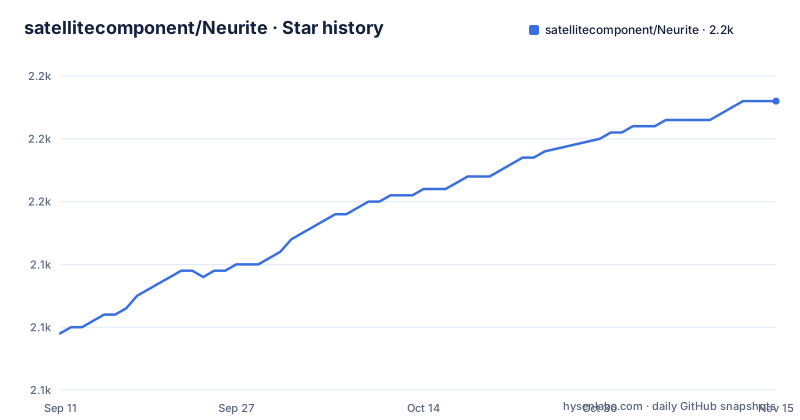
Star history
- satellitecomponent/Neurite2,166 ★ · +37
| Repository | 2026-09-11 | 2026-11-15 |
|---|---|---|
| satellitecomponent/Neurite | 2.1k | 2.2k |
37 Stars in the last 65 days, measured from the daily GitHub snapshot. Compare with other projects
Editorial analysis
The manifest says ISC and every other source says MIT
Four places in this repository make a statement about licensing and one of them disagrees with the other three.
The repository records the MIT licence. There is a licence file at the root. The badge at the top of the readme links to the MIT licence text on the opensource.org site. And the package manifest declares ISC.
That last one is the one that matters in practice, because the manifest is what a package manager reads. Anyone who copies this into an internal project, wraps it, or reads the published metadata will see ISC, while the readme's badge and the repository's own field say MIT. The two are not equivalent: MIT carries an attribution requirement, ISC does not.
The manifest is otherwise thin in a way that matches the rest of the project. Version 1.0.0, described in three words as a fractal mind map, an author name, an empty keywords array, and no dependencies section with anything in it.
If you need to know which terms apply, the licence file at the root is the artifact to read. A licence conflict between metadata and repository fields is common enough that it is a good habit to resolve rather than assume.
Zero runtime dependencies, and a build that copies three directories by hand
The dependency list in the manifest is empty. Not small, empty. There is no runtime dependency of any kind, and there are exactly two development dependencies: a bundler and a shell helper for cross-platform file copying.
That is a real constraint on what the application can be. A workspace with a real-time fractal renderer, a physics simulation for node placement, an agent network view and a synchronisation layer is not doing any of that through a library it declares. So either the code is vendored, and the tree supports that reading with a directory of scripts that the build step copies wholesale into the output alongside a resources directory and a wiki directory, or something is fetched at runtime from a place the manifest does not describe.
The build script makes the vendoring explicit. After the bundler runs, three copy operations move the scripts, the resources and the wiki into the output directory. Nothing in that list is generated; they are maintained in the repository and shipped as-is.
There is also an overrides block pinning two transitive versions, one for a globbing package and one for the bundler's own compiler. Pinning transitive versions in a project with no dependencies of its own is a small window with a large view, which tells you the author has had to reason about the bundler's dependency tree.
Three directories, two scripts, one bundler. That is the entire toolchain, and it is worth understanding before you judge what the application is doing.
Three components release on three different clocks
The release tags are not version numbers. They are component names, dates and time stamps, and there are three separate streams.
One stream is the Electron desktop build, tagged with a June 2025 date. A second is the frontend, tagged with a May 2025 date. A third is the local servers component, tagged with an April 2025 date. Each release name repeats the component and the stamp, so a tag tells you what shipped and roughly when, but not what changed.
Nothing here corresponds to the manifest's 1.0.0. The three streams are independent, which is the correct choice for a project with a desktop shell, a web frontend and a server component that can move at different speeds, and it also means there is no single version to pin.
The newest of the three is from June 2025. The last push to the default branch is dated 2026-03-16, nine months later. So the tree has moved a long way past anything that has been released, and the three release streams have not moved at all in that window.
For someone who wants to run the desktop application, that gap is the thing to check: what the tags contain is from mid-2025, and what the default branch contains is from the following March.
The agent features have no declared backend anywhere on the page
Three feature groups depend on something the repository does not describe.
The first is a multi-agent interface: connect and manage several AI nodes and hold a graph-based conversation between multiple agents and the user. The second is a memory system the page calls a Zettelkasten that responds as a graph of thoughts, with non-linear retrieval of memories and conversation history through graph search. The third is what the contents list calls a Neural API.
None of them is reachable from what is visible. The manifest declares no dependencies, so there is no client library. The contents list promises a Neural API section and a gallery; the page reaches neither, stopping inside the feature table. And the local servers component, which is the only thing in the repository that looks like it could serve anything, is released separately and gets no explanation on the page.
That absence is worth stating as absence rather than as suspicion. It may be that the endpoint is documented on the project website, which the page links repeatedly, or in the wiki directory that the build copies. What can be said from what is here is that a reader cannot verify where an agent conversation goes, which is a different question from whether it works.
The one concrete integration the page does describe is the other direction: a bi-directional sync between the fractal workspace and the Zettelkasten archive.
Nodes execute the code you define inside the app
The trust surface here is stated plainly in the feature table, in the same row as two other capabilities.
Nodes can hold text, images, video, audio, webpages, PDFs and AI agents. Text nodes support code highlighting and execution. And custom nodes can be defined and tested without leaving the application.
So the app runs code you write, in the same window where you keep notes and where agents are connected. That is a reasonable design for a research tool, and it is the design to think about before installing it, because the scope of what a custom node can reach is the scope of whatever the browser or the shell it runs in can reach.
The page carries one accessibility warning above all of this: the interface contains flashing lights and colours that may affect people with photosensitive epilepsy. Given that the canvas is a live fractal that regenerates as you move through it, that is a reasonable warning rather than boilerplate.
The physics simulation is the other piece worth understanding. Nodes are simulated so that they fall toward the fractal visualisation, and the stated purpose is to scatter and arrange your thoughts. The layout of this map is not chosen by an algorithm you configure; it is a consequence of a force simulation over a fractal surface.
The navigation surface is a fractal you can zoom through
Most graph tools lay out a tree and let you move nodes. This one puts the graph on a mathematical surface and makes the surface the viewport.
The canvas renders a fractal in real time and can be navigated by zooming into it, with the renderer regenerating as you interact rather than redrawing discrete tiles. Several fractals are available, named in the page as the Mandelbrot set, the Burning Ship and the Julia set. The colour, the quality and the speed of generation are all adjustable, and one of the listed controls is generating the fractal according to the current mouse position.
That last control explains the interaction model. Your pointer is not selecting among objects laid out on a plane; it is choosing a point in an infinite space, and the content associated with that point is what you see.
The graph sits on top of that surface. The repository description calls the whole approach a fractal graph-of-thought with rhizomatic mind mapping, for agents, web links, notes and code, and the page frames the aim as growing agentic graphs of fractal creativity and collaboration.
Whether the metaphor survives contact with daily note-taking is the open question. What is not in doubt is that nothing else in this category renders its canvas by evaluating an iterative equation per frame.
The page's visual argument is missing while its prose stays behind
The readme is laid out as a series of two-column tables, and in most of them the image half is empty.
The fractal rationale table has four cells and two of them contain nothing at all. The contents table has a heading element with no text. The feature table's last visible row breaks off after its first cell. There is a gallery section in the contents that the page does not reach.
The effect is worse than a page with few screenshots. The surviving prose is written to be read alongside images that are not there: it points at a fractal canvas, at physics-settled nodes, at a graph-of-thoughts memory display, all of which are visual claims. What a reader gets is a description of an interface from someone looking at it, with none of the interface.
The parts that survive on their own terms are the ones that do not need a picture. The claim that the workspace is not locked into a note format, with custom tags for headings and reference brackets, is a statement about flexibility and stands up on its own. The statement that memories are retrieved non-linearly through graph search rather than by linear recall is also self-contained.
Two years of iteration are claimed on the page. The tree's most recent commit is dated 2026-03-16, and the newest release is from June 2025.
Editorial conclusion
The idea is genuinely distinct: the map's geometry is a fractal you can zoom through, and thoughts are physics-simulated nodes placed on it. What the page does not give you is the part that matters before installing anything. The AI and multi-agent features have no declared backend and no documented endpoint in the visible text, and nodes execute code you define inside the app. Read those two things as the open questions they are, and check the licence file yourself rather than either of the two conflicting declarations.
Frequently asked questions
What is Neurite?
An open source mind-mapping workspace whose canvas is a real-time fractal renderer. Nodes hold text, images, video, audio, webpages, PDFs and AI agents, and are physics-simulated so that they fall toward the fractal surface.
Does Neurite have any npm dependencies?
None are declared at runtime. The manifest lists exactly two development dependencies, a bundler and a shell helper, and the build step copies three maintained asset directories into the output by hand. Two transitive versions are pinned in an overrides block.
How does Neurite release its components?
In three separate streams with no shared version number: an Electron desktop build, a frontend build, and a local servers build, each tagged with a component name and a date and time stamp. None of them corresponds to the 1.0.0 in the package manifest.
What licence is Neurite under?
The repository records MIT and there is a licence file at the root, with a badge linking the MIT text, while the package manifest declares ISC. The manifest is what a package manager reads, so read the root licence file before relying on either field.
Can Neurite nodes run code?
Yes. Text nodes support code highlighting and execution, and the page says custom nodes can be defined and tested without leaving the application. The page also warns that the interface contains flashing lights and colours that may affect people with photosensitive epilepsy.
Official sources
Add this badge to your README
If you maintain this project, the badge below links readers to this analysis and shows its maintenance status from the daily GitHub snapshot. Paste the markdown into your README; add ?metric=license or ?metric=stars to the image URL for a different field.

[](https://hysenlabs.com/projects/satellitecomponent-neurite)Star history chart for your README
[](https://hysenlabs.com/projects/satellitecomponent-neurite)Was this useful?