Script Hub claims seven clients and converts between five
Advanced Script Converter for QX, Loon, Surge, Stash, Egern, LanceX and Shadowrocket, with script rewriting and ruleset conversion.
At a glance
- What is it?
- A converter for proxy client scripts and rule sets, where the tagline names seven clients but the feature list delivers five, every parser ships twice as a beta and a stable copy, the production image installs a file watcher from the runtime dependencies, and the docker ignore file is missing its leading dot.
- Who is it for?
- Script Hub is worth using if you maintain rules for more than one of these clients and want one canonical source rather than hand porting each release, and the converter is unusually honest about what it will not translate. Two things to check before relying on it.
- Can I use it commercially?
- Yes, with conditions. GPL-3.0 is a copyleft licence: if you distribute software that includes it, you must release that software's source code under the same licence. Running it internally without distributing it does not trigger that obligation.
- Is it still maintained?
- Yes. The repository last received commits 2 days ago.
- What is it written in?
- Mainly JavaScript, according to GitHub's language statistics.
Answers come from the project's GitHub data, last synced on November 15, 2026, and from our analysis. They are not legal advice.
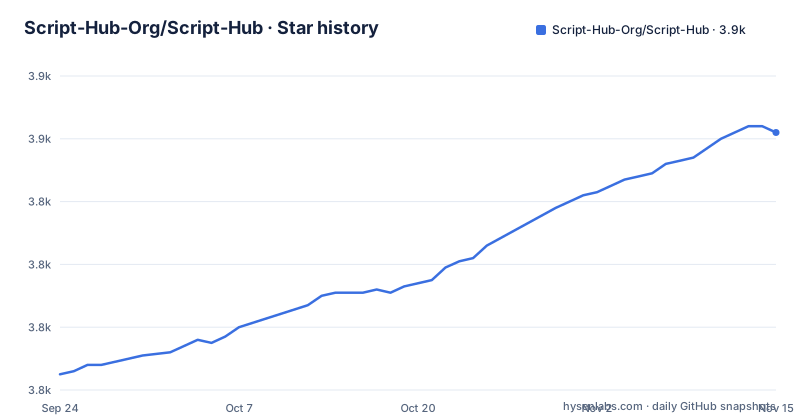
Star history
- Script-Hub-Org/Script-Hub3,862 ★ · +77
| Repository | 2026-09-24 | 2026-11-15 |
|---|---|---|
| Script-Hub-Org/Script-Hub | 3.8k | 3.9k |
77 Stars in the last 52 days, measured from the daily GitHub snapshot. Compare with other projects
Editorial analysis
One client is in the tagline and in none of the features
The header line and the repository description both name seven targets: Quantumult X, Loon, Surge, Stash, Egern, LanceX and Shadowrocket. The feature list underneath never mentions LanceX. What it does enumerate is a directional matrix, and the directions differ. A Quantumult X rewrite can go to Surge, Shadowrocket, Loon or Stash. A Surge module can go to Loon or Stash only. A Loon plugin can go to Surge, Shadowrocket or Stash. Rule sets are parsed from Quantumult X, Surge, Loon, Shadowrocket and Clash and emitted for Surge, Shadowrocket, Stash and Loon. So of the seven names in the header, one never appears as a destination, and the reverse paths are uneven: a Surge module has two outlets where a Quantumult X rewrite has four.
Every parser ships twice, once labelled beta
The root of the repository holds five parsers and converters, each in two copies.
Rewrite-Parser.js
Rewrite-Parser.beta.js
The same doubling applies to `rule-parser`, `script-converter` and `script-hub`, plus a `SurgeModuleTool.js` with a macOS-specific sibling. So the split between stable and beta is a filename convention applied consistently across the parser layer rather than a branch or a build flag, which means choosing one is the loader's job. The page says the beta modules use the official `main` parser for the Loon Script v2 work, which is a third thing again: not the local stable parser, not the local beta one, but the upstream branch. Anyone vendoring this needs to know which of the ten files is actually running.
The production image installs a file watcher
The manifest lists everything in one block, with no separation between what runs in production and what is needed to develop. `nodemon` is the automatic-reload tool, and it is a runtime dependency. So is `cross-env`, the environment-variable shim. So is `http-server`, which has not had a release in years and is serving the HTML preview. The container then installs the production set.
RUN --mount=type=cache,id=pnpm,target=/pnpm/store pnpm install --prod --no-frozen-lockfile`--prod` filters development dependencies, and there are none, so a file watcher and a legacy static server both go into the shipped image. The `--no-frozen-lockfile` flag additionally tells the installer to ignore the lockfile, and the build copies `package*.json`, which brings an npm lockfile into a repository whose package manager field pins pnpm.
The docker ignore file is missing its leading dot
The top level contains a file called `dockerignore`, not `.dockerignore`. Docker only reads the dotted name, so that file has no effect on any build. What the build does instead is copy the entire working directory into the image.
COPY . .With no working ignore file, that brings in everything the repository holds, including the version control directory, any local node modules, and an `env/` directory that sits at the root alongside the source. The container also runs as root and the manifest contains no start script beyond starting the service, so there is no obvious user or working-directory arrangement that would limit the damage. This is the sort of thing that is invisible until somebody builds the image and looks at what is in it.
The converter promises not to drop what it cannot translate
This is the part of the page that deserves credit. Anything with no equivalent in the target is reported rather than quietly dropped, and the page names the categories that will be flagged: the request method, the response status code, combinations of header conditions, and the debug flag. It also draws a distinction that a naive port would get wrong, stating that `binary_body_mode` is not the same thing as `requires_body` and that if you need the full response body you must set the latter in the source script. Per-target behaviour is spelled out too: a network-changed trigger becomes a named event for one family, a diagnostic survives in another, an image URL is preserved in one target and mapped to a tile icon in another, one target has no support for a whole script type at all, a dynamic enable flag becomes a comment, and mixing native v2 with legacy scripts keeps source order.
The converter will fetch a file you name
There is a boundary statement worth reading twice. The page says that WebAssembly, encryption logic and script content are never decrypted or rewritten, and that only host configuration is converted. That is a meaningful promise for a tool that handles other people's proxy scripts. Alongside it, though, is a note that when JSON maps to a body rewrite's filter expression, the referenced filter file is read by the converter service and inlined into the output. So the hosted converter will dereference a path or address that appears in the rule you paste in. That is how a converter for this format has to work, and it is still worth knowing before you feed it anything you would not fetch yourself.
One regression test, for one path, in CommonJS
The whole testing story is one command.
npm run test:loon-v2It resolves to Node's built-in test runner pointed at a single file, a CommonJS test file, for the Loon Script v2 parser. So there is one regression suite, covering one of the several conversion paths, in a repository whose other source files are not declared as either module format. The README calls it the regression test for the beta modules and says they use the official main parser, which makes the coverage question sharper: the test guards a beta path that depends on an upstream branch, and nothing on the page suggests the stable converters or the rule-set parser are covered at all.
The lineage is several forks deep and every one is named
The credits are unusually thorough and are the best documentation of what this code actually is. It is powered by an environment helper library, the original script is credited to another author, the modifications to another, and the parser is described as having borrowed heavily from a named resource parser in someone else's repository. A further contributor is credited with working on this project's web front end and is named against three specific files. Another is credited with a body-replacement module that has since been modified here. Guidance comes from one more person, the logo from one, and the plugin icons come from two separate icon projects. For a converter assembled from at least half a dozen upstream sources, saying so plainly is better practice than most projects manage.
Editorial conclusion
Script Hub is worth using if you maintain rules for more than one of these clients and want one canonical source rather than hand porting each release, and the converter is unusually honest about what it will not translate. Two things to check before relying on it. The matrix is directional, so a rule written for one client has fewer destinations than the header implies, and one client is named in the tagline and appears in none of the features. And the packaging ships a development file watcher as a runtime dependency while the docker ignore file is inert, so read the image before you run it anywhere shared.
Frequently asked questions
What is Script Hub?
A converter for proxy client scripts and rule sets. It parses rewrites, modules and plugins from Quantumult X, Surge, Loon and Shadowrocket and emits them for other clients, with rule-set parsing covering Quantumult X, Surge, Loon, Shadowrocket and Clash. Its hosted site is on Vercel and it also ships a container image.
how to use script hub
The page carries no usage steps and points at the project wiki for installation and first use. What it does set out is the conversion surface, the Loon Script v2 triggers it handles in beta, and one development command, a local preview of the HTML front end.
What Loon Script v2 triggers can Script Hub convert?
The beta path handles request, response, cron, network-changed and generic triggers, converting them to Surge or Egern, Shadowrocket and Stash, and keeping native v2 syntax when the target is Loon itself. Fields it keeps where they map include timeout, enable, requires_body and binary_body_mode.
Does Script Hub rewrite my script?
The page states that WebAssembly, encryption logic and script content are never decrypted or rewritten, and that only host configuration is converted. Conditions and parameters with no equivalent in the target are reported rather than dropped, with the incompatible list covering the request method, response status codes, combinations of header conditions and the debug flag.
how to use roblox script hub
That is a different thing entirely. This repository converts proxy client rewrite rules and rule sets between formats including Quantumult X, Surge, Loon, Shadowrocket and Stash. It has nothing to do with Roblox.
Is there a Roblox cheat script hub?
Not what this repository is. It is a configuration converter for mobile and desktop proxy clients, with a hosted site, a container image exposing two ports, and a server edition the page describes as still in testing.
Official sources
Add this badge to your README
If you maintain this project, the badge below links readers to this analysis and shows its maintenance status from the daily GitHub snapshot. Paste the markdown into your README; add ?metric=license or ?metric=stars to the image URL for a different field.

[](https://hysenlabs.com/projects/script-hub-org-script-hub)Star history chart for your README
[](https://hysenlabs.com/projects/script-hub-org-script-hub)Was this useful?