markdown-exit: TypeScript Markdown Parsing with Async Rendering
Fast, customizable Markdown parser and renderer with full CommonMark support. TypeScript rewrite of markdown-it with enhancements.
At a glance
- What is it?
- markdown-exit is a TypeScript rewrite of markdown-it with CommonMark support, typed APIs, plugins, and asynchronous rendering. Its compatibility model suits migration, although the README still carries a public beta warning for v1.
- Who is it for?
- Application teams that want markdown-it-compatible syntax, TypeScript declarations, and asynchronous rendering should first check their required plugins and rule behavior against the migration guide. Consumers should not treat the latest package as a settled API while the README still warns that v1 may contain breaking changes.
- Can I use it commercially?
- Yes. MIT is a permissive licence: you can use, modify and sell software built on it, as long as you keep its copyright and licence notices.
- Is it still maintained?
- Yes. The repository last received commits 5 days ago.
- What is it written in?
- Mainly TypeScript, according to GitHub's language statistics.
Answers come from the project's GitHub data, last synced on November 6, 2026, and from our analysis. They are not legal advice.
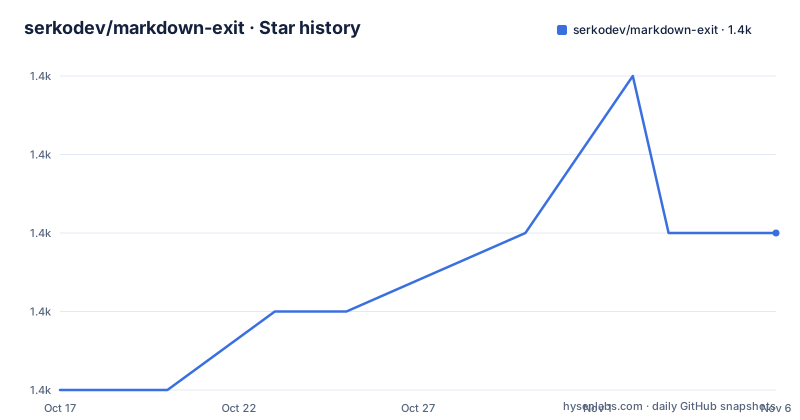
Star history
- serkodev/markdown-exit1,372 ★ · +2
| Repository | 2026-10-17 | 2026-11-06 |
|---|---|---|
| serkodev/markdown-exit | 1.4k | 1.4k |
2 Stars in the last 20 days, measured from the daily GitHub snapshot. Compare with other projects
Editorial analysis
Why markdown-exit Targets TypeScript Markdown Pipelines
markdown-exit addresses teams that already process Markdown but do not want to maintain separate runtime code and community-maintained TypeScript declarations. It is a TypeScript rewrite of markdown-it rather than a new syntax with an unrelated processing model. The project describes full CommonMark support and compatibility with markdown-it v14.3.0, including its plugin API. That makes it most relevant to Node.js and TypeScript applications rendering user-authored Markdown for documentation, comments, previews, content management, or static pages.
The main additions are typed development, plugins, custom rendering, and asynchronous rendering for every rule, including syntax highlighting. Asynchronous support matters when a renderer must wait for work outside ordinary string transformation, such as an external highlighting operation. The project does not present these additions as a completely separate parser architecture. It retains the familiar markdown-it surface and exposes two documented construction paths: the `createMarkdownExit()` factory and the `MarkdownExit` class.
There is a clear audience boundary. markdown-exit is not a Markdown editor, static-site generator, or browser-based preview application. It is a library that receives Markdown text and produces rendered output. Developers evaluating it should therefore compare parser behavior and integration cost, not look for authoring features that the repository does not claim.
markdown-exit's Parser, Renderer, and Plugin Model
The documented API follows the established markdown-it model closely enough that migration begins with an import change. Markdown enters through `render()`, and the returned value is rendered HTML. The package offers both a factory helper and a class constructor, so application code can select a functional setup without relying on the default export.
Its plugin system provides the main extension points for syntax and renderer changes. The README describes plugins as a way to extend Markdown syntax and implement custom rendering. It also states compatibility with the markdown-it v14.3.0 plugin API, but that compatibility statement should not be interpreted as proof that every existing plugin will work without review. Plugins may depend on exact parser internals, rule ordering, token shapes, or renderer contracts. The repository points to a dedicated migration guide for the detailed boundary.
Asynchronous rendering is a distinct capability rather than merely a TypeScript improvement. The documentation says it applies to all rules, including syntax highlighting. That design can support renderers with asynchronous work, but it also means teams should inspect their plugins and surrounding rendering code for assumptions that every rule returns synchronously. The README does not document a timeout policy, cancellation mechanism, error format, or fallback behavior for rejected asynchronous rules. Those details need verification in the relevant guide before being relied upon.
Installing markdown-exit and Rendering the First Document
The normal package install uses npm. This installs the current v1 package described by the README as containing the newest features, but the same section carries a warning that v1 may introduce breaking changes.
npm i markdown-exitFor a first TypeScript use, create the parser through the named factory import and render a heading. The README shows that `render()` accepts the Markdown source directly and returns the rendered HTML.
import { createMarkdownExit } from 'markdown-exit'

const md = createMarkdownExit()
const html = md.render('# markdown-exit')
A class-based import is also documented and is useful when object-oriented application code prefers constructor syntax.
import { MarkdownExit } from 'markdown-exit'

const md = new MarkdownExit()
const html = md.render('# markdown-exit')
The default import remains available for markdown-it compatibility. The README warns that it supports a callable constructor pattern but may create drawbacks for module interoperability and tree-shaking. New TypeScript projects can avoid that uncertainty by using one of the named forms above.
For migration from an existing markdown-it import, the documented change is direct:
import MarkdownExit from 'markdown-exit'

const md = MarkdownExit()
const html = md.render('Existing Markdown')
That snippet demonstrates import and invocation compatibility, not complete behavioral compatibility for every plugin or option.
The v1 Upgrade Boundary Between markdown-exit and markdown-it
markdown-exit is intended as a drop-in replacement for markdown-it, with a TypeScript implementation and additional capabilities. Its documented compatibility target is markdown-it v14.3.0. The migration guide is specifically linked from the README, which is the correct place to examine changes before replacing a production parser.
The clearest alternative is markdown-it itself. An established application that does not need first-party TypeScript types, asynchronous rules, or the added plugin and rendering capabilities can remain on markdown-it. Its continued use also avoids evaluating whether markdown-exit's v1 changes affect existing configuration. markdown-exit's case rests on integration value, not on abandoning markdown-it semantics.
There is also a separate markdown-exit legacy path. The README describes `markdown-exit@legacy` as the v0 line, intended for full compatibility with markdown-it usage while adding TypeScript support, bug fixes, and performance improvements. Choosing the current package rather than the legacy line is therefore an API decision, not just a routine version update.
Migration risk comes from the combination of compatibility claims and an explicit beta warning. The README still says v1 is in public beta and that breaking changes may occur until a stable `v1.0.0`. The listed release history includes `v1.2.1` on 2026-08-24, `v1.2.0` on 2026-08-22, and `v1.1.0-beta.2` on 2026-05-31. A release tag alone does not resolve the warning. Teams with extensive plugin dependencies should inspect the migration guide and run their own application fixtures before changing the dependency.
Plugin and Asynchronous Rendering Failure Modes
The most likely failure point is not basic heading parsing. It is compatibility around extensions and custom rendering. A plugin written against markdown-it v14.3.0 is a reasonable candidate for review, but the README does not guarantee identical behavior for every third-party plugin or configuration pattern. Token expectations, synchronous renderer methods, and assumptions about rule order are especially relevant areas to inspect.
Asynchronous rendering introduces another boundary. A custom rule that performs asynchronous highlighting may succeed when awaited but fail in an application path that expects `render()` to be purely synchronous. The README does not show the exact method name for invoking asynchronous rendering, nor does it show how multiple asynchronous rules are coordinated. Those details should come from the linked rendering guide before an application adopts that path.
Raw HTML handling is another security decision, although the README does not document its policy. The repository documentation excerpt does not establish whether raw HTML is enabled by default or how it is sanitized. A team rendering untrusted user input must not infer safety from CommonMark support or markdown-it compatibility. It needs to verify the actual HTML policy and add an appropriate sanitization layer if its threat model requires one.
The README also does not document a rollback procedure. That omission matters for production adoption because changing parser dependencies can alter generated HTML. Keeping the previous dependency available and comparing representative rendered documents is more concrete than assuming the migration guide covers deployment rollback.
Maintenance Signals, Releases, and the MIT License
The repository is not archived, and its last push was on 2026-08-24. Recent releases listed for the package include `v1.2.1` on 2026-08-24, `v1.2.0` on 2026-08-22, and `v1.1.0-beta.2` on 2026-05-31. These dates show recent release and repository activity, but the README's public beta warning remains the more important adoption constraint for API stability.
The repository is organized as a pnpm workspace. Its root `package.json` names `@markdown-exit/monorepo`, is private, uses ES modules, and declares `[email protected]` as the package manager. Maintainer work includes linting, tests, building, type checking, documentation generation, and release scripts. Those scripts indicate a defined contribution workflow, but they do not guarantee compatibility with every consumer environment.
The package is distributed under the MIT License. The repository credits the original markdown-it authors and identifies copyright associated with Alex Kocharin, Vitaly Puzrin, and SerKo. MIT licensing generally concerns permission and notice obligations rather than compatibility guarantees. A consuming organization still needs to review its actual dependency tree, notices, and release artifacts. It should also budget for migration tests and for tracking breaking changes while the README continues to warn about v1.
Editorial conclusion
Application teams that want markdown-it-compatible syntax, TypeScript declarations, and asynchronous rendering should first check their required plugins and rule behavior against the migration guide. Consumers should not treat the latest package as a settled API while the README still warns that v1 may contain breaking changes. Projects already stable on markdown-it should retain their existing parser unless async rendering or TypeScript integration justifies the migration work. The most important first verification is whether the markdown-it version and plugins in use are supported by the documented compatibility boundary.
Frequently asked questions
How do I install and use markdown-exit in TypeScript?
Install the package with `npm i markdown-exit`, then import `createMarkdownExit` and pass Markdown to `render()`. The README also documents `new MarkdownExit()` as a class-based alternative.
Is markdown-exit compatible with markdown-it?
The project states compatibility with markdown-it v14.3.0 and its plugin API. The README links to a migration guide, while existing plugins and configuration should still be checked against that documentation.
Does markdown-exit support asynchronous rendering?
The README states that every rule can use asynchronous rendering, including syntax highlighting. It does not show the full asynchronous invocation API or document cancellation and timeout behavior.
Is markdown-exit stable for production v1 releases?
The README calls v1 a public beta and warns that breaking changes may occur until a stable `v1.0.0` is released. The listed `v1.2.1` release does not remove that warning in the README.
Can I replace the markdown-it import directly with markdown-exit?
The documented minimal change is replacing the package import. The README calls it a drop-in replacement with enhancements, but also provides a migration guide, so production users should verify their configuration and plugins first.
Official sources
Add this badge to your README
If you maintain this project, the badge below links readers to this analysis and shows its maintenance status from the daily GitHub snapshot. Paste the markdown into your README; add ?metric=license or ?metric=stars to the image URL for a different field.

[](https://hysenlabs.com/projects/serkodev-markdown-exit)Star history chart for your README
[](https://hysenlabs.com/projects/serkodev-markdown-exit)Was this useful?