markstream-vue publishes three tags for one package
Multi-framework streaming Markdown renderers for AI apps: Vue/Nuxt, React/Next.js, Svelte, and Angular, with Mermaid, KaTeX, stream-diffs code blocks, safe HTML, and low-jitter updates.
At a glance
- What is it?
- Markstream is a family of Markdown renderers for chat interfaces where the text is still arriving while someone reads it, shipped as eight packages covering six frameworks plus a framework-agnostic parser. The pitch is two sentences long and unusually clear. The packaging is where the interesting detail is: version 2 removed two code block runtimes, the same package carries three distribution tags, and the only code example in the readme binds a prop under a different name from the one it declares.
- Who is it for?
- Markstream fits a chat interface where a model is still emitting tokens and the reader can see partial syntax, which is a genuinely different requirement from rendering a finished document and is stated as such in two sentences. Two things to check before you adopt it.
- Can I use it commercially?
- Yes. MIT is a permissive licence: you can use, modify and sell software built on it, as long as you keep its copyright and licence notices.
- Is it still maintained?
- Yes. The repository received new commits within the last day.
- What is it written in?
- Mainly Vue, according to GitHub's language statistics.
Answers come from the project's GitHub data, last synced on November 24, 2026, and from our analysis. They are not legal advice.
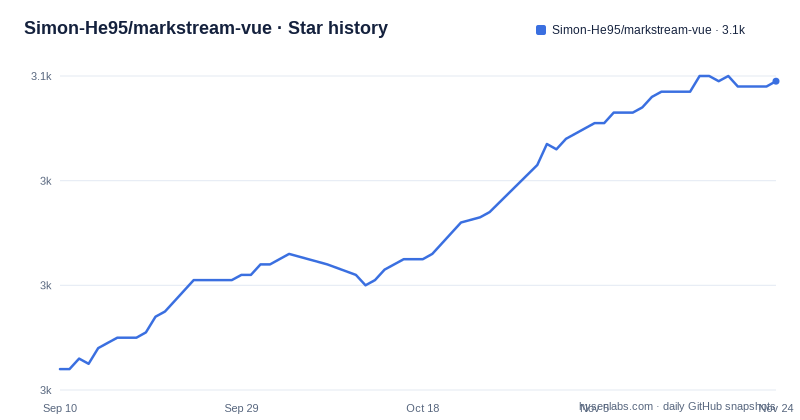
Star history
- Simon-He95/markstream-vue3,059 ★ · +55
| Repository | 2026-09-10 | 2026-11-24 |
|---|---|---|
| Simon-He95/markstream-vue | 3k | 3.1k |
55 Stars in the last 75 days, measured from the daily GitHub snapshot. Compare with other projects
Editorial analysis
The positioning is two sentences, and they are the whole pitch
Most readmes in this category lead with a feature list. This one has a section headed by the three libraries you would otherwise reach for, and it answers in two sentences.
Use the general-purpose Markdown libraries for finished documents. Use this one when the Markdown is still changing while the user is reading it.
That is the entire argument, and it is a real one. A general renderer assumes a parse tree that will not change; a chat renderer has to survive an unclosed fence, a half-written table, a math delimiter with nothing after it, and a diagram that is three lines into its definition. Every subsequent decision in the project, from the incremental updates to the handling of heavy blocks, follows from that sentence.
The project is also honest about not being the only answer. Four comparison pages are published, against another Vue streaming renderer, against a streaming renderer built on top of a general-purpose library, against the general-purpose React one, and against the two general-purpose parsers themselves.
Which is rarer than it sounds. Most of these projects compare themselves to nothing.
Three distribution tags on one package
The install section is short and the interesting part is what is not in it.
There is one command, and it installs the current major from the tag the readme calls the stable one. There is an optional peer for enhanced code and diff blocks, with the instruction to add it only when you need that surface.
Then there is a second command for applications that must stay on the old line, and the paragraph after it is where the packaging gets interesting. The old line is not simply the previous major; it is pinned through its own version range, preserved on a second distribution tag, and its prereleases live on a third.
So the package carries three tags at once. The current stable major, the maintained older major, and the older major's prereleases. Only one of them is what you get by installing with no range, and the other two exist so that a frozen application keeps resolving to a line that is still being fixed.
That is a more careful scheme than most libraries attempt, and it has a matching failure mode: a dependency listed as a caret range on the major will silently drift onto the stable line on the next upgrade, and the migration guide for the cutover is a separate document you have to go and find.
Version 2 removed a code editor and a second code block runtime
The stability section names what changed in the current major, and it is not a small change.
Version 2 removes two code block runtimes: a full code editor component and the previous code block runtime under a different name. In their place there is an optional peer providing the enhanced code block surface.
The framing throughout the file is about weight, and this is the biggest weight decision in it. A code editor is a large dependency to ship inside a chat message, and pulling it out of the default path is the sort of change that gets made once and then defines the package.
What the file does not do is show you the migration. It links a guide for the upgrade and refers to it twice, once in the install section and once in the stability section, and the practical effect is that the two commands at the top of the file install materially different things.
The stable surface is then listed in full, and it is a long list: the renderer component itself, streaming content rendering, rendering of pre-parsed nodes, a safe HTML policy, optional diagram, maths and two further integrations, enhanced code blocks, virtual scroll coordination, CSS exports, worker client subpaths, and server rendering imports for the three build tools the Vue side supports.
The only code example binds a prop under a different name
There is exactly one code block in the visible file, and it is the one every Vue user copies.
<script setup lang="ts">
import MarkdownRender from 'markstream-vue'
import 'markstream-vue/index.css'

defineProps<{
  content: string
  isDone: boolean
}>()
</script>

<template>
  <MarkdownRender mode="chat" :content="content" :final="isDone" />
</template>
The props type declares two names, one for the text and one for whether the stream has finished. The template passes both, and the finished flag is bound under a different name than the one it was declared with.
That is not a stylistic slip, it is two names for one concept in the project's own headline example. Either the prop type or the binding is out of date, and a user who types the props out and then binds the declared name gets a component that never learns the stream finished.
The example also imports the stylesheet by a deep path rather than through the package's export map, which is a second thing to check against whatever version you install.
Twelve playgrounds for eight packages, most of them elsewhere
The packages table lists eight: one per framework, plus a framework-agnostic parser and a framework-agnostic set of streaming controller utilities.
A second list underneath maps each framework to its package, and it has the same eight entries. So the readme tells you twice how to choose, in a table and in a list.
The tree is where it gets interesting, because there are twelve playground directories. One per framework, one per React major version, one for the meta-framework integrations, and a shared one.
But look at where the packages live. Two of the table's documentation links are relative paths into this repository, and the rest point at the documentation site. And the readme says outright to use sibling packages for non-Vue frameworks.
So this repository carries a playground for every framework, a workspace, a shared playground, design assets, themes, prompt files and a documentation tree, while most of the actual renderer packages are maintained somewhere else. That is a monorepo that has become an umbrella for a product family, and it is worth knowing before you file an issue against the wrong repository.
The release checklist is still labelled 1.0
Two sentences in the stability section point at documents for the full release contract and a go or no-go checklist, and at a reproducible performance evidence path.
All three of those are labelled for the 1.0 release. The checklist document is named for 1.0 readiness, the benchmark report is named for 1.0, and the command to regenerate it carries a 1.0 suffix.
The shipped packages are on 2.0. So the release contract you are pointed to, the checklist you would use to decide whether a version is ready, and the performance report you would use to justify the upgrade are all named for a major that has been superseded.
That is a small bookkeeping lag rather than a broken process, and the file does provide a migration guide for the current cutover. But it is the kind of thing that matters in a project whose entire value proposition is not re-rendering on every token: if the performance evidence is two majors behind, the number you are quoting is not about the code you installed.
Four tsconfigs for the public API, and one that bans the DOM
Look at the configuration files in the tree and there is more there than a component library usually needs.
There is a build configuration, a base configuration, and then three more named for checking the public API, one of which is scoped to a node environment without a DOM.
That last one is the interesting file. It is a separate type check that asserts the package's public surface is usable in an environment with no browser globals, which is exactly the check a chat renderer needs to pass before it can be used in a server rendering path, a worker, or a build step.
So the project is verifying a claim it makes in the readme, namely server rendering support, by running the type checker in a second environment. That is a much better use of a configuration file than the other three.
The rest of the tooling is equally deliberate. A declaration file for auto-imported symbols and another for auto-registered components, both generated, both committed, which is what makes the example code in the readme work without an import for every component. A formatter and linter configuration as modules. A tailwind configuration and a separate preset. A task runner configuration. A no-Jekyll marker, which is what stops a documentation folder from being processed by the wrong static site generator. And an editor configuration directory, committed, which is the one file here that a maintainer probably did not mean to publish.
Editorial conclusion
Markstream fits a chat interface where a model is still emitting tokens and the reader can see partial syntax, which is a genuinely different requirement from rendering a finished document and is stated as such in two sentences. Two things to check before you adopt it. Work out which line you are on, because the current major deleted a full code editor runtime and a second code block runtime, and the replacement is an optional peer rather than something you get by default. And pin the tag rather than the range, since the package carries three distribution tags at once and only one of them is the stable current line.
Frequently asked questions
What is Vue used for?
That question is about the framework rather than this project. What this repository is: a family of Markdown renderers for chat interfaces where the text is still arriving while someone is reading, shipped for Vue, React, Svelte, Angular, two other Vue targets, plus a framework-agnostic parser.
Is Vue.js a framework or a library?
The readme does not address it. What it does is give the positioning that matters for this package: use a general-purpose Markdown library for finished documents, and use this one when the Markdown is still changing while the user is reading it, because a partial parse tree is the problem this renderer exists to solve.
Is Vue.js still widely used?
Not a question this repository answers. What it shows is the shape of its own support: one package for the current Vue with the meta-framework and static site integrations, one for the previous Vue major, and separate sibling packages for four other frameworks, each with its own landing page and quick start.
How do I install markstream-vue?
One command installs the current major from the stable distribution tag. An optional peer adds the enhanced code and diff block surface. Applications that must stay on the older major install a pinned range instead, and the file notes that the old line is also preserved under a second tag with its prereleases under a third.
What changed between markstream-vue 1.x and 2.0?
Version 2 removes two code block runtimes, a full code editor component and the previous code block runtime, and points at an optional peer for the enhanced code block surface. The readme links a dedicated migration guide twice and refers to the change as a code block runtime change.
Official sources
Where developers are discussing it
Posts on Hacker News, dev.to and Lobsters that link to this repository, found by our scan of those communities. 1 in the last 30 days; newest first.
- Streaming Markdown in Vue: Rendering LLM Tokens Without Flickerdev.to · Nov 3, 2026 · 3 points · 0 comments
Add this badge to your README
If you maintain this project, the badge below links readers to this analysis and shows its maintenance status from the daily GitHub snapshot. Paste the markdown into your README; add ?metric=license or ?metric=stars to the image URL for a different field.

[](https://hysenlabs.com/projects/simon-he95-markstream-vue)Star history chart for your README
[](https://hysenlabs.com/projects/simon-he95-markstream-vue)Was this useful?