Runestone ships as a Swift package with a submodule, a ported line tree, and no API sample
📝 Performant plain text editor for iOS with syntax highlighting, line numbers, invisible characters and much more.
At a glance
- What is it?
- Runestone is a plain text editor framework for iOS apps, built on Tree-sitter parsing with line management translated from AvalonEdit. Its README contains exactly one command, its Mac Catalyst support is declared unfinished, and its most recent release is 0.5.2 from 2026-03-25.
- Who is it for?
- Runestone is worth evaluating as a Swift package with a specific shape: a Tree-sitter backed text view plus line handling ported from AvalonEdit, published for other apps to consume, with the editor app built elsewhere. Two things deserve settling before you depend on it.
- Can I use it commercially?
- Yes. MIT is a permissive licence: you can use, modify and sell software built on it, as long as you keep its copyright and licence notices.
- Is it still maintained?
- Yes. The repository received new commits within the last day.
- What is it written in?
- Mainly Swift, according to GitHub's language statistics.
Answers come from the project's GitHub data, last synced on November 15, 2026, and from our analysis. They are not legal advice.
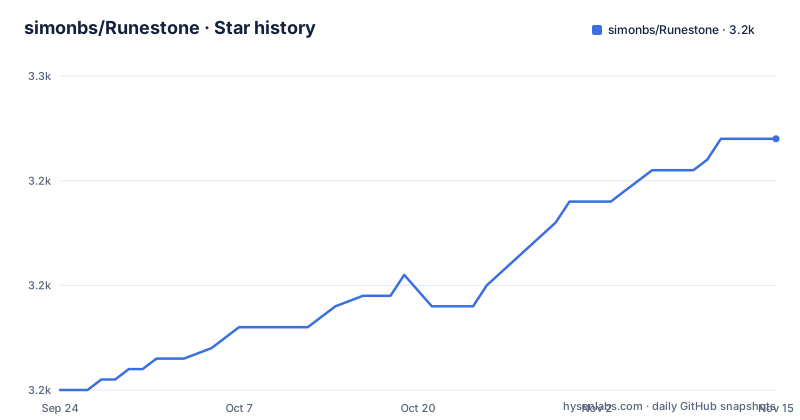
Star history
- simonbs/Runestone3,244 ★ · +24
| Repository | 2026-09-24 | 2026-11-15 |
|---|---|---|
| simonbs/Runestone | 3.2k | 3.2k |
24 Stars in the last 52 days, measured from the daily GitHub snapshot. Compare with other projects
Editorial analysis
Tree-sitter arrives as a submodule and the clone URL is SSH
Tree-sitter does not come in through the package manager here. It arrives as a git submodule, and the contributing section is blunt about the consequence: the submodule must be cloned as well before Runestone can be built, so the clone has to carry the recursive flag.
git clone --recursive [email protected]:simonbs/Runestone.gitA .gitmodules file at the root confirms the arrangement. The tree also carries Package.resolved, so the project resolves some dependencies through SwiftPM and at least one through git. A checkout made without --recursive therefore looks complete and fails later, at the point where a build reaches the parser rather than at the point where you cloned. The address in that command is the SSH form, [email protected]:simonbs/Runestone.git, and the document prints no HTTPS alternative for people who only have read access to public repositories. This clone command is the one piece of executable text the whole document contains.
The framework is the deliverable, the app is built elsewhere
What this repository publishes is the framework, and the editor app is a separate product. The framework is called Runestone, and the project states that an app of the same name is built on it, a plain text editor for iPhone and iPad that uses all the features of the framework. That app has its own App Store listing with the identifier id1548193893. The repository itself is a Swift package: Package.swift declares it, Package.resolved pins what SwiftPM resolved, and a .spi.yml file sits at the root for the Swift Package Index. So the editor component can be taken by another app without the editor app entering the picture. The only Xcode project listed in the tree is Example.xcodeproj under Example/, which belongs to the sample, so nothing in these files produces the binary a person installs from the App Store.
The Getting Started section has no steps in it
Two sections of the document redirect rather than instruct. Getting Started is a pointer to a documentation article and a tutorial series, both on docs.runestone.app. Documentation of all public types lives at the same address and is generated from the Swift code with Apple's DocC documentation compiler, which makes the API reference a build output instead of files in this repository. What is left is a fifteen item feature list with no configuration sample anywhere, so the document tells you what the editor can do and not how a caller switches any of it on. The repository does supply automation instead: five workflow badges, covering build and test, documentation, the example project, CodeQL and SwiftLint. Two more root files sit alongside them without being mentioned in the text at all, .swiftlint.yml for the linter one of those workflows runs, and swiftgen.yml.
Catalyst is described as expected, untested and unfinished
Mac Catalyst gets its own short section, and it is not a support promise. The project says it should mostly work with Catalyst on the Mac, that it is not fully tested, and that the implementation is not considered done, with the focus currently on the iPhone and iPad. Read strictly, that is three separate limits in one sentence: the functional expectation is mostly rather than fully, the test coverage is absent by the project's own account, and the implementation itself is unfinished. The one line description attached to the repository says the editor is for iOS and stops there, and no item in the feature list is specific to Catalyst or to pointer or trackpad input. Anyone planning a Mac version from this framework is working from that single sentence, with no configuration notes and no statement of what does not work.
Performance is argued for with a build setting, not with numbers
Performance is the one topic the document argues for, and the argument is an instruction rather than a result. It says Runestone was built to be fast, and credits the good performance by far mostly to Tree-sitter's incremental parsing and to AvalonEdit's approach for managing lines in a document, linking the line tree file in that project. Then it tells the reader how to measure: when judging the performance of Runestone it is key to build your app in the release configuration, because the optimizations applied by the compiler in that configuration become very apparent when opening large documents. No document size, no timing, no comparison with another editor appears anywhere in the file. The section names two mechanisms to credit and one build setting to use, and leaves every figure to whoever runs the measurement.
Four upstream projects enter in four different ways
The acknowledgments list relationships that are easy to read as one thing and are not. Tree-sitter is used to parse code incrementally, and it is also the submodule the build requires. Line management is translated to Swift from AvalonEdit, which makes that code a port rather than a dependency you resolve at build time. Two further projects, swift-tree-sitter and SwiftTreeSitter, served as inspiration for the Tree-sitter bindings, so what sits under Sources is that author's own implementation and not a vendored copy of either package. Detection of the indent strategy was inspired by auto-detect-indentation. Four people are then thanked by name, among them the developers of Textastic, Essayist and Drafts, plus the developer of Tree-sitter. The repository carries an MIT license file at its root, and the document has no licensing section at all, so the ported line management code has no attribution note beyond that credits paragraph.
Indentation is detected only, line endings are detected and settable
Two settings that look like the same kind of decision get different treatment in the feature list. Indentation is automatic and only automatic: Runestone detects whether a file is using spaces or tabs, and nothing in the list mentions overriding that choice. Line endings get both halves, because you can specify CR, LF or CRLF for the line break you insert and the editor also detects the endings already present in a text. The rest of the list is about what the screen shows rather than what the file contains: line numbers, highlighting the selected line, showing invisible characters such as tabs, spaces and line breaks, toggling line wrapping, adjusting line height, adding a page guide, adding vertical and horizontal overscroll, highlighting ranges in the text view, searching with regular expressions, inserting character pairs such as a trailing quotation mark when the leading one is typed, and customizing colors and fonts. Not one of these fifteen items is shown with a configuration sample.
Three releases, and the newest one shares its timestamp with the last push
The release history describes the current state more plainly than any sentence about upkeep would. The three releases are 0.5.0 on 2024-03-23, 0.5.1 on 2024-06-11 and 0.5.2 on 2026-03-25, so close to two years separate the second patch release from the third. The release names carry no v prefix, and each tag matches its version string exactly. The timestamp of 0.5.2 and the last push to the default branch main are the same moment, 2026-03-25, which means the newest release is also the newest state of the branch and nothing has landed on main since. The repository is not archived. That gives you one concrete date to plan around, and one gap to inspect: read the commit history between 0.5.1 and 0.5.2 if the two years in between matter to you, since no changelog file appears among the root entries. Two patch releases in the first three months of 2024, then nothing until March 2026, is also the shape of the feature list you get: fifteen items, none of them dated, and no note anywhere about which of them arrived in 0.5.2.
Editorial conclusion
Runestone is worth evaluating as a Swift package with a specific shape: a Tree-sitter backed text view plus line handling ported from AvalonEdit, published for other apps to consume, with the editor app built elsewhere. Two things deserve settling before you depend on it. The last state of main is the 0.5.2 release of 2026-03-25, with a gap of nearly two years behind it and no changelog among the root entries, so read the commit history if that period matters to your plans. And if you need Mac Catalyst or a pipeline that produces a shipping app, neither is finished here: Catalyst is described as untested and unfinished, the README carries no API sample, and no workflow in the tree builds the App Store binary. Measure speed yourself in a release configuration, since the README names the two mechanisms behind its performance and publishes no numbers.
Frequently asked questions
What is Runestone, the iOS editor framework by simonbs?
It is a plain text editor framework for iOS written in Swift, using Tree-sitter to parse code into a syntax tree. That parse is what the features needing an understanding of the code are built on, and syntax highlighting is the example the project gives. An app of the same name, a plain text editor for iPhone and iPad, is built on the framework.
Does the Runestone framework work with Mac Catalyst?
The project says it should mostly work with Catalyst on the Mac, then adds that it is not fully tested and that the implementation is not considered done. The stated focus is currently the iPhone and iPad.
How do I clone simonbs/Runestone so that it will build?
Clone it with submodules, because Runestone depends on Tree-sitter through one and the submodule must be cloned as well before the project can be built: git clone --recursive [email protected]:simonbs/Runestone.git. The address in that command is the SSH form, and the project prints no HTTPS alternative.
How would I use the Runestone framework in my own iOS app?
It is distributed as a Swift package: the tree carries Package.swift, Package.resolved and a .spi.yml file for the Swift Package Index. Documentation of all public types is published at docs.runestone.app, generated from the Swift code with Apple's DocC documentation compiler, and the getting started pointer in the README is an article and a tutorial series on that site. No API sample appears in the repository itself.
When was the Runestone repository last changed?
The last push to the default branch main is dated 2026-03-25, the same day and the same time as release 0.5.2. The two releases before it are 0.5.1 from 2024-06-11 and 0.5.0 from 2024-03-23. The repository is not archived.
Official sources
Add this badge to your README
If you maintain this project, the badge below links readers to this analysis and shows its maintenance status from the daily GitHub snapshot. Paste the markdown into your README; add ?metric=license or ?metric=stars to the image URL for a different field.

[](https://hysenlabs.com/projects/simonbs-runestone)Star history chart for your README
[](https://hysenlabs.com/projects/simonbs-runestone)Was this useful?