Shrimply's README names one UI toolkit and its workspace carries three
you're telling me a shrimp made this video?!
At a glance
- What is it?
- A GPL-3.0 Rust video editor in pre-alpha, rendering through Skia, wgpu and CUDA on a Wayland or macOS host. The developer section lists GTK 4 and libadwaita as the interface, while the Cargo workspace holds separate editor and launcher binaries for GTK, Qt and AppKit.
- Who is it for?
- Shrimply is worth following rather than adopting, and the README is honest enough about why: it describes itself as pre-alpha and lists slop, undocumented footguns, random performance regressions, irreversible project file breakage, and random crashes and resource leaks as things to expect, with only the inability to build struck through now that CI exists. Nobody should put real work into project files it cannot promise to reopen.
- Can I use it commercially?
- Yes, with conditions. GPL-3.0 is a copyleft licence: if you distribute software that includes it, you must release that software's source code under the same licence. Running it internally without distributing it does not trigger that obligation.
- Is it still maintained?
- Yes. The repository received new commits within the last day.
- What is it written in?
- Mainly Rust, according to GitHub's language statistics.
Answers come from the project's GitHub data, last synced on November 25, 2026, and from our analysis. They are not legal advice.
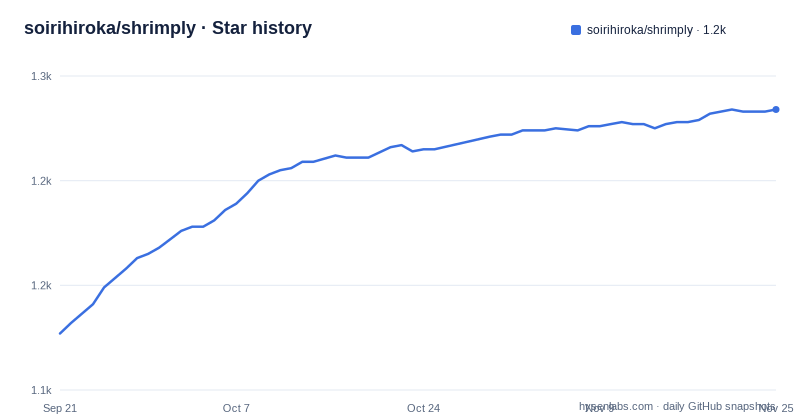
Star history
- soirihiroka/shrimply1,234 ★ · +107
| Repository | 2026-09-21 | 2026-11-25 |
|---|---|---|
| soirihiroka/shrimply | 1.1k | 1.2k |
107 Stars in the last 65 days, measured from the daily GitHub snapshot. Compare with other projects
Editorial analysis
The pre-alpha warning is a punch list, not a disclaimer
The status section is the most informative paragraph in the README. Shrimply is pre-alpha software, and the list of what to expect is written as slop, then a struck-through line reading unable to build with the aside that there is CI now, then undocumented footguns, random performance regressions, irreversible project file breakage, and random crashes and resource leaks. Two of those deserve to be read literally. Irreversible project file breakage is a warning that a saved project may not reopen, which for an editor is the difference between a toy and a tool. And random performance regressions mean the speed you measure this week is not the speed you will have next month, which is worth saying before anyone benchmarks it.
One toolkit in the docs, three in the workspace
The developer section lists the interface as GTK 4 and libadwaita, and rendering as Skia, wgpu, Slang and CUDA, with FFmpeg and PipeWire for media and a Python compute server. The Cargo workspace does not match that description. It declares separate binary crates for an editor and a launcher in each of three toolkits: `editor-gtk` and `launcher-gtk`, `editor-qt` and `launcher-qt`, and `editor-appkit` and `launcher-appkit`. The GPU side is similarly split three ways with a vulkan crate, a metal crate and a cuda crate, and the manim bridge for animation has its own variant per backend. So the documented stack is the shipped stack for Linux, and the other two are ports in progress. Worth knowing before you file a bug about a missing build target.
Requires Wayland or macOS 15, on an Nvidia or Apple Silicon GPU
Two system requirements and no third. A GPU, either Nvidia or Apple Silicon, and either Wayland or macOS 15 or later. The Wayland half is the significant constraint: there is no X11 session listed, so a machine running Xorg as its only display server is not a supported host even though the renderers include a Vulkan path. The Apple Silicon line explains the Metal crates in the workspace, and the Nvidia line explains the CUDA crates. The media stack is FFmpeg plus PipeWire, which means audio capture and routing go through the Linux sound server. Everything else is delegated to the documentation site, which is split into a getting started page for installation and a development page for building from source.
The build pins a nightly from April and a compute target from Ampere
The Makefile is where the constraints become concrete. The Rust toolchain is not tracked; it defaults to a specific nightly dated 2026-04-03, which means a contributor needs that exact nightly installed rather than whatever is current. The CUDA settings are equally explicit: the target architecture defaults to sm_86, which is the Ampere generation, with a PTX target of compute_50 for forward compatibility, a host compiler of g++-15, and the CUDA toolkit expected under `/usr/local/cuda`. There is also a source line limit of 2000 in the build variables, which tells you the project enforces a maximum file length. OptiX is expected in a vendored location under `external/`, and the toolchain file and a Nix flake are both present for reproducible environments.
The container builds Qt binaries and bundles their shared libraries
The Dockerfile is built on Fedora 44 and does more than compile. It installs FFmpeg from the RPM Fusion repositories, pulls the CUDA toolkit from NVIDIA's own package repository, and then works around the fact that a container has no GPU driver by symlinking the driver stub into the CUDA library directory so the compile succeeds. The build step is short:
make release qt-releaseThat line matters because it builds the Qt front end rather than the GTK one, so the container is not exercising the stack the README documents. After installing, the Dockerfile walks the dynamic dependencies of five binaries, `shrimply`, `shrimply-editor`, `shrimply-mcp`, `shrimply-qt` and `shrimply-editor-qt`, and copies every shared library into a bundle directory, filtering out the C library set. There is a second Dockerfile, `Dockerfile.flatpak-gtk`, and a Flatpak manifest, so the packaging story spans three formats.
GPL-3.0 with NVIDIA and model weights in the dependency tree
The licence section is more nuanced than the single SPDX identifier suggests. Shrimply itself is free software under the GNU General Public License version 3 or later. The next sentence is the one to note: some features depend on components that are not free software. Those are NVIDIA's CUDA Toolkit and display driver under their own end-user licence, the OptiX SDK, the Optical Flow SDK, and the Video Codec SDK, plus separately licensed model weights. Those components retain their own terms, and the README points at a licences document in the docs sources and a third-party notices file for the detail. So the honest summary is that the editor is GPL-3.0 and its optional GPU and upscaling features are not, and which ones you use decides what you can redistribute.
Release tags are timestamps, not version numbers
The two most recent releases are named after the moment they were built rather than after a version. One is a macOS artifact tagged with a UTC timestamp, published 2026-10-01T00:41:24Z, and the other is a Flatpak build whose tag is a package identifier with its own embedded timestamp, published seconds later at 00:51:37Z. There is no semantic version anywhere in the feed, which means there is no way to compare two builds or to say which one is newer except by reading the tag. The last push to the repository is dated 2026-10-01, so the project is moving daily. For an application whose README warns about random performance regressions, that cadence and that naming scheme together mean you cannot pin a good build and come back to it later.
Editorial conclusion
Shrimply is worth following rather than adopting, and the README is honest enough about why: it describes itself as pre-alpha and lists slop, undocumented footguns, random performance regressions, irreversible project file breakage, and random crashes and resource leaks as things to expect, with only the inability to build struck through now that CI exists. Nobody should put real work into project files it cannot promise to reopen. Three things to understand before you even get that far. The host requirement is Wayland or macOS 15 or later on an Nvidia or Apple Silicon GPU, so there is no X11 path and no Windows path in the stated requirements even though the project calls itself cross-platform. The build pins a specific nightly Rust toolchain from April 2026 rather than tracking stable. And the licence picture is split: the project is GPL-3.0-or-later, while several features depend on NVIDIA components and separately licensed model weights that keep their own terms.
Frequently asked questions
What is Shrimply and is it ready to use?
It is a cross-platform video editor written in Rust, and it describes itself as pre-alpha software. The README lists what to expect, including slop, undocumented footguns, random performance regressions, irreversible project file breakage, and random crashes and resource leaks.
What are the Shrimply system requirements?
An Nvidia or Apple Silicon GPU, and either Wayland or macOS 15 or later. The rendering stack is Skia, wgpu, Slang and CUDA, media handling is FFmpeg and PipeWire, and the compute server is Python.
How is Shrimply licensed?
The project itself is under the GNU General Public License version 3 or later. Some features depend on components that are not free software, including NVIDIA's CUDA Toolkit and display driver, the OptiX SDK, the Optical Flow SDK and the Video Codec SDK, as well as separately licensed model weights, which keep their own terms.
Can I build Shrimply from source?
Yes, and the documentation points to a development page for it. The Makefile pins a specific nightly Rust toolchain dated 2026-04-03, sets the CUDA target to sm_86 with a PTX target of compute_50 and a host compiler of g++-15, and expects OptiX under a vendored external directory. A Nix flake and a rust-toolchain file are present in the repository.
Does Shrimply support Qt and macOS front ends?
The Cargo workspace contains separate editor and launcher binaries for GTK, Qt and AppKit, with matching GPU crates for Vulkan, Metal and CUDA. The README's technology stack section names only GTK 4 and libadwaita, and the container build compiles the Qt target.
How can I help with Shrimply besides writing code?
The README lists reporting and investigating issues, improving the documentation, translating the interface, testing editing workflows and project importers, and helping other users. For code changes it asks you to comment on an issue before starting something larger so the scope can be discussed, and to read the contribution terms first.
Official sources
Add this badge to your README
If you maintain this project, the badge below links readers to this analysis and shows its maintenance status from the daily GitHub snapshot. Paste the markdown into your README; add ?metric=license or ?metric=stars to the image URL for a different field.

[](https://hysenlabs.com/projects/soirihiroka-shrimply)Star history chart for your README
[](https://hysenlabs.com/projects/soirihiroka-shrimply)Was this useful?