spring-cloud-netflix is now a Eureka build, and its README is mostly build instructions
Integration with Netflix OSS components
At a glance
- What is it?
- The Spring Cloud integration for Netflix OSS components now carries Eureka client, server and starter modules, and the documentation is almost entirely about compiling it, generating its README and importing it into Eclipse.
- Who is it for?
- Take spring-cloud-netflix when your Spring services need Eureka registration through Spring-managed beans or an embedded Eureka server from declarative Java configuration. Do not expect it to document client configuration for you: the written guidance stops at compilation, Eclipse import and the release licence, and says nothing about registration URLs, ports or health checks.
- Can I use it commercially?
- Yes. Apache-2.0 is a permissive licence: you can use, modify and sell software built on it, as long as you keep its copyright and licence notices.
- Is it still maintained?
- Yes. The repository last received commits 3 days ago.
- What is it written in?
- Mainly Java, according to GitHub's language statistics.
Answers come from the project's GitHub data, last synced on November 15, 2026, and from our analysis. They are not legal advice.
Star history
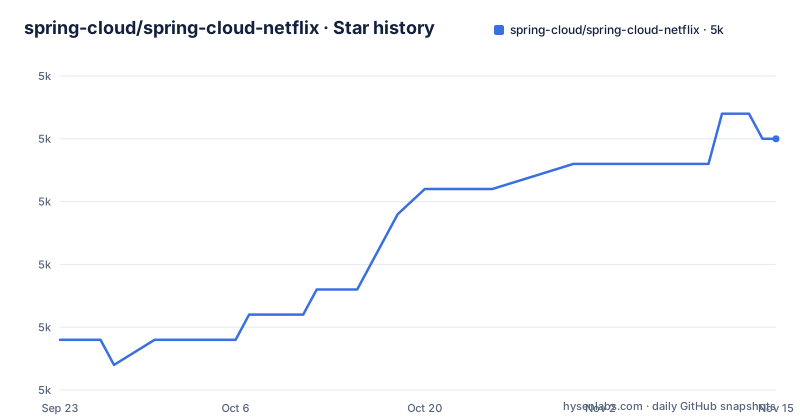
- spring-cloud/spring-cloud-netflix4,975 ★ · +8
| Repository | 2026-09-23 | 2026-11-15 |
|---|---|---|
| spring-cloud/spring-cloud-netflix | 5k | 5k |
8 Stars in the last 53 days, measured from the daily GitHub snapshot. Compare with other projects
Editorial analysis
The module list is Eureka, not the wider Netflix stack
The root of the repository carries a narrow set of modules: spring-cloud-netflix-dependencies for the bill of materials, spring-cloud-netflix-eureka-client, spring-cloud-netflix-eureka-server, spring-cloud-netflix-eureka-client-tls-tests, and the two starters spring-cloud-starter-netflix-eureka-client and spring-cloud-starter-netflix-eureka-server. There is no directory at the root for Hystrix, Zuul or Ribbon, and no starter for them, so the practical answer to what this artifact family still carries is the pair of Eureka modules plus their TLS test module. The behaviour claimed for those modules is spelled out in two bullets. Eureka instances can be registered and clients can discover them using Spring-managed beans, and an embedded Eureka server can be created with declarative Java configuration. That is the whole feature list in the written documentation. Nothing in it names a default port, a registration URL, a heartbeat interval, a fetch interval or a health check endpoint, so those values have to come from the dependency you pull in rather than from this README.
Editing README.adoc by hand throws the change away
The file you are reading at the repository root is not a source document. Its first lines are a generated-file warning: DO NOT EDIT THIS FILE. IT WAS GENERATED, followed by the instruction to edit the files in the src/main/asciidoc/ directory instead. Both paths exist in the tree, src/ and the root README.adoc, along with asciidoctor.css and a docs/ directory, so the real text lives one level down and the root copy is an artefact. The documentation section explains what produces it. The spring-cloud-build module carries a docs profile that switches on Antora processing of asciidoc sources from `modules/ROOT/`, and during that process it looks for `docs/src/main/asciidoc/README.adoc`, loads all the includes without parsing or rendering them, and copies the result to `${main.basedir}`, which defaults to the project root. The practical consequence for a contributor is that a README change shows up as a modified file in the root after a Maven build, and that modified file is the one you commit and push.
JDK 17, a bundled wrapper and a Maven profile that must be active
Building from source needs JDK 17, set as the `:jdkversion:` attribute in the document; a .java-version file and a .sdkmanrc also sit at the repository root. The build itself is the wrapper committed alongside mvnw.cmd for Windows:
$ ./mvnw installIf you would rather use your own Maven, the stated floor is 3.3.3 or better, and you can run `mvn` where the examples show `./mvnw`. Either way there is a step that is easy to miss: Spring Cloud requires the spring Maven profile to be activated so the spring milestone and snapshot repositories resolve. The instructions say to set that profile in your IDE, and warn that you may otherwise hit build errors. If your local settings have no repository declarations for spring pre-release artifacts, the fallback is to add `-P spring` yourself, or to copy the repository settings out of spring profile of the parent pom into your own settings.xml. The tree also carries a .settings.xml and a .mvn directory, so the project keeps its own Maven configuration under version control.
Maven memory and a missing Redis are the two build stoppers
Two failure modes are written down before anything else, and both are environmental rather than code problems. The first is memory. The guidance says you might need to raise the memory available to Maven by setting a `MAVEN_OPTS` environment variable with a value like `-Xmx512m -XX:MaxPermSize=128m`, and that the project tries to cover this in the `.mvn` configuration so the setting does not have to live on your machine. If you still have to set it yourself to make a build succeed, the instruction is to raise a ticket so the settings get added to source control. Note that the sample value still names MaxPermSize, an option removed from later JVMs, so the memory advice is worth reading as historical rather than as a value to copy into a modern CI image. The second is middleware: projects that require middleware such as Redis for testing generally require a local Docker to be installed and running. A contributor without a Docker daemon is therefore not facing a code failure but a missing prerequisite, and the tests that need Redis will not pass.
The docs profile generates a site from one command
If you want the rendered documentation rather than the generated root file, one command produces it:
./mvnw -pl docs -P docs antora:antoraThe `-pl docs` restricts the reactor to the documentation module and `-P docs` is the profile that switches on Antora, which is the tool the spring-cloud-build module uses to process the asciidoc sources. The same docs profile is what copies README.adoc into the project root as a build side effect; this command builds a site. The document says nothing about a preview server, a publishing step or where the output lands, so treat the command as a generator rather than a complete docs pipeline. If the Antora run fails, the first thing to check is whether the includes exist under `docs/src/main/asciidoc/`, because that path is where the build looks for README.adoc.
Eclipse import has two documented routes and both need profile edits
Eclipse is treated as the primary IDE, with Spring Tools Suite or Eclipse named as the tools to use and m2eclipse recommended for Maven support. Any other IDE is said to work as long as it drives Maven 3.3.3 or better. The documented caveat is version drift: older versions of m2e do not support Maven 3.3, so a project imported into Eclipse may report a wall of errors related to the POMs. Two fixes are offered. Add the spring profile to your `settings.xml`, or copy the repository settings from the spring profile of the parent pom into `settings.xml`. When m2eclipse is not wanted at all, the project metadata is generated by hand:
$ ./mvnw eclipse:eclipseThe generated projects are then brought in with `import existing projects` from the file menu. An eclipse/ directory sits at the repository root alongside the m2e route. One special case is called out separately: to build the module `spring-cloud-netflix-hystrix-contract` together with the entire Netflix project, run the `build.sh` script in the `scripts` directory. That module name is the only place in the written documentation where a Netflix component other than Eureka appears.
Two release lines shipped on the same day in June
Recent tags show two lines moving at once. v5.1.0-RC1 and v5.0.3 were both published on 2026-10-23, minutes apart, after a milestone for the next line, v5.1.0-M1, on 2026-09-24. A release-train-settings.xml file at the repository root is the visible handle on that train. What this pattern tells a consumer is that the 5.0.x line is still receiving releases while 5.1 is in pre-release. What it does not tell you is the support window, the compatibility matrix against Spring Boot versions, or the migration path between the two lines, because none of that appears in the written documentation. The last push to the main branch is dated 2026-10-26, so the repository is still moving, and the milestone and release-candidate tags mean 5.1 is where new work is landing while 5.0.x receives maintenance releases.
Everything documented is about building, none of it is about running
Read end to end, the documentation covers features, building, compiling and testing, generating the docs, importing into Eclipse, contributing and the licence. Configuration at runtime is absent. There is no application.yml or properties sample, no example client, no embedded server snippet for the declarative Java configuration the Features section promises, and no explanation of what the eureka-client-tls-tests module asserts about client certificates. For a team deciding whether this artifact fits, the honest summary is that the repository is a maintained build of the Eureka integration whose documentation tells you how to compile it rather than how to configure it. The licence is the non-restrictive Apache 2.0, with the text at LICENSE.txt and contribution instructions pointing at the issue trackers in the project. Public documentation is served from cloud.spring.io/spring-cloud-netflix, so runtime configuration questions are answered outside this repository rather than inside it.
Editorial conclusion
Take spring-cloud-netflix when your Spring services need Eureka registration through Spring-managed beans or an embedded Eureka server from declarative Java configuration. Do not expect it to document client configuration for you: the written guidance stops at compilation, Eclipse import and the release licence, and says nothing about registration URLs, ports or health checks. Before you commit, confirm your pipeline can activate the spring Maven profile, budget a local Docker for the Redis-backed tests, and decide whether the 5.0.x line or the 5.1 pre-releases match your Spring Boot generation.
Frequently asked questions
what is spring cloud netflix
It is the Spring Cloud integration with Netflix OSS components. What the project now ships at its root is Eureka: a client module, a server module, a TLS test module for the client, a dependencies module and the two Eureka starters.
what is spring cloud netflix eureka
It is the Eureka part of that integration. Eureka instances can be registered and discovered by clients through Spring-managed beans, and an embedded Eureka server can be created with declarative Java configuration.
How do I build spring-cloud-netflix from source?
Install JDK 17 and run `./mvnw install`, or use your own Maven at 3.3.3 or newer in place of the wrapper. Spring Cloud requires the spring Maven profile to be activated for the milestone and snapshot repositories to resolve, and tests that need middleware such as Redis want a local Docker running.
Why do I get POM errors after importing the project into Eclipse?
Older versions of m2e do not support Maven 3.3, so an imported project reports many errors related to the POMs. Add the spring profile to your settings.xml, or copy the repository settings from the spring profile of the parent pom into settings.xml.
Can I change the content of README.adoc directly?
No, that file is generated and manual changes are lost the next time it is built. Edit the files under src/main/asciidoc/ instead; after a Maven build the regenerated root README shows up as a modified file that you commit and push.
Official sources
Add this badge to your README
If you maintain this project, the badge below links readers to this analysis and shows its maintenance status from the daily GitHub snapshot. Paste the markdown into your README; add ?metric=license or ?metric=stars to the image URL for a different field.

[](https://hysenlabs.com/projects/spring-cloud-spring-cloud-netflix)Star history chart for your README
[](https://hysenlabs.com/projects/spring-cloud-spring-cloud-netflix)Was this useful?