Not a crack, not a cheat, not a server: what the Sunrise project actually is
Destiny 2 Offline Exploration Mod
At a glance
- What is it?
- stanuwu/Sunrise is a C++ project that installs onto an old build of Destiny 2 so the game can be played offline, with mission scripting and a persistent save. Its own page states what it is not first, in three lines, before describing anything else, and then discloses that reverse engineering, development and documentation were the uses of an AI assistant in building it. This is an architecture and dependency write-up; the page's own install guide lives elsewhere.
- Who is it for?
- Read this as a reverse engineering project with a legal posture rather than as a way to play the game, because that is how its own documentation positions it and because the page says plainly that some gameplay is unsupported and that things may break in unexpected ways. Two architectural decisions are worth taking away regardless of whether you ever install it.
- Can I use it commercially?
- Yes, with conditions. GPL-3.0 is a copyleft licence: if you distribute software that includes it, you must release that software's source code under the same licence. Running it internally without distributing it does not trigger that obligation.
- Is it still maintained?
- Yes. The repository received new commits within the last day.
- What is it written in?
- Mainly C++, according to GitHub's language statistics.
Answers come from the project's GitHub data, last synced on November 15, 2026, and from our analysis. They are not legal advice.
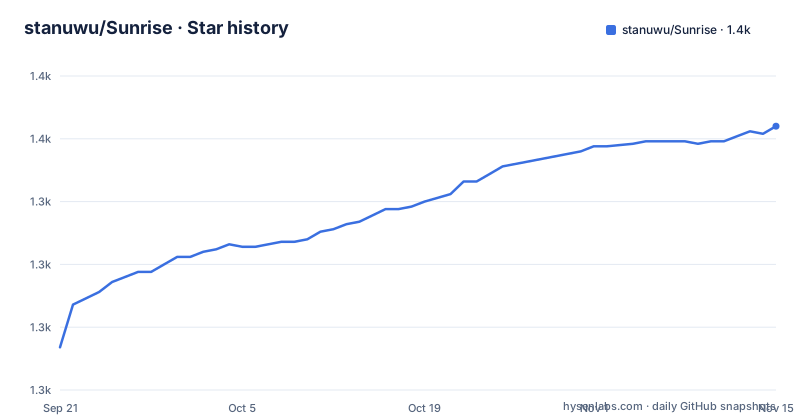
Star history
- stanuwu/Sunrise1,355 ★ · +88
| Repository | 2026-09-21 | 2026-11-15 |
|---|---|---|
| stanuwu/Sunrise | 1.3k | 1.4k |
88 Stars in the last 55 days, measured from the daily GitHub snapshot. Compare with other projects
Editorial analysis
The page states what it is not before it states what it is
Three lines appear before the feature list, and they are the most important content on the page. Sunrise is not a crack. It is not a cheat. It is not a custom server.
The supporting sentences are specific rather than rhetorical. Everyone has to provide their own copy of the game, so no piracy is involved. The mod does not connect to any servers and runs completely locally. No servers or services are offered. A legal disclaimer adds that the project is not for profit, that it does not affect live servers or newer versions of the game where research like this could pose a security risk, and that no game data is included in the release.
Those claims are checkable in one specific way. The contribution rules include a no-copyrighted-data rule stating that all game data should be extracted at runtime, which is a rule about the commit history rather than a promise, and the repository tree contains no data directory. A fourth disclaimer says the project is not affiliated with the publisher or its parent company in any way.
Server behaviour is supposed to go through real requests, not client patches
One contribution rule states the architecture better than any description could: for features intended to be part of the server, do not abuse client patches, sometimes it is needed but mostly everything should go through the right requests and pushes.
That single sentence tells you what this codebase is. It is not a set of menu shortcuts and no-clip toggles. It is an attempt to have the game believe it is talking to the services it expects, which is why the rules push contributors toward issuing the requests a real client would issue rather than short-circuiting the answer locally.
The team list matches that shape. The lead developer is credited with core work and with the mission script SDK and API, one member is credited with peer-to-peer multiplayer, and another with investment and progression. That last one sits awkwardly against the feature list, which names full progression among the things not currently supported.
The four shipped features are correspondingly narrow: load into any destination, script missions, exploration features including flight and noclip, and a persistent save. The first of those even carries an inline caveat that matchmade activities are currently broken.
Four dependencies, two third-party files, three clang configs
The dependency list is four items long. A C++ immediate-mode GUI library for the interface, Microsoft's binary-patching library, the Lua scripting language, and SQLite for storage.
Those four match the feature set exactly. Lua is the mission scripting language, which is also the language the game itself shipped with, and the lead developer's remit includes a script SDK and API over it. SQLite is where a persistent save lives. The patching library is how a game process is instrumented at all, and the GUI library is the mod's own interface.
The repository root is tidier than a reverse engineering project usually is. It ships two files about third-party material, not one, alongside a toolchain file for cross-compiling, three separate clang configuration files, an editor config, and both a Visual Studio solution and a CMake list, which is two build systems for one project.
The credits go further. An all-contributors heading is present with nothing under it, artwork is credited to one person who also appears in the testing list, and about twenty further repositories are listed as inspiration and help, several of them toolkits for unpacking, decompiling and mapping game archives.
The Linux build downloads the vendor SDK and accepts its licence
The Windows path is a normal Visual Studio build, with one catch: the project names a specific toolset version and a specific Windows SDK, and tells you to check that both are selected in the installer. When either moves, a build that worked yesterday stops.
The Linux path is more interesting, because it is not native compilation. It is a cross-compilation of Windows code, and the toolchain file for that is committed at the repository root. The prerequisites are a build system, a compiler suite, a build generator, the compiler toolchain itself, and one more tool whose job is fetching the vendor's SDK:
$ xwin --sdk-version 10.0.26100 --accept-license splat --include-debug-libs --output .xwin-cache
$ cmake -B build -G Ninja -DCMAKE_TOOLCHAIN_FILE=$(pwd)/linux-to-win-toolchain.cmake -DCMAKE_BUILD_TYPE=Release
$ cmake --build build
Three things follow from those three lines. The build accepts a licence on your behalf without asking. It asks for debug import libraries, which is unusual and says something about what the toolset links against. And it needs network access to a vendor endpoint, with the result cached in a directory the repository chooses.
Reverse engineering is named as an AI use, and a human reviews what ships
There is a disclaimer about the use of an AI assistant, and it is unusually specific rather than boilerplate.
The first line says AI was used in the creation of the project and tells readers who are not comfortable with that in programming projects to beware. The second paragraph draws the line: AI was not used to create art or creative writing, only for reverse engineering, development and documentation purposes. The third says all AI work that is publicly released is reviewed by a human, and closes with the sentence that the user is responsible for the results the tool produces.
Naming reverse engineering as a use case is notable. It is the one part of this project where a machine assistant and a human reverse engineer are doing the same task, and it is also the part where mistakes are hard to see, because a wrong assumption about a game structure produces code that compiles and behaves plausibly.
The human review requirement is the mitigation, and it is the sentence to hold the project to. A disclaimer is not a process, and the page does not describe how the review happens.
The project calls itself a work in progress with missing documentation
There is a short section headed as work in progress, and it is short because it has three sentences. Things might break. Things might work in unexpected ways. There is currently a lack of documentation, and that will improve over the coming weeks.
That is the honest version, and it sits alongside a list of unsupported gameplay: full progression, multiplayer, and a large number of missions. So the supported surface is destinations, mission scripting, exploration and a save file, and everything else is explicitly not the point yet.
The documentation itself is entirely off-repository. The page links out for install instructions, for a frequently asked questions page, and for documentation, and none of those URLs is a file in this tree. What is in the tree is one source directory, one licence, the build files, and two third-party documentation files.
For a project whose central claim is that its install is not a crack and not a cheat, keeping the install guide on a separate site rather than in the repository means the two claims are not versioned together.
Rules for the issue tracker are three sentences long
The contribution rules are detailed, with eight of them covering formatting, cleanliness, documentation, follow-up requests, one feature per pull request, complete implementations, and the server focus rule. The rules for the issue tracker are three sentences, and they are strict.
Issues are for bug reports only. Pull requests are for pull requests only. And the third sentence tells people not to go there to argue or chat, and points them to the chat server instead.
That is an unusual amount of control over where a community talks, stated without justification on the page. It is also consistent with the rest of the document: the page is written as a set of instructions rather than as an invitation, and the support section opens by asking for a star on the repository, tells readers that anyone trying to sell them this content is scamming them, and suggests donating to charity instead.
All of that is the author's prerogative on their own project. It does tell you what kind of project this is before you read a line of the source.
Release names changed convention partway through
Three releases are visible and the naming is inconsistent. Two of them carry the project name in the release title, one at 0.5 and one at 0.5.1, published a day apart in September 2026. The third, published in August, has a title that is nothing but its own version number.
So the project moved from bare version strings to project-prefixed release names somewhere between those two points, which is a small thing that matters when you are reading a tag list to work out which build a bug report was filed against.
The default branch is master rather than main, the licence is GPL-3.0 with the file at the root, and the last commit is dated 2026-09-27, six days before the newest release. The repository has no homepage field at all; every destination it points to is on a separate documentation site or a chat invite, which means the repository is the code and everything a user needs is somewhere else.
Editorial conclusion
Read this as a reverse engineering project with a legal posture rather than as a way to play the game, because that is how its own documentation positions it and because the page says plainly that some gameplay is unsupported and that things may break in unexpected ways. Two architectural decisions are worth taking away regardless of whether you ever install it. The first is that server-side behaviour is supposed to go through the requests the game would really send, not be faked by patching the client, which is a rule contributors are held to and explains what the project actually is. The second is that the Linux build is a cross-compilation of Windows code, with the vendor SDK headers downloaded and the licence accepted by a script, which means the build depends on network access and on a specific SDK version with no pinned manifest in the repository. For anyone considering an install, read the project's own install guide and its legal disclaimer rather than a summary, and understand that the result is an offline restoration of an old build rather than a supported game client.
Frequently asked questions
What is stanuwu/Sunrise?
An offline preservation project for Destiny 2, written in C++ and GPL-3.0 licensed. It installs onto an old build of the game so that exploration, mission scripting and a persistent save work without the game's online services. Its own page states it is not a crack, not a cheat and not a custom server, and that it connects to no servers.
Does Sunrise support all Destiny 2 gameplay?
No. The page lists full progression, multiplayer and a large number of missions as not currently supported, and notes that matchmade activities are broken. It describes itself as a work in progress where things might break or work in unexpected ways, and says documentation is currently lacking.
How is Sunrise built on Linux?
By cross-compiling. The build needs git, cmake, clang, ninja, llvm and xwin, then a command downloads the matching Windows SDK headers into a local cache while accepting the licence non-interactively and including debug libraries, and cmake is pointed at a cross-compilation toolchain file committed in the repository with Ninja as the generator.
What libraries does Sunrise depend on?
Four named ones: a C++ immediate-mode GUI library, Microsoft's binary-patching library, the Lua scripting language and SQLite. The repository also ships two files documenting third-party material, three clang configuration files, and a credits list of about twenty further repositories consulted while building the project.
Is Sunrise affiliated with Bungie or Sony?
The page states it is not affiliated with Bungie or Sony in any way. It also states that everyone must supply their own copy of the game, that no game data is included in the release, that the project does not affect live servers or newer versions of the game, and that it is not for profit.
Official sources
Add this badge to your README
If you maintain this project, the badge below links readers to this analysis and shows its maintenance status from the daily GitHub snapshot. Paste the markdown into your README; add ?metric=license or ?metric=stars to the image URL for a different field.

[](https://hysenlabs.com/projects/stanuwu-sunrise)Star history chart for your README
[](https://hysenlabs.com/projects/stanuwu-sunrise)Was this useful?