claude-conductor writes the Markdown scaffolding Claude Code reads, and nothing else
Claude Conductor - a simple Claude Code framework
At a glance
- What is it?
- claude-conductor is a Node CLI that generates an interconnected set of Markdown files for a codebase so Claude Code can navigate it. It creates files and scans directories; it does not run Claude, and one maintainer asks you to commit your work before you let it touch anything.
- Who is it for?
- claude-conductor fits a team that wants its repository to carry a consistent, machine-readable documentation set and is willing to maintain those files afterwards. It does not fit a codebase where documentation is generated from source, because the templates are static Markdown that no build step regenerates.
- Can I use it commercially?
- Yes. BSD-2-Clause is a permissive licence: you can use, modify and sell software built on it, as long as you keep its copyright and licence notices.
- Is it still maintained?
- Activity is slowing. The repository last received commits 6 months ago.
- What is it written in?
- Mainly JavaScript, according to GitHub's language statistics.
Answers come from the project's GitHub data, last synced on November 15, 2026, and from our analysis. They are not legal advice.
Star history
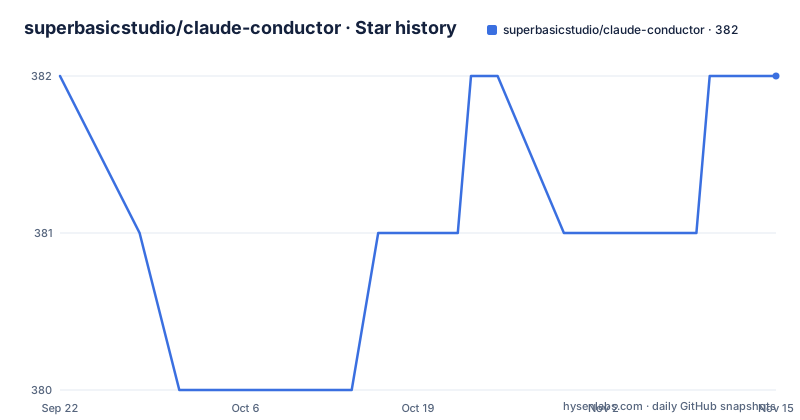
- superbasicstudio/claude-conductor382 ★ · +0
| Repository | 2026-09-22 | 2026-11-15 |
|---|---|---|
| superbasicstudio/claude-conductor | 382 | 382 |
0 Stars in the last 54 days, measured from the daily GitHub snapshot. Compare with other projects
Editorial analysis
The first thing the README says is commit your work
The most prominent block in the README is not a feature list. It is a notice that the project is maintained by one individual in their free time, followed by an explicit disclaimer: the software is provided as is without warranty, and using it means accepting responsibility for backing up your code and using version control.
That framing is unusual and worth taking at face value rather than reading past. The advice underneath it is concrete, not ritual: keep a real Git strategy, back up regularly, and commit before running any script you found on the internet. The last point is aimed at the `npx` path specifically, which downloads and executes the package on the spot without installing it into your project.
The maintenance record lines up with the notice rather than contradicting it. The last push to the repository was on 2026-05-17, and the newest tagged release is v2.2.0 from 2026-03-31, titled for security hardening and the move to Node 20. The manifest in the repository is at 2.2.1, so the published npm version and the GitHub release tag are not the same number.
Five Markdown files by default, fifteen with the --full flag
The default run writes five templates. CONDUCTOR.md is the master navigation hub and framework reference. CLAUDE.md holds assistant guidance tailored to the project. ARCHITECTURE.md covers system design and tech stack, BUILD.md holds build, test, and deployment commands, and JOURNAL.md is a development changelog that the tool creates on its own.
`--full` adds ten more: API.md for endpoints and contracts, CONFIG.md for configuration and environment variables, DATA_MODEL.md for the database schema, DESIGN.md for the visual design system, UIUX.md for interface patterns, TEST.md for testing strategies, CONTRIBUTING.md, ERRORS.md as a critical error ledger, PLAYBOOKS/DEPLOY.md for deployment procedures, and TASKS.md for active task management with phase tracking.
Two details in that list matter more than the rest. TASKS.md is the newest addition, and it is the piece that lets state survive between sessions: active work with phase tracking rather than a chat log. ERRORS.md is a ledger, which makes it a file an agent can append to and a human can grep. The interconnection the README promises comes from the file set itself, since CONDUCTOR.md is written to be the index the others hang off.
The count is worth checking against your own needs. Five files is a small commitment to maintain. Fifteen is a documentation project that now belongs to whoever commits next.
Three install paths, and only one of them touches your manifest
The recommended path runs the package without installing it:
# Initialize with core templates (recommended)
npx claude-conductor
# Or use the shorthand
npx claude-conduct

# Initialize in a specific directory
npx claude-conductor ./my-project
A global install puts two commands on your PATH, `claude-conductor` and `claude-conduct`, and the package manager is your choice:
# npm
npm install -g claude-conductor

# pnpm
pnpm add -g claude-conductor

# yarn
yarn global add claude-conductor

# bun
bun add -g claude-conductor
The third path is the one worth considering for a team, because it makes the tooling a declared part of the project:
npm install --save-dev claude-conductor{
"scripts": {
"docs:init": "claude-conductor"
}
}What the npm package actually ships is narrow: the `templates/` directory, the `bin/` directory, `README.md`, `CLAUDE.md`, and `RESPONSE_STYLE_CONFIG.md`. The runtime dependencies are four packages, chalk, commander, fs-extra, and glob, all pinned to exact versions. There is no API client and no model dependency in that list, which is the clearest evidence that this tool never talks to Claude itself.
The deep scan is a flag, and the README does not explain what it finds
Four flags change what gets written. `--full` selects the whole template set. `--force` overwrites files that already exist, which is the one to think about twice since CONDUCTOR.md or ARCHITECTURE.md in your repository would be replaced. `--deepscan` performs deeper codebase analysis, described as slower but more detailed. A path argument sets the target directory, and the three combine.
What the analysis actually extracts is the part the README does not spell out. The features section breaks off at the heading for default analysis, labelled fast at 2 to 3 seconds, and the text after it is cut short. So the promise in the quick start is that `--deepscan` produces more detail, and the file does not then say which files it reads or what it writes into the templates.
That gap matters for a specific decision. If you were hoping the tool would infer your stack and fill in ARCHITECTURE.md accurately, the repository does not promise that. Treat the generated content as a skeleton with headings and prompts in it, then edit. Running `--deepscan` and assuming the output is finished documentation is the mistake this project is easiest to walk into.
Two aliases and a third one-liner for the security checkup
Every example in the README comes in pairs, because the package registers two bin names, `claude-conductor` and `claude-conduct`, both pointing at the same `bin/init.js`. There is a third spelling in the quick start, `npx claude-cond`, used for the checkup.
The checkup is a subcommand rather than a flag, which is worth noticing because everything else in this tool is a flag:
# Run security checkup
npx claude-conductor checkup
npx claude-cond
What the checkup inspects is not described in the repository README, and the documentation links for it are external. That leaves you with no basis for deciding what the command covers, so read its output rather than treating it as a control you can depend on.
The shorter alias also shows up in the other commands, which makes `claude-cond` usable anywhere the long form is. If you install globally you can run the tool from any directory and point it at a project with an absolute path, which is the documented alternative to navigating into the project first.
Node 20 is the floor, and Node 18 users are pinned to an old line
The requirement is Node.js 20.0.0 or newer, enforced in the manifest's `engines` field. Version 2.0.0 dropped Node 18, which reached end of life in April 2025, and the README gives the escape hatch explicitly: if you have to stay on Node 18, pin to `[email protected]`.
That pin has a cost worth naming. The 2.2.0 release is the one titled for security hardening, so a team that pins to 2.1.x to hold Node 18 is also holding a line from before that hardening. Running an old Node on an old release is a defensible choice in a locked-down environment, but it should be a decision rather than a leftover from an install that never got revisited.
The manifest also carries three `overrides` entries that force transitive versions of brace-expansion, picomatch, and minimatch to patched releases. That is the kind of thing a maintainer adds after a dependency advisory, and it is a small signal about how the project handles supply chain issues: at the cost of pinning resolution for anyone who installs it.
Claude Anchor is the companion, and the licence files disagree
The external resources list points at Claude Anchor, described as a companion behavioral framework, hosted under the same GitHub organisation. It is a separate package, and the README treats it as a complement rather than a dependency, so nothing in this repository's manifest refers to it.
The repository's own top level is a reasonable picture of how the tool is developed. It keeps a CLAUDE.md and a JOURNAL.md for itself, a RESPONSE_STYLE_CONFIG.md, and separate PRIVACY.md, TERMS.md, and SECURITY.md documents. Development is conventional: Jest for tests with watch and coverage scripts, ESLint and Prettier with lint-staged and husky hooks wired through `prepare`, and a `prepublishOnly` script that runs the test suite before anything reaches npm.
Licensing is where the repository contradicts itself, and you should check which one governs your use. The licence recorded for this project is BSD-2-Clause, while the `license` field in package.json says MIT and the README links an MIT License file. Anyone planning to vendor this into a closed-source product has to resolve that before shipping, because the two licences carry different obligations and this is not something to guess at.
Editorial conclusion
claude-conductor fits a team that wants its repository to carry a consistent, machine-readable documentation set and is willing to maintain those files afterwards. It does not fit a codebase where documentation is generated from source, because the templates are static Markdown that no build step regenerates. Before running it on a real project, commit your work and run `npx claude-conductor checkup` first, since --force overwrites existing files and the README's own notice asks for version control before any script from the internet runs.
Frequently asked questions
What is claude conductor?
claude-conductor is a modular documentation framework for Claude Code. It is a Node CLI that writes a scaffolded set of Markdown files into a project, so an AI assistant can navigate the codebase, and it does not call a model itself.
How do I install and run claude-conductor?
Run `npx claude-conductor` in the project directory, or install it globally with `npm install -g claude-conductor` and then use `claude-conduct` from anywhere. Node.js 20.0.0 or newer is required.
Which files does claude-conductor create by default?
Five core templates: CONDUCTOR.md, CLAUDE.md, ARCHITECTURE.md, BUILD.md, and JOURNAL.md. The `--full` flag adds API.md, CONFIG.md, DATA_MODEL.md, DESIGN.md, UIUX.md, TEST.md, CONTRIBUTING.md, ERRORS.md, PLAYBOOKS/DEPLOY.md, and TASKS.md.
Can I still use claude-conductor on Node 18?
Version 2.0.0 and newer require Node.js 20 or higher, because Node 18 reached end of life in April 2025. The README says to pin to `[email protected]` if you have to stay on Node 18.
What does the --deepscan flag do in claude-conductor?
It performs a deeper codebase analysis, described in the quick start as slower but more detailed. The repository README does not go into what the scan reads or how the results reach the templates, so the generated content should be treated as a skeleton to edit.
Official sources
Add this badge to your README
If you maintain this project, the badge below links readers to this analysis and shows its maintenance status from the daily GitHub snapshot. Paste the markdown into your README; add ?metric=license or ?metric=stars to the image URL for a different field.

[](https://hysenlabs.com/projects/superbasicstudio-claude-conductor)Star history chart for your README
[](https://hysenlabs.com/projects/superbasicstudio-claude-conductor)Was this useful?