autoComplete.js: the size table is written by the library it compares itself to
Simple autocomplete pure vanilla Javascript library.
At a glance
- What is it?
- A vanilla JavaScript autocomplete read through its own packaging: a comparison table with no measurement method, twenty five keywords that repeat one idea, an ES module field pointing at a minified file, and eighteen months between two patch releases.
- Who is it for?
- autoComplete.js fits a project that wants autocomplete on plain markup with no framework and no dependencies, including on contentEditable elements, and it does not fit anyone who needs the comparison table treated as evidence, since the figures and the claim of being the smallest option in the category come from the library itself with no stated method.
- Can I use it commercially?
- Yes. Apache-2.0 is a permissive licence: you can use, modify and sell software built on it, as long as you keep its copyright and licence notices.
- Is it still maintained?
- Yes. The repository last received commits 146 days ago.
- What is it written in?
- Mainly JavaScript, according to GitHub's language statistics.
Answers come from the project's GitHub data, last synced on November 22, 2026, and from our analysis. They are not legal advice.
Star history
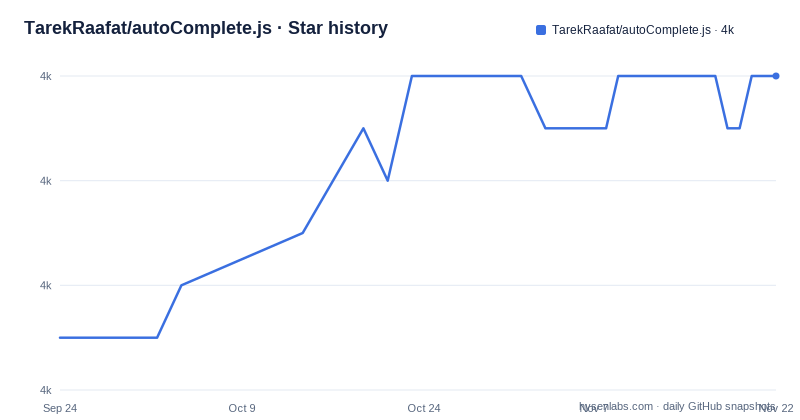
- TarekRaafat/autoComplete.js4,038 ★ · +5
| Repository | 2026-09-24 | 2026-11-22 |
|---|---|---|
| TarekRaafat/autoComplete.js | 4k | 4k |
5 Stars in the last 59 days, measured from the daily GitHub snapshot. Compare with other projects
Editorial analysis
The comparison table has no stated method behind its numbers
The table lists seven libraries with three measured columns and one judgement column. The size column is labelled gzip, so it is at least a defined unit, but nothing says what was included in the measurement: the minified file, or the minified file plus its stylesheet, or a specific version of each competitor. The dependency column is a number for most rows and a library name for two, with Select2 listed as jQuery and react-select at nine. The framework column says React only for Downshift and react-select, None for Tom Select and Choices.js, Any with a Preact core note for Algolia Autocomplete, and None for vanilla JavaScript for this project. The drop-in column is a yes or no. The rows and their figures are: this project at about 3.7 KB with zero dependencies, Downshift at about 8 KB with five, Tom Select at about 16 KB with one, Select2 at about 17 KB with jQuery, Choices.js at about 20 KB with zero, Algolia Autocomplete at about 25 KB with five, and react-select at about 27 KB with nine. The sentence under the table says this is the smallest full-featured option in the category, and points to a longer comparison on the project's own documentation site.
Both CDN snippets pin the same version, which is the newest release
The CDN route is two lines, a script and a stylesheet, and both are pinned to an explicit version rather than to a range:
<script src="https://cdn.jsdelivr.net/npm/@tarekraafat/[email protected]/dist/autoComplete.min.js"></script><link rel="stylesheet" href="https://cdn.jsdelivr.net/npm/@tarekraafat/[email protected]/dist/css/autoComplete.min.css">The version in both URLs, 10.2.10, matches the version field in the manifest and the newest release tag, so the page is not advertising a stale build. Pinning by hand is the right default for a library that ships breaking changes across major versions, and the doubled version number in both lines means an upgrade is two edits rather than one. The package manager routes are the other two lines on the page, npm i @tarekraafat/autocomplete.js and yarn add @tarekraafat/autocomplete.js, and note the name mismatch with the repository: the repository is called autoComplete.js while the published package is @tarekraafat/autocomplete.js, lower case and scoped.
The module field points at the minified build
The manifest names four entry points, and one of them is unusual. main is dist/autoComplete.js, the unminified build, while browser and unpkg both name dist/autoComplete.min.js. The module field, which is what a bundler reads when it honours ES modules, also names dist/autoComplete.min.js. So a bundler that trusts the module field gets the minified artefact, and a Node resolution that trusts main gets the readable one. There is no exports map in the visible portion of the manifest, which is the newer mechanism that would resolve this ambiguity properly, so the resolution depends on the bundler's fallback order rather than on an explicit contract. Two other fields explain the packaging layout. The files array publishes both dist and src, so the source ships alongside the build and can be read inside node_modules. The directories block maps src to src, dist to dist, lib to dist as well, doc to docs, and example to docs/demo, so the published lib and dist paths are the same files under two names.
Twenty five keywords describing the same adjective four times
The keyword list is the most revealing field in the manifest, and it is not a short one. It runs to twenty five entries and includes the project name in several spellings, autoComplete.js, autoCompleteJS, autocomplete, autocompletion, autosuggestion and autosuggest, alongside the generic category words javascript, search and dropdown. The performance adjectives appear four times over: light, blazing, fast and lightning. Versatility gets two, versatile and scalable, and flexibility gets two more as customizable and extensible. Ease gets one, easy. Then there is hackable. That last one is worth pausing on, because a keyword is a discovery mechanism: it is how the package surfaces in registry search, and the words chosen are the ones a maintainer thinks will match how people look for a library. Nothing here is wrong, and the list does no harm at runtime. It does mean the manifest spends most of its metadata on adjectives while the description field, which is what a registry actually displays, carries the sentence that matters: a simple vanilla JavaScript autocomplete, zero dependencies, built for speed and for integration with many kinds of project.
The feature list is a claim list with no configuration surface shown
Twelve features are listed in the page and none of them is described there. The list covers pure vanilla JavaScript, zero dependencies, a search engine with two different modes, diacritics support, debounce support, life cycle events, a plugin API, WAI-ARIA compliance, high customisation, and a claim that it works on anything including input elements, textarea elements and contentEditable elements. It also says well documented, which points at the documentation site rather than at the page. Three of those deserve attention from someone deciding whether to adopt it. A search engine with two modes is the one that changes behaviour, and neither mode is named on this page. Life cycle events and a plugin API are the two extension points, and neither is enumerated. The contentEditable support is the least common of the three element types and the one most likely to be the reason to choose this library over a React combobox. All of the detail lives behind the documentation link, so the page is an index rather than a specification, and configuration details are described there rather than here.
Adoption evidence is a logo list and a count with a link
The Used By section names six projects and then a number. IBM Carbon through the carbon-for-ibm-dotcom repository, The Guardian, Snapcraft from Canonical, Weblate, Blockscout, Eclipse Ditto, and 2,400 or more projects across many industries and ecosystems. The 2,400 figure is a link to a page on the project's own documentation site rather than to anything in the repository, so the count cannot be checked from what is here, and the six named projects are a self-selected list with no stated criteria for inclusion. Two of them are worth noting for what they imply about the library's element requirements: Carbon is a design system with an accessibility focus, and Eclipse Ditto is an IoT connectivity project with a web client, so WAI-ARIA compliance is presumably being relied on by at least one of them. The support section splits into two channels, with technical questions going to a Stack Overflow tag named autoCompletejs and general questions or new ideas going to GitHub Discussions. The author section names one person, and the same page lists two other projects by them: Eleva.js, described as an ultra lightweight signal based reactivity framework of about 2.5 KB, and Skalex.js, described as an AI first zero dependency database with vector search and encryption.
Eighteen months separate two patch releases in the same minor line
The release history explains the pin in the CDN examples. Three tags are visible: v10.2.10 dated 2026-04-12, v10.2.9 dated 2024-10-22, and v10.2.8 dated 2024-10-16. So the last two patches of the 10.2 line are six days apart in October 2024, and then there is a gap of about eighteen months to v10.2.10 in April 2026. The most recent commit is dated 2026-06-30, so there has been work since the newest release that no tag covers, and the default branch is master. The repository is not archived. The tree explains where the artefacts come from: rollup.config.js at the root, src/ for the source, dist/ checked in for the builds, jsdocs.json for the API documentation generator, and docs/ for the documentation site including a demo directory. Two files at the root are aimed at tools rather than people: llms.txt and llms-full.txt, which are the compact and full text descriptions of a project intended to be read by a language model. The build itself uses rollup with a babel preset and the terser plugin, with acorn as a parser, all in devDependencies, and CHANGELOG.md and ROADMAP.md in the root are the two files that would tell you what changed and what is planned.
Editorial conclusion
autoComplete.js fits a project that wants autocomplete on plain markup with no framework and no dependencies, including on contentEditable elements, and it does not fit anyone who needs the comparison table treated as evidence, since the figures and the claim of being the smallest option in the category come from the library itself with no stated method. Before adopting, read the ROADMAP.md that the page links for planned work, and note the release spacing: v10.2.9 shipped in October 2024 and v10.2.10 in April 2026. If you bundle it, check which entry point you are pointing at, since the manifest's module field names the minified file.
Frequently asked questions
How do I install autoComplete.js?
Three routes are given. From a CDN, a script tag pointing at dist/autoComplete.min.js on jsDelivr and a matching stylesheet link, both pinned to version 10.2.10. From npm, npm i @tarekraafat/autocomplete.js. From yarn, yarn add @tarekraafat/autocomplete.js. Note that the published package name is @tarekraafat/autocomplete.js rather than the repository name autoComplete.js.
Which HTML elements does autoComplete.js work with?
The feature list says it works on anything, naming input elements, textarea elements, and contentEditable elements. Configuration and usage details are not on that page and are described in the project documentation instead.
Does autoComplete.js have dependencies?
Zero. It is described as pure vanilla JavaScript with no dependencies, and the comparison table lists it with 0 in the dependencies column. The manifest's devDependencies exist only for the build, with rollup, babel, terser and acorn.
How does autoComplete.js compare to other autocomplete libraries?
The page lists seven libraries with gzip sizes, dependency counts, framework requirements and whether they are drop-in. The figures given are about 3.7 KB for this project, 8 KB for Downshift, 16 KB for Tom Select, 17 KB for Select2, 20 KB for Choices.js, 25 KB for Algolia Autocomplete and 27 KB for react-select, with a longer comparison linked from the project's documentation site. No measurement method is stated.
What is the latest autoComplete.js release?
v10.2.10, dated 2026-04-12, preceded by v10.2.9 from 2024-10-22 and v10.2.8 from 2024-10-16. The most recent commit is dated 2026-06-30, the default branch is master, and the repository is not archived. A ROADMAP.md in the repository is linked for upcoming releases.
Official sources
Add this badge to your README
If you maintain this project, the badge below links readers to this analysis and shows its maintenance status from the daily GitHub snapshot. Paste the markdown into your README; add ?metric=license or ?metric=stars to the image URL for a different field.

[](https://hysenlabs.com/projects/tarekraafat-autocomplete-js)Star history chart for your README
[](https://hysenlabs.com/projects/tarekraafat-autocomplete-js)Was this useful?