OpenDTU: ESP32 firmware that replaces the Hoymiles cloud gateway with a reverse-engineered protocol
Software for ESP32 to talk to Hoymiles/TSUN/Solenso Inverters
At a glance
- What is it?
- OpenDTU is C++ firmware for ESP32 boards that talks to Hoymiles, TSUN and Solenso inverters. This review covers its origin, the partition table upgrade trap, the breaking-change log, and the documentation that lives outside the repository.
- Who is it for?
- Use OpenDTU if you own a Hoymiles, TSUN or Solenso inverter and want to drop the vendor cloud gateway for your own ESP32. Do not use it if you expect the repository to explain wiring, flashing or inverter compatibility, because that all sits on opendtu.solar.
- Can I use it commercially?
- Yes, with conditions. GPL-2.0 is a copyleft licence: if you distribute software that includes it, you must release that software's source code under the same licence. Running it internally without distributing it does not trigger that obligation.
- Is it still maintained?
- Yes. The repository last received commits 3 days ago.
- What is it written in?
- Mainly C++, according to GitHub's language statistics.
Answers come from the project's GitHub data, last synced on November 25, 2026, and from our analysis. They are not legal advice.
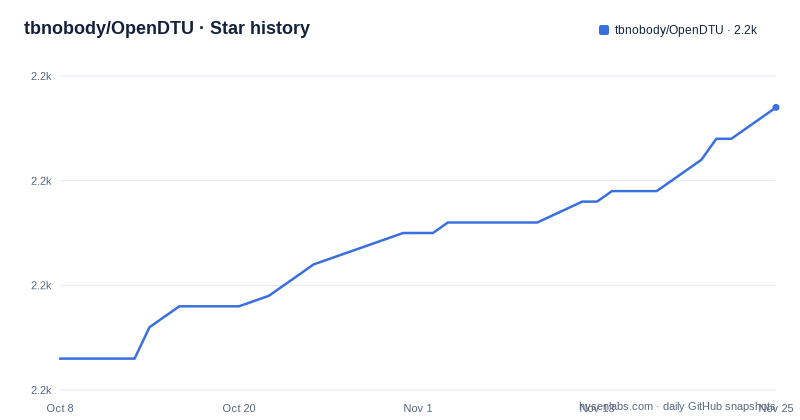
Star history
- tbnobody/OpenDTU2,217 ★ · +24
| Repository | 2026-10-08 | 2026-11-25 |
|---|---|---|
| tbnobody/OpenDTU | 2.2k | 2.2k |
24 Stars in the last 48 days, measured from the daily GitHub snapshot. Compare with other projects
Editorial analysis
It started as a way to replace the Hoymiles DTU and its cloud access
OpenDTU came out of a discussion thread on Mikrocontroller.net. The stated goal was to replace the original Hoymiles DTU, the telemetry gateway that sends inverter data to Hoymiles through its cloud. To get there, the author reverse engineered the Hoymiles protocol until it was decrypted and analyzed.
That origin explains the repository description: software for ESP32 to talk to Hoymiles, TSUN and Solenso inverters. The project is firmware that runs on a microcontroller, not a desktop program, and it speaks to the inverter directly instead of going through the vendor gateway.
The code is C++ under the GPL-2.0 license, built with PlatformIO. The top-level entries include platformio.ini, platformio_override.ini, src/, include/, lib/ and pio-scripts/, which is the usual layout for a PlatformIO project, plus lang/ for translations.
Anything older than 15.03.2023 needs the ESP32 partition table upgraded first
The README opens with a block titled IMPORTANT UPGRADE NOTES. If you are upgrading from a version before 15.03.2023, you have to upgrade the partition table of the ESP32, and the README points to docs/UpgradePartition.md for the steps.
This is the one hard trap for people with an old install. A normal firmware update does not change the partition layout, so skipping the extra procedure leaves the board in a state the newer firmware was not built for. The README does not describe the exact failure, only that the upgrade is required.
The repository ships three partition files, partitions_custom_4mb.csv, partitions_custom_8mb.csv and partitions_custom_16mb.csv. They map to the flash size of the ESP32 board you use, so the board's flash size matters when you pick a build. The README does not say which boards carry which size, so check the hardware pages before buying.
The breaking-change list is generated from git log and shows what moved in the Web API
The README includes a list of commits marked BREAKING, generated with this command:
git log --date=short --pretty=format:"* %h%x09%ad%x09%s" | grep BREAKINGThe entries visible in the README are:
- 2025-08-07: the WebAPI endpoint /api/limit/config requires different parameters - 2025-04-18: logging newline changed from \r\n to \n - 2024-01-30: the Web API endpoints /api/livedata/status and /api/prometheus/metrics changed
The list is cut off in the README, ending mid-word on a 2024-01-29 entry, so it is not complete as shown.
The practical reading is for anyone who scrapes the device. If a script or dashboard polls /api/livedata/status or reads /api/prometheus/metrics, the January 2024 change affects it. If you set power limits through /api/limit/config, the August 2025 change affects it. The README gives no details of the new parameters, so the commit itself is the source.
Releases use a year-month-day version and v26.9.28 is the latest listed
Three releases appear in the listing: v26.9.28 on 2026-09-28, v26.3.30 on 2026-03-30 and v26.3.28 on 2026-03-28. The numbering looks like year, month and day, so v26.9.28 reads as 2026-09-28, and the dates match that reading.
The repository is not archived. The last push was on 2026-10-19, three weeks after the newest release, so work continued after v26.9.28 was tagged. Two releases landed two days apart in March 2026.
A calendar version tells you when a build was cut and nothing about compatibility. Between versions, check the breaking-change list above before updating a device that other software depends on.
Wiring, hardware and the supported inverter list live on opendtu.solar
The README holds very little operating detail. Documentation is at opendtu.solar, and a separate repository, tbnobody/OpenDTU-docs, accepts pull requests to improve it. The supported inverter list is a separate page there, the supported inverter overview.
So the README cannot tell you whether your inverter model works, which radio module you need, or how to flash the board. The README has no install command and no flashing steps. The firmware is obtained from the GitHub releases of tbnobody/OpenDTU, and the build is driven by platformio.ini if you compile it yourself. Expect to read the documentation site before buying parts.
The repository does include webapp/ and webapp_dist/, so the configuration web interface is built from source in the repository and a prebuilt copy is stored alongside it. CI badges show four workflows: build, cpplint, yarnlint and yarnprettier.
LLM output is banned from issues, pull requests and forum posts
OpenDTU has an unusual section for a hardware project, an LLM and AI development policy. LLM output is expressly prohibited for any direct communication: issues or comments, feature requests or comments, pull request bodies or comments, and forum or chat posts or comments.
The rule is that anything you post must be your own words, explanation and description, not a verbatim dump of an LLM's output. The maintainers say they expect you to understand what you are posting, and violating the rule results in closure or deletion of the offending item.
There is one exception. LLM-assisted translations are allowed if you have trouble conveying your intent in English. You must note it explicitly, for example by saying you translated from your language with an LLM, and if possible post in your original language too. For a contributor who plans to use a chatbot to draft a bug report, this decides whether the report survives.
Editorial conclusion
Use OpenDTU if you own a Hoymiles, TSUN or Solenso inverter and want to drop the vendor cloud gateway for your own ESP32. Do not use it if you expect the repository to explain wiring, flashing or inverter compatibility, because that all sits on opendtu.solar. Before flashing anything, check the date of your current firmware: anything older than 15.03.2023 needs the partition table upgraded first.
Frequently asked questions
What is OpenDTU?
OpenDTU is ESP32 firmware that talks to Hoymiles, TSUN and Solenso inverters. It began as an effort to replace the original Hoymiles DTU and its cloud access.
How does OpenDTU compare with Ahoy DTU?
The OpenDTU README does not compare itself with AhoyDTU. Its documented goal is replacing the Hoymiles DTU gateway, and its supported inverter overview is on opendtu.solar.
How does OpenDTU differ from the Hoymiles DTU?
The Hoymiles DTU is the original telemetry gateway with cloud access. OpenDTU replaces it with an ESP32 running firmware built on a reverse engineered Hoymiles protocol.
Official sources
Add this badge to your README
If you maintain this project, the badge below links readers to this analysis and shows its maintenance status from the daily GitHub snapshot. Paste the markdown into your README; add ?metric=license or ?metric=stars to the image URL for a different field.

[](https://hysenlabs.com/projects/tbnobody-opendtu)Star history chart for your README
[](https://hysenlabs.com/projects/tbnobody-opendtu)Was this useful?