companion: a durable agent control plane that states in its first paragraph what it is not
Persistent AI companions on Box, powered by Pi. Simple web, durable execution, reproducible local development.
At a glance
- What is it?
- Persistent AI companions with their own Linux box, built on a Bun and PostgreSQL control plane with a Pi agent harness, where the README opens by declining to vouch for the hosted service and its billing.
- Who is it for?
- companion fits a team that wants to run agents with their own machine and their own durable state, and that is comfortable operating a multi-role deployment rather than a single container.
- Can I use it commercially?
- Yes. MIT is a permissive licence: you can use, modify and sell software built on it, as long as you keep its copyright and licence notices.
- Is it still maintained?
- Yes. The repository last received commits 14 days ago.
- What is it written in?
- Mainly TypeScript, according to GitHub's language statistics.
Answers come from the project's GitHub data, last synced on November 22, 2026, and from our analysis. They are not legal advice.
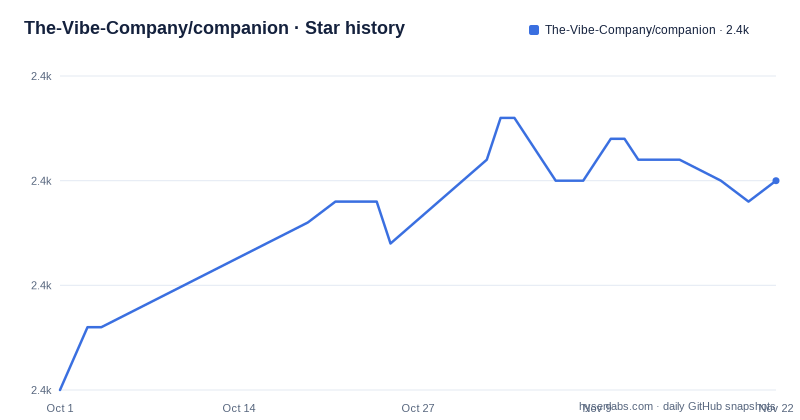
Star history
- The-Vibe-Company/companion2,410 ★ · +10
| Repository | 2026-10-01 | 2026-11-22 |
|---|---|---|
| The-Vibe-Company/companion | 2.4k | 2.4k |
10 Stars in the last 52 days, measured from the daily GitHub snapshot. Compare with other projects
Editorial analysis
The README declines to vouch for the hosted product
The second paragraph is the one to read before anything else, and it is unusual. The repository states that it currently implements the local product path and the hosted integration boundaries, and that it is not evidence that the hosted service, the provider OAuth applications, the Stripe prices or cold Box performance are production ready. It points at a V0 status and gaps document in `docs/v0.md`.
That is a project drawing a line around what its code demonstrates, and it is the correct line to draw for something with a billing surface and three operating system roles. The consequence for a reader is that the code answers questions about architecture, schema discipline and local operation, and does not answer questions about whether the hosted service will hold up.
The rest of the product shape is compact. Each personal account owns an isolated set of companions, conversations, connections, automations, templates, files and billing records. Pi is the agent harness, Bun packages the Linux runtime, PostgreSQL is the durable control plane, and the web client is React with shadcn/ui and AI Elements. The project also notes that it used to live somewhere else: the former Skills Hub is now maintained in a separate Skillpack repository, with the history in a repository migration document.
The release tags show a rename and a version that goes backwards
The release list contains two naming schemes. Two older releases are named after the project itself, `the-companion-v0.94.0` from 2026-03-30 and `the-companion-v0.95.0` from 2026-04-01. The newest is a plain `v0.2.0` from 2026-06-03.
So the tags moved from `the-companion-v0.95.0` to `v0.2.0`, which is both a rename and a reset of the version number downwards. Whatever the reason, a script or document that parses these tags has to cope with two prefixes and a discontinuity, and a reader who assumes the newest tag is numerically the largest will be wrong here.
The timing is the other fact. The last commit to the default branch is dated 2026-09-28 and the newest release is v0.2.0 from 2026-06-03, so roughly four months of work sit on the branch without a tag. Nothing is archived, so the repository is being worked on; it is simply not being cut often enough that the tag list tells you what is running anywhere.
Every checkout derives its own ports, database, bucket and inbox
Local operation is built so two clones can run on one machine without colliding. Each checkout derives its own ports, database, object bucket, mail inbox and labeled containers. Setting `CONDUCTOR_PORT` chooses an explicit web port, and the rest of the ports are offsets from it: the API is plus one, PostgreSQL plus two, MinIO plus three, Mailpit SMTP plus five and the Mailpit web interface plus six.
The gap at plus four is worth noticing, because either a role was removed from that slot or it was reserved, and the file does not say which.
Startup is one script, and it does more than start things.
git clone https://github.com/The-Vibe-Company/companion.git
cd companion
python3 scripts/dev.py
It downloads a checksum-verified Bun 1.4.2 inside the checkout and brings up isolated PostgreSQL, MinIO, Mailpit, API, worker, executor and web processes. There is also a worktree workflow, entered with `./dev setup --portless` and then `./dev workspace`, whose panel starts, stops and restarts components and shows service URLs and validation results. Ctrl-C stops the resources owned by that checkout while keeping its local data, which is the behaviour you want when you abandon a branch and come back to it.
Migration is a release step and services check a fingerprint
The schema discipline is the most transferable part of this README. The local launcher applies the complete PostgreSQL schema before it starts any service, and a hosted release is required to use the same order: run `bun run migrate` as the release command, then start the API, executor and worker with `COMPANIONS_SCHEMA_PREPARED=1`. Each service verifies the stored schema fingerprint before it becomes ready.
The fallback path is documented too. A service launched on its own without that flag still performs the migration, and the migration is idempotent and advisory-locked, skipping DDL when the current fingerprint is already present. So there is no third state where a service silently starts against a stale schema, which is the failure that produces corrupted data at 2am rather than a failed deploy at 2pm.
The environment defaults match that ordering. The container image ships with `COMPANIONS_SCHEMA_PREPARED=1` already set, which means the image assumes the release command ran and refuses to paper over it.
Two npm scripts run the same command, and a build stage checks the agent refuses to start
In `package.json`, the script named `verify:probe` and the script named `test:probe` both run `python3 experiments/pi-bun/verify.py`. They are the same command under two names, so a reader cannot tell from the script list whether one is meant to be the CI entry point and the other a local convenience, or whether the duplication is accidental.
The rest of the scripts are more informative. The dev entry is the Python launcher rather than a JavaScript task, migration points at a TypeScript file under the server app, and the agent test script names six test files explicitly, covering a daemon, an environment, memory, a memory store, a memory service and skills. Plugin tests run three files. There is a box template preparation script as well.
The Dockerfile has a stage worth reading on its own. After the build stage it switches to a Debian slim image, copies the built distribution, and runs the agent binary with `AGENT_TOKEN` unset. The check fails the build if the agent starts successfully, and passes only when the captured output is exactly `MISSING_AGENT_TOKEN`. That is an executable assertion that the agent refuses to run unconfigured, enforced at image build time rather than at first request.
Private beta access is an environment variable you must set three times
An invitation-only beta is configured by setting `PRIVATE_BETA_EMAILS` to an exact comma-separated list of email addresses, on the API, the executor and the worker. Those users sign in with a verified magic link and can work without Stripe activation. Everyone else cannot sign in and cannot use an existing session, and runtime work rechecks the owner's current verified email rather than trusting the session.
The edge cases are specified, which is what makes this usable: an explicitly empty list closes access entirely, removing the variable restores normal subscription requirements, the list has to be redeployed across all three roles when it changes, and `BILLING_TEST_MODE` is to stay disabled in production. Beta usage is still recorded even though it is excluded from Stripe delivery, including after the beta ends.
The release procedure carries the same insistence. A routine publication-mode release needs a coordinated rollout rather than independent automatic deployments: pause them before merging, stop the old roles, migrate, start all three from the updated image with the API last, then follow the mandatory rollout and rollback procedure before admissions resume. The stated reason is blunt: an old executor does not enforce the new publication modes.
Trigger filters run in QuickJS, which is why no role needs a Docker socket
Only the API role needs an exposed port. Trigger filters execute inside the image's own bounded QuickJS WebAssembly runtime, so the API, executor and worker never need access to a Docker socket. `LOCAL_RUNTIME=0` is the image default, and a hosted executor uses Box rather than trying to launch local agent containers.
That is a meaningful isolation decision for a product whose whole premise is agents that run code: the orchestration services do not hold the container runtime's control surface at all.
Two more details from the same area. The Pi agent harness is pinned aggressively, with `overrides` in the manifest forcing seven `@earendil-works` packages, including chord, agent core, client, protocol, telemetry and tui, to exactly the same version as the three direct dependencies at 0.85.0. And the build image is pinned by digest with a comment explaining why: Bun's standalone compiler inherits the builder's libc even with the baseline target, so the image is built on GNU libc because the machines it targets run Debian.
The environment template also carries a rule worth repeating out loud: hosted model keys belong only to the API service, never to Box or the executor.
Editorial conclusion
companion fits a team that wants to run agents with their own machine and their own durable state, and that is comfortable operating a multi-role deployment rather than a single container. Before you plan around it, accept the framing in its own opening paragraph: this repository implements the local product path and the hosted integration boundaries, and it is not evidence that the hosted service, the provider OAuth applications, the Stripe prices or cold Box performance are production ready. Four operational facts will shape your deployment. Migration is a release step, not a startup step, and each role verifies a schema fingerprint before it reports ready, so a service that starts without the prepared flag still migrates on its own. Access control for a private beta is an environment variable that has to be set on all three roles at once, and removing it restores subscription requirements. Trigger filters run inside a bounded QuickJS runtime so no role needs a Docker socket, which is a deliberate design choice worth keeping. And releases are coordinated rather than independent: the API goes last, and an old executor does not enforce new publication modes, so a partial rollout leaves you in a mixed state by construction.
Frequently asked questions
What does The-Vibe-Company/companion actually implement today?
The repository says it implements the local product path and the hosted integration boundaries, and explicitly that it is not evidence that the hosted service, provider OAuth applications, Stripe prices or cold Box performance are production ready. It points at `docs/v0.md` for the status and gaps.
How do I run companion locally?
Clone the repository, enter it and run `python3 scripts/dev.py`. The launcher downloads a checksum-verified Bun 1.4.2 inside the checkout and starts isolated PostgreSQL, MinIO, Mailpit, API, worker, executor and web processes, with its own derived ports per checkout.
How do I run companion against a real model?
Create an uncommitted `.env` with `AGENT_TEST_MODE=0`, a provider, a model id and the matching key, then restart the launcher. Google, Anthropic, OpenAI, OpenRouter and the Z.AI Coding Plan are named in the README, and local mode uses a deterministic test model by default.
Does the companion container need a Docker socket?
No. Only the API role needs an exposed port, and trigger filters run inside the image's bounded QuickJS WebAssembly runtime, so the API, executor and worker do not need a Docker socket. `LOCAL_RUNTIME=0` is the image default and a hosted executor uses Box instead.
What does PRIVATE_BETA_EMAILS do in companion?
It sets an invitation-only beta as an exact comma-separated list, configured on the API, executor and worker together. Listed users sign in with a verified magic link and can work without Stripe activation, an empty list closes access, and removing the variable restores normal subscription requirements.
Official sources
Add this badge to your README
If you maintain this project, the badge below links readers to this analysis and shows its maintenance status from the daily GitHub snapshot. Paste the markdown into your README; add ?metric=license or ?metric=stars to the image URL for a different field.

[](https://hysenlabs.com/projects/the-vibe-company-companion)Star history chart for your README
[](https://hysenlabs.com/projects/the-vibe-company-companion)Was this useful?