Argo's compatibility table tells you to avoid a branch name the repository no longer uses
GitHub describes it as Functional JSON parsing library for Swift. The repository metadata lists Swift as its primary language. The metadata lists the MIT license. This article stays within the project description and details documented in the GitHub repository README.
At a glance
- What is it?
- Argo is a Swift JSON decoding library built on applicative operators, and the repository has not been touched since 2021-09-24 with no release since 2020. Its README recommends using a tagged release rather than the development branch, its compatibility table maps two different Argo lines to the same Swift version, and its quick start needs an external module that none of the three install routes mentions.
- Who is it for?
- Argo shows one approach to JSON decoding in Swift, and that approach is worth reading even if you do not adopt it: decoding is expressed as a function that returns a Decoded value, and each field is composed with an operator that says whether it is required, optional, an array, or reached by a key path. Two things to settle before you build on it.
- Can I use it commercially?
- Yes. MIT is a permissive licence: you can use, modify and sell software built on it, as long as you keep its copyright and licence notices.
- Is it still maintained?
- Probably not. The repository last received commits 62 months ago, on September 24, 2021.
- What is it written in?
- Mainly Swift, according to GitHub's language statistics.
Answers come from the project's GitHub data, last synced on November 15, 2026, and from our analysis. They are not legal advice.
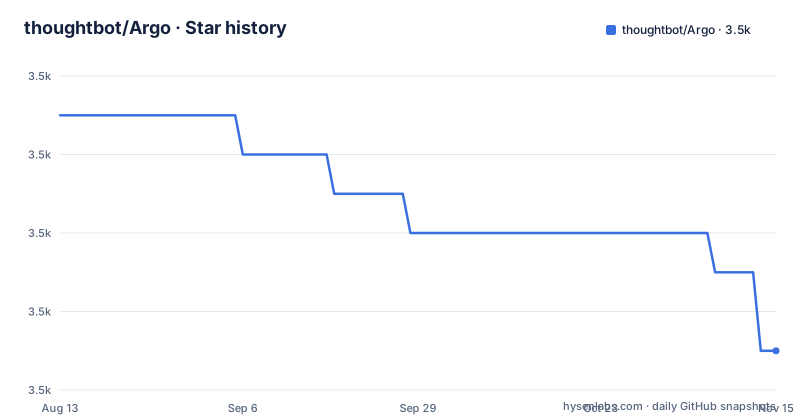
Star history
- thoughtbot/Argo3,465 ★ · -6
| Repository | 2026-08-13 | 2026-11-15 |
|---|---|---|
| thoughtbot/Argo | 3.5k | 3.5k |
-6 Stars in the last 94 days, measured from the daily GitHub snapshot. Compare with other projects
Editorial analysis
The table recommends against the branch it names
The version compatibility section opens with a warning about the development branch. The project says it is aggressive about pushing master forward along with new versions of Swift, and therefore highly recommends against pointing at master, using one of the tagged releases instead. Two dates make that advice concrete. The newest release is v5.0.0 on 2020-05-22, and it was cut thirty minutes after v4.2.0 on the same night. The last push to the repository's default branch is dated 2021-09-24. So for the last five years the branch has been the only place with movement, and the newest thing you can install by tag is from the spring of 2020. The release titles are also part of the tone: 5.0 is labelled Swift Compatibility, 4.2 is spelled out as four point two, and 4.1.2 is called the Iteration Generation.
Two Argo lines claim the same Swift version
The compatibility table maps six Swift versions to six Argo lines, and one of the rows overlaps another. Swift 1.2 through 2.0 maps to Argo 1.X, while the row above it maps Swift 2.0 and 2.1 to Argo 2.X, so Swift 2.0 is claimed twice. Above those, Swift 2.2 and 2.3 map to Argo 3.X, Swift 3.X maps to Argo 4.X, and Swift 4.X maps to master. The newest row in the table is therefore a branch name rather than a version, even though v5.0.0 exists and is the release the same document tells you to install. A reader looking for which tag supports a given Swift version has to infer it, because the row for the current Swift line points at unreleased code and the 5.x line is not in the table at all. The name itself is worth a line, since the README explains it: Argo is the Greek word for swift and also the name of the ship used by Jason, son of Aeson, of the Argonauts, and Aeson is the JSON parsing library in Haskell that inspired Argo, much as Aeson inspired his son.
Three install routes, and the third is discouraged in the text
Installation is documented three times over. Carthage asks you to add one line to a Cartfile:
github "thoughtbot/Argo"and then run carthage update, following Carthage's own instructions for the current way of adding frameworks. CocoaPods asks for a pod line in a Podfile, plus use_frameworks, and then pod install with CocoaPods 0.36 or newer. The third route is git submodules, and its introduction is the sentence I guess you could do it this way if that's your thing. Under that route you add the repository as a submodule, add its project file to your workspace, and link the built framework into your application target. The practical difference between the three is not the initial command, it is what you have to remember afterwards.
Newer versions need a second framework linked by hand
There is a dependency that the install instructions never automate. A note under the Carthage route says that if you are using newer versions of Argo you will need to link both Argo.framework and Runes.framework into your app. The submodule route repeats the requirement for the second framework. So on recent versions of the library there are two frameworks to link rather than one, and neither of the two automated package managers is told to do it for you: you add the pod or the Cartfile entry, and then you discover at link time that a second binary is expected. The same split appears in the usage example, which imports Runes alongside Argo and notes that an older version of Argo might not need that import at all.
The quick start needs a module no install route mentions
The usage section asks for three imports before it shows any code: Argo, Runes, and Curry. The Curry import is called out as an additional external module that lets the example use a curry function, and Curry appears nowhere in the three installation routes. So the first thing a new user copies requires adding a package by hand. The example itself is the interesting part. A model conforms to Decodable and returns a Decoded value from a decode function; the first field is combined with one operator and the rest with another, optional fields use a third, arrays of objects a fourth, and nested objects are written as a key path array of company and name. The sample stops partway through the array line, with the comment cut off after the words parse arrays of.
Five manifest files and three Carthage files at the root
The repository root shows how many toolchains the library has been carried across. There are five package manifests: Package.swift plus four version-specific files for Swift 3.1, 4, 4.2 and 5, which is how SwiftPM selects a manifest by toolchain. There are three Carthage files, the dependency list, a private one, and the resolved lock. Both an Xcode project and an Xcode workspace are committed, which is more than most projects keep, and the workspace is what the submodule route tells you to add by hand. Two linters are configured, one through Hound and one through SwiftLint, and an editor configuration file for Vim sits at the root beside them. Continuous integration is CircleCI, and there are separate directories for documentation, resources, sources, tests, a bin directory and a web directory.
Copyright 2015 and a hiring link, next to no release since 2020
The closing sections read like the project is current. The licence section says Argo is copyright 2015 thoughtbot, inc, free software redistributable under the terms in the licence file. The about section says the project is maintained and funded by thoughtbot, that the names and logos are trademarks, and then links to the company's community page, its case studies and its hiring page with the invitation to help build your iOS app. None of that is a maintenance claim in the sense the gate cares about, but it sits next to a release history that stopped in May 2020 and a last push in September 2021. The contributing section is similarly open-ended: point at the contributing document, open an issue for large changes first, keep pull requests and commits short, and let the commit message carry the intent.
Editorial conclusion
Argo shows one approach to JSON decoding in Swift, and that approach is worth reading even if you do not adopt it: decoding is expressed as a function that returns a Decoded value, and each field is composed with an operator that says whether it is required, optional, an array, or reached by a key path. Two things to settle before you build on it. The library has not been changed since September 2021 and the newest release is from May 2020, so it is pinned to the Swift versions of its era, and its own compatibility table sends Swift 4 users to the development branch rather than to any tag. And the quick start needs two external modules, one of which the install instructions never mention, so following it means adding packages by hand.
Frequently asked questions
What is the thoughtbot Argo library used for?
It extracts models from JSON or similar structures in Swift. A model conforms to Decodable and its decode function returns a Decoded value, with each field combined by an operator that says whether it is required, optional, an array of objects, or reached through a key path, so you do not hand-write type validation or empty-field checks.
How do I install Argo in a Swift project?
Three routes are documented: add github "thoughtbot/Argo" to a Cartfile and run carthage update; add pod 'Argo' to a Podfile with use_frameworks and run pod install with CocoaPods 0.36 or newer; or add the repository as a git submodule and link the built framework. On newer versions you also have to link Runes.framework alongside Argo.framework.
Which Swift versions does the Argo library support?
The compatibility table maps Swift 1.1 to Argo 0.3.X, Swift 1.2 through 2.0 to 1.X, Swift 2.0 and 2.1 to 2.X, Swift 2.2 and 2.3 to 3.X, Swift 3.X to 4.X, and Swift 4.X to the master branch. Note that Swift 2.0 appears in two rows, and that the newest line is a branch rather than a tag.
Is the Argo Swift library still being worked on?
The repository's last push is dated 2021-09-24 and the most recent release is v5.0.0 from 2020-05-22, published thirty minutes after v4.2.0 the same night. The repository is not archived. The README recommends using a tagged release rather than the development branch for exactly this reason.
What extra modules does the Argo quick start example need?
Three imports: Argo itself, Runes, which the notes describe as a dependency of Argo in newer versions, and Curry, which they call an additional external module that provides the curry function used in the example. Curry does not appear in any of the three documented installation routes, so it has to be added separately.
Official sources
Add this badge to your README
If you maintain this project, the badge below links readers to this analysis and shows its maintenance status from the daily GitHub snapshot. Paste the markdown into your README; add ?metric=license or ?metric=stars to the image URL for a different field.

[](https://hysenlabs.com/projects/thoughtbot-argo)Star history chart for your README
[](https://hysenlabs.com/projects/thoughtbot-argo)Was this useful?