The install line is a wildcard, and the speed claim is hedged
A modular implementation of timely dataflow in Rust
At a glance
- What is it?
- TimelyDataflow/timely-dataflow is a cyclic dataflow engine in Rust that scales one program from a laptop thread to a cluster. Its README is candid about several rough edges, including a wildcard dependency, an example that ignores your command line, and a workspace that excludes its own WebAssembly sample.
- Who is it for?
- Timely dataflow fits someone who already understands cyclic dataflow and wants that model in Rust with a low-latency path to multiple machines. Three things to settle before you commit.
- Can I use it commercially?
- Yes. MIT is a permissive licence: you can use, modify and sell software built on it, as long as you keep its copyright and licence notices.
- Is it still maintained?
- Yes. The repository last received commits 16 days ago.
- What is it written in?
- Mainly Rust, according to GitHub's language statistics.
Answers come from the project's GitHub data, last synced on November 24, 2026, and from our analysis. They are not legal advice.
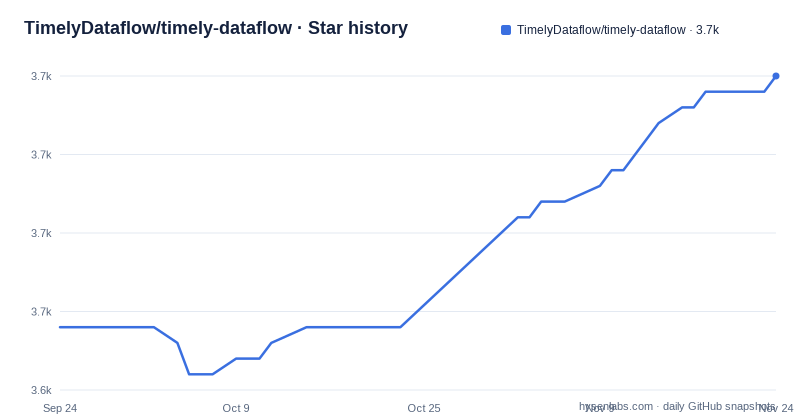
Star history
- TimelyDataflow/timely-dataflow3,665 ★ · +16
| Repository | 2026-09-24 | 2026-11-24 |
|---|---|---|
| TimelyDataflow/timely-dataflow | 3.6k | 3.7k |
16 Stars in the last 61 days, measured from the daily GitHub snapshot. Compare with other projects
Editorial analysis
The dependency line the README hands you pins no version at all
The entire install instruction for a Cargo project is two lines:
[dependencies]
timely="*"
A wildcard means Cargo resolves whatever the newest published timely happens to be on the day the lock file is generated, which is convenient for reading the example and poor for anything you intend to run. The workspace itself takes a firmer line than its README does, declaring edition 2021, a rust-version floor of 1.86, and resolver 2, so the toolchain requirement is pinned even though the library version is not. Releases arrive as a coordinated set rather than one crate: timely_logging, timely_container, and timely_communication were all published as 0.31.0 within seconds of each other on 2026-07-14. A release-plz.toml at the root indicates that coordination is automated, and a CHANGELOG.md sits beside it. Commits have landed on the default branch since that release, most recently on 2026-09-22, so the crates.io versions are behind the working tree by roughly two months.
simple.rs throws your command line away, so -w2 changes nothing
Two entry points exist and they are not interchangeable. The short example is built on timely::example:
use timely::dataflow::operators::*;

fn main() {
    timely::example(|scope| {
        (0..10).to_stream(scope)
               .container::<Vec<_>>()
               .inspect(|x| println!("seen: {:?}", x));
    });
}
The README states plainly that simple.rs always uses one worker thread because it uses timely::example, which ignores user-supplied input. So the documented way to add threads, the -w or --workers option, does nothing when passed to that example, and a reader who tries it sees the same single-worker output and concludes the flag is broken. The second example, hello.rs, switches to timely::execute_from_args(std::env::args(), |worker| ...) and drives the dataflow separately, which is what makes it the one to read if you care about worker count. The README calls the first example very simple and says it only just suggests how you might write dataflow programs, which is fair, but it does not mention the flag caveat until the execution section.
Multi-process launch needs four arguments that every host has to agree on
Threads inside one process take a single flag, and processes across machines take three more plus the thread count. A hostfile is a text file whose lines are hostname:port entries:
% cat hostfile.txt
host0:port
host1:port
host2:port
host3:port
...
The processes are then launched individually, each carrying the whole set:
host0% cargo run -- -w 2 -h hostfile.txt -n 4 -p 0
host1% cargo run -- -w 2 -h hostfile.txt -n 4 -p 1
host2% cargo run -- -w 2 -h hostfile.txt -n 4 -p 2
host3% cargo run -- -w 2 -h hostfile.txt -n 4 -p 3
-w sets threads, -h names the hostfile, -n gives the process count and takes a prefix of that file, and -p is the calling process's own index. Nothing enforces agreement between hosts, and the README states one constraint that a mismatch would violate: the number of workers should be the same for each process. There is no coordinator process here, so a typo in one host's -p produces a cluster that starts and quietly misroutes rather than one that refuses to launch.
The workspace excludes its own wasm example from a normal build
One crate in the repository cannot be built by the command most people will run. The workspace manifest excludes timely/examples/wasm-bindgen, and the exclusion carries a comment explaining that the example is its own crate with wasm-only dependencies, wasm-bindgen and web-sys, and that leaving it inside the workspace would make a native cargo build --workspace attempt to compile it. The fix is continuous integration checking it separately:
cargo check --target wasm32-unknown-unknown --manifest-path timely/examples/wasm-bindgen/Cargo.tomlSo the example is compiled on every CI run against an explicit wasm target and an explicit manifest path, while cargo build --workspace skips it. The workspace members are bytes, communication, container, logging, mdbook, and timely, which matches the directories at the root, and the single shared workspace dependency is columnar at 0.13. A reader cloning the repository to try the browser example will find that the ordinary build says nothing about it and that the only instructions are a CI command.
The performance comparison is hedged in the project's own words
The README does not benchmark anything, and it says so with a hedge. The claim runs that the main goals are expressive power and high performance, that this is something akin to a distributed data-parallel compute engine scaling the same program from one laptop thread to a cluster, and that it is probably strictly more expressive and faster than whatever you are currently using, assuming you aren't yet using timely dataflow. Nothing in the file supports either half. No benchmark, no comparison table, and no baseline is named, and strictly more expressive is a formal claim that the text makes no attempt to argue. The abstraction story is at least honest about its own shape. Timely dataflow is the lower layer, offering primitives such as map, filter, and concat, loop entry and exit through enter and leave, and generic unary and binary operators whose implementations you supply with closures. Differential dataflow sits above it with group, join, and iterate, its implementation described as fully incrementalized and, in the README's phrasing, pretty cool if mysterious. Judge the layering, not the speed claim.
The long-form tutorials are from 2015 and are flagged as possibly unbuildable
There are three documentation routes and each carries a warning. The rendered documentation on docs.rs is described as a work in progress but mostly improving. The mdbook at the project site is the version with examples tested against current builds. The three blog posts introducing timely dataflow are dated 2015, and the README attaches a caveat to them directly: the examples there may need tweaks to build against the current code. That is an unusually honest note to find in a README, and it also means the most readable introduction to the model is a decade older than the code it describes. The second example demonstrates what the newer API looks like, with the run shown at two workers:
% cargo run --example hello -- -w2
Running `target/debug/examples/hello -w2`
worker 0:   hello 0
worker 1:   hello 1
worker 0:   hello 2
worker 1:   hello 3
worker 0:   hello 4
worker 1:   hello 5
worker 0:   hello 6
worker 1:   hello 7
worker 0:   hello 8
worker 1:   hello 9
Every worker introduces the same data and the exchange operator routes each element to a specific worker using the data itself, which is why worker 1 receives the odd numbers.
The mdbook is a workspace member, and the applications paragraph names nothing
The ecosystem section promises a category it never populates. It says there are also a few applications built on timely dataflow, and the sentence ends there, so the README points at a class of downstream work without naming a single one you could go and read. What it does spell out is the layering intent, supporting multiple levels of abstraction from manual dataflow assembly at the bottom through to declarative layers above, with the set of layers expected to grow as people write their own or build on those of others. Meanwhile the mdbook/ directory is a workspace member alongside the five library crates, so an ordinary cargo build --workspace also compiles the book. The members are bytes, communication, container, logging, mdbook, and timely, and three of those directories correspond to the crates published separately at 0.31.0. Two files at the root handle provenance, a LICENSE carrying MIT and a separate COPYRIGHT file that the README does not explain.
Editorial conclusion
Timely dataflow fits someone who already understands cyclic dataflow and wants that model in Rust with a low-latency path to multiple machines. Three things to settle before you commit. Replace the wildcard dependency with a pinned version and generate a lock file, because the published 0.31.0 set dates from 2026-07-14 while the branch has moved since. Read hello.rs rather than simple.rs if you care about worker count, since the short example discards your arguments. And decide early whether the abstraction you want is timely or differential dataflow, since the higher-level language is where group, join, and iterate live and its implementation is described in the README as mysterious.
Frequently asked questions
What is timely-dataflow from TimelyDataflow used for?
It is a low-latency cyclic dataflow computational model implemented in Rust, introduced by the Naiad paper and extended here into a modular implementation. The aim is to scale the same program from a single thread on a laptop to distributed execution across a cluster of computers.
How do I add timely-dataflow to a Cargo project?
The README gives a single dependency line, timely="*", which resolves to whatever the newest published version is and therefore pins nothing. The workspace itself requires Rust 1.86 or newer and uses edition 2021.
What is the difference between timely dataflow and differential dataflow?
Timely dataflow is the lower layer, providing primitives such as map, filter, concat, enter and leave, plus unary and binary operators built from closures. Differential dataflow is a higher-level language built on top of it, adding group, join, and iterate, with an implementation the README describes as fully incrementalized.
How do I run a timely-dataflow example across several machines?
You need a hostfile whose lines are hostname:port entries, then launch each process separately with the worker count, the hostfile, the process count, and that process's own index. The README states that the number of workers should be the same for each process.
Official sources
Add this badge to your README
If you maintain this project, the badge below links readers to this analysis and shows its maintenance status from the daily GitHub snapshot. Paste the markdown into your README; add ?metric=license or ?metric=stars to the image URL for a different field.

[](https://hysenlabs.com/projects/timelydataflow-timely-dataflow)Star history chart for your README
[](https://hysenlabs.com/projects/timelydataflow-timely-dataflow)Was this useful?