tower-rs/tower: four workspace crates, a 1.64.0 compiler floor, and a request / response assumption
async fn(Request) -> Result<Response, Error>
At a glance
- What is it?
- Tower is a Rust library of modular components for request and response networking, split across four workspace crates, with a rolling six month policy that governs how its compiler floor moves.
- Who is it for?
- Tower suits Rust projects whose traffic is request and response shaped and whose toolchain can sit at 1.64.0 or newer. Skip it for purely stream based protocols, and skip it on targets without a standard library unless you depend only on tower-layer and tower-service.
- Can I use it commercially?
- Yes. MIT is a permissive licence: you can use, modify and sell software built on it, as long as you keep its copyright and licence notices.
- Is it still maintained?
- Yes. The repository last received commits 153 days ago.
- What is it written in?
- Mainly Rust, according to GitHub's language statistics.
Answers come from the project's GitHub data, last synced on November 22, 2026, and from our analysis. They are not legal advice.
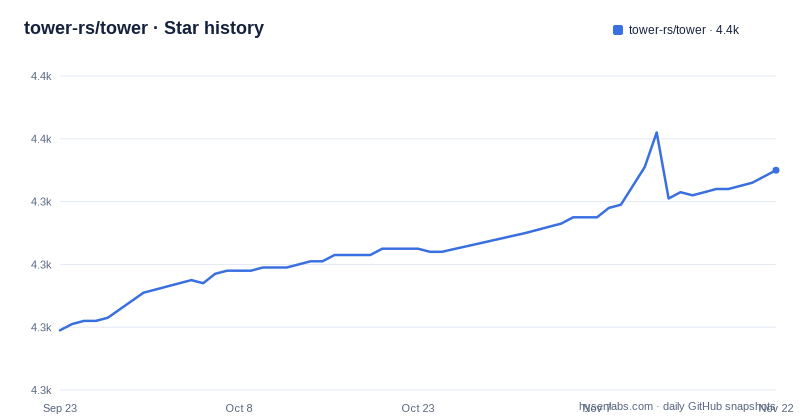
Star history
- tower-rs/tower4,350 ★ · +51
| Repository | 2026-09-23 | 2026-11-22 |
|---|---|---|
| tower-rs/tower | 4.3k | 4.4k |
51 Stars in the last 60 days, measured from the daily GitHub snapshot. Compare with other projects
Editorial analysis
Tower assumes a request and a response
Tower is protocol agnostic, and that claim is worth testing first. It is designed around a request / response pattern, and the project states the consequence plainly: if your protocol is entirely stream based, Tower may not be a good fit. No amount of middleware repairs that shape mismatch, because the pattern sits underneath the service abstraction rather than beside it.
The order of decisions follows from this. Check whether your traffic is request and response shaped before you look at any service or layer. If it is, the four member workspace declared in Cargo.toml is the surface you actually depend on.
The MSRV floor sits at 1.64.0 and only moves on a six month delay
The current MSRV is 1.64.0, and the policy that governs it is a rolling one. Tower keeps a rolling MSRV policy of at least 6 months, and when it does increase the MSRV, the new Rust version must have been released at least six months ago.
Read together, those two sentences mean the floor can only move toward compiler versions that are already old. That gives downstream users a predictable schedule, and it also means the floor lags whatever toolchain you happen to run. If you are on a recent compiler and need to stay there, nothing in the stated policy obliges the project to follow. The workspace dependency requirements are consistent with that posture: tokio requires at least "1.6.2" and futures at least "0.3.22", both low floors.
For a reader the consequence is a lock on your side. Pick the exact tower release you use and check the compiler floor yourself, because a project with a moving MSRV can turn a routine cargo update into a toolchain change.
no_std support stops short of the tower crate itself
The no_std story is split across the workspace, and reading only the crate name would give the wrong answer. `tower` itself is not `no_std` compatible. `tower-layer` and `tower-service` are.
That split is the practical part. A library author who needs layer composition or the service abstraction on a target without a standard library can depend on those two crates and stop there. Anyone who reaches for the `tower` crate in the same environment will not build. The README states the compatibility boundary but does not point at a feature flag or build script that would narrow it, so the decision gets made at dependency selection time rather than discovered once you are already compiling.
If your target is embedded, check which of the four workspace members you actually need before you add the dependency, because the top level crate is the one that will refuse.
Four workspace members share one pinned dependency set
The workspace manifest is where the pinned dependency set is visible. Four members are declared: tower, tower-layer, tower-service, tower-test. Everything after that block is a workspace dependency that members can draw on:
[workspace]

members = [
  "tower",
  "tower-layer",
  "tower-service",
  "tower-test",
]

[workspace.dependencies]
futures = { version = "0.3.22", default-features = false }
futures-core = "0.3.22"
futures-util = { version = "0.3.22", default-features = false }
hdrhistogram = { version = "7.0", default-features = false }
http = "1"
indexmap = "2.0.2"
pin-project-lite = "0.2.7"
quickcheck = "1"
rand = "0.9"
slab = "0.4.9"
sync_wrapper = "1"
tokio = "1.6.2"
tokio-stream = "0.1.1"
tokio-test = "0.4"
tokio-util = { version = "0.7.0", default-features = false }
tracing = { version = "0.1.2", default-features = false }
tracing-subscriber = { version = "0.3", default-features = false }
Two details are worth noting. Several pins turn default features off explicitly, so enabling one later means reading this manifest instead of guessing. And the runtime version floors are low: tokio "1.6.2", tokio-util "0.7.0", tokio-stream "0.1.1".
Thirteen months between tower 0.5.2 and tower 0.5.3
Release dates tell you more about the rhythm than a CI badge will. tower 0.5.1 was published on 2024-09-05, tower 0.5.2 on 2024-12-11, and tower 0.5.3 on 2026-01-12. The gap between the first two is a little over three months. The gap between the last two is a little over thirteen.
The last push to the repository landed on 2026-06-22 and the project is not archived, so work continues on the default branch even while the published version numbers move slowly. Nothing in the README describes a deprecation window or a breaking change policy for the 0.5.x line.
For readers this argues for pinning rather than tracking. A thirteen month gap between patch level releases means the version you pick may remain the newest one available for a long stretch, and a lockfile is the cheapest way to hold that choice steady across machines.
The front page has no code and sends you to the guides directory
The README is short and stops at orientation. It carries the crates.io, documentation, documentation for master, CI, license, and Discord badges, then an overview paragraph, the MSRV policy, the no_std note, the license statement, and a contribution note under which contributions are MIT unless stated otherwise.
There is no code in it. For anyone brand new to Tower, the recommendation is to check out some of the guides, which live in the `guides/` directory of the repository. The top level also shows an `examples/` directory, though the only example file recorded there is `examples/Cargo.toml`, a manifest rather than a runnable program. `netlify.toml` sits at the top level, and the crate documentation is published at docs.rs/tower.
The consequence is that there is nothing to copy from the front page. Getting a first service running means going into the guides directory or the published API documentation and reading from there.
The README leaves the crate surface unstated
Several things a reader would check first are simply absent. The README does not enumerate which services or middleware the `tower` crate exposes, so the visible surface stops at the four workspace member names in `Cargo.toml`. It does not state a runtime requirement, even though the workspace depends on tokio, and it does not say whether a given service is runtime bound. It does not describe what `tower-test` provides beyond its name.
The top level also contains `deny.toml`, which is where dependency policy settings such as advisory and license checks usually live. Its contents are not reproduced anywhere in the README, so the policy applied to that dependency set cannot be read from the project page.
None of that makes the library unusable. It means the front page answers who the project is for and what the compiler floor costs, and leaves the surface area questions to the guides and the published docs.
Editorial conclusion
Tower suits Rust projects whose traffic is request and response shaped and whose toolchain can sit at 1.64.0 or newer. Skip it for purely stream based protocols, and skip it on targets without a standard library unless you depend only on tower-layer and tower-service. Before adopting it, pin the exact release and read the guides directory, since the README carries no code example and names no runtime requirement.
Frequently asked questions
Is tower-rs/tower a good fit for stream based protocols?
Tower is protocol agnostic but is designed around a request / response pattern, and the README states it may not be a good fit if your protocol is entirely stream based.
What is the minimum supported Rust version for tower-rs/tower?
The current MSRV is 1.64.0. Tower keeps a rolling MSRV policy of at least 6 months, and an increase can only move to a Rust release that is already at least six months old.
Can tower-rs/tower be compiled without a standard library?
The `tower` crate itself is not `no_std` compatible, while `tower-layer` and `tower-service` are.
Which crates belong to the tower-rs/tower workspace?
Cargo.toml declares four members: tower, tower-layer, tower-service, and tower-test.
Does the tower-rs/tower README include a working code example?
No. It carries badges, an overview, the MSRV policy, the no_std note, and the license text, then sends newcomers to the guides directory. The only example file in the repository listing is `examples/Cargo.toml`.
Official sources
Add this badge to your README
If you maintain this project, the badge below links readers to this analysis and shows its maintenance status from the daily GitHub snapshot. Paste the markdown into your README; add ?metric=license or ?metric=stars to the image URL for a different field.

[](https://hysenlabs.com/projects/tower-rs-tower)Star history chart for your README
[](https://hysenlabs.com/projects/tower-rs-tower)Was this useful?