ElvUI: a one-line README, and a Makefile that fetches libraries from another project
User Interface replacement AddOn for World of Warcraft.
At a glance
- What is it?
- tukui-org/ElvUI is a Lua user interface replacement add-on for World of Warcraft whose repository carries twelve words of prose, three source directories, a packaging manifest, and a single Make target that populates the bundled libraries by piping a third-party packager script, fetched from that project's master branch, straight into bash.
- Who is it for?
- ElvUI is not a repository you evaluate by reading it, and the project is not pretending otherwise. The prose is one sentence and the documentation lives on a website and a chat server, which is a coherent choice for an add-on whose installation runs through the game's own directory rather than a package manager.
- Can I use it commercially?
- Check first. The repository uses a licence we do not classify automatically, so read its LICENSE file before any commercial use.
- Is it still maintained?
- Yes. The repository received new commits within the last day.
- What is it written in?
- Mainly Lua, according to GitHub's language statistics.
Answers come from the project's GitHub data, last synced on October 22, 2026, and from our analysis. They are not legal advice.
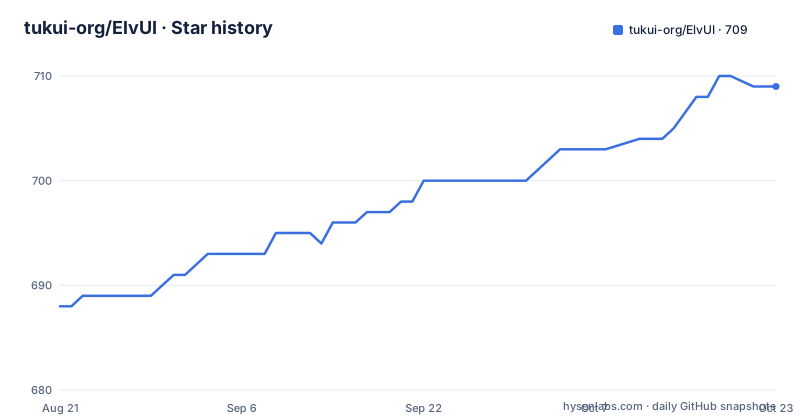
Star history
- tukui-org/ElvUI709 ★ · +21
| Repository | 2026-08-21 | 2026-10-22 |
|---|---|---|
| tukui-org/ElvUI | 688 | 709 |
21 Stars in the last 62 days, measured from the daily GitHub snapshot. Compare with other projects
Editorial analysis
The README is one sentence and the links do the explaining
The entire prose content of the README is a single line describing a user interface replacement add-on for World of Warcraft. Everything else on the page is four badges pointing outward: a support page and an ElvUI page on the project website, the changelog file in this repository, and a Discord invite. There is no installation section, no configuration walkthrough, no compatibility table, and no list of what changed in which game version. For a project of this size that is a deliberate division of labour rather than an oversight, and it has a specific consequence: the repository is the artefact you build from, while the website is the documentation you read. If you are deciding whether to use the add-on, you will learn more from the site than from the code, and the code is worth reading only if you intend to change it.
ElvUI_Libraries is filled by piping another project's master branch
The Makefile has one target and it is not a build. It fetches a script and runs it:
PACKAGER_URL := https://raw.githubusercontent.com/BigWigsMods/packager/master/release.shcurl -s $(PACKAGER_URL) | bash -s -- -c -d -z
cp -a .release/ElvUI_Libraries/* ElvUI_Libraries/So the vendored libraries that ship inside the add-on are not authored in this repository. They are produced by a packager tool that lives in a different organisation's project, downloaded from that project's default branch with no tag and no checksum, given three flags, and then copied into the `ElvUI_Libraries/` directory that the add-on actually loads. That directory is also tracked by the repository, so its contents are whatever the last run of this target happened to leave. This is the single most important thing to know before building this project from source.
Running make with no target does nothing at all
The target list is worth reading closely. `.PHONY` names exactly one target, `libs`, and the default goal is `all`, which is declared with no recipe following it. So a bare `make` succeeds, prints nothing, and changes nothing. Whatever else a maintainer might expect a Makefile in a Lua add-on to do, this one does not: there is no compile step, no test target, no lint target, no packaging target, and no clean. Its whole job is the library fetch described above. That is a coherent design for a project whose real build tooling is the game's own add-on packer reading a manifest, and it also means anyone looking for a standard build entry point will not find one here. The packaging story is `.pkgmeta` at the repository root, which is the metadata file the game's tooling reads when it packages the add-on for installation.
Three directories with three separate jobs
The tree is short and the naming is the documentation. `ElvUI/` holds the add-on itself, the Lua that replaces the game's interface. `ElvUI_Libraries/` holds the third-party code bundled alongside it, which is the directory the Make target overwrites. `ElvUI_Options/` holds the options database, the generated descriptions behind the in-game settings panel, which is why `how to access elvui settings` is answered by a directory rather than by prose. The three are kept apart so that the add-on's own source, the code it does not own, and the generated configuration never get confused with one another during an update. Around them sit `.github/`, `.gitignore`, `AGENTS.md`, `CHANGELOG.md`, `LICENSE.md`, `Makefile`, `README.md`, and `ThirdPartyNotices.md`. Keeping the vendored directory in its own place is what lets the fetch target overwrite it wholesale without touching anything the maintainers wrote.
No recognised licence id, but two licence files at the root
The repository's own metadata reports no recognised licence identifier, which normally means a detector could not map the file it found. That is not the end of the question here, because the root carries both `LICENSE.md` and `ThirdPartyNotices.md`. The second of those is the more consequential of the two for a project shaped like this one. ElvUI replaces the entire game interface, which means it necessarily carries a large amount of code that its author did not write, either vendored into `ElvUI_Libraries/` or referenced by the notices file. When the licence metadata is unreadable and the bundled libraries are produced by a script fetched at build time, the notices file is the document that tells you whose code you are about to ship. Read it before redistributing anything built from this repository.
No releases, so the changelog is the version history
There are no GitHub releases attached to this repository, so there is no tag to pin, no release notes page, and no published changelog on the project's own hosting. The version history that does exist is `CHANGELOG.md` in the root, which the README badges, and whatever the project website records. That is a coherent arrangement for an add-on distributed through a game client rather than a registry: the add-on is pulled from a distribution channel and updated in place, so the release mechanism is not where people look for changes. The last push to `main` is dated 2026-10-01, which is recent, and the repository is not archived. Between the two, the practical position for a new user is that the code is current and the writing is elsewhere.
An AGENTS.md sits next to the add-on source
The root carries `AGENTS.md` alongside `CONTRIBUTING`-style material, `.github/`, and the source directories. In a Lua add-on for a game client, that is an unusual file to find, and it says something about who is expected to make changes here: there are instructions written for automated coding agents, kept in the repository rather than in a wiki, alongside a `CHANGELOG.md` that a human maintainer is expected to keep current. Combined with the `Makefile` and `.pkgmeta` at the same level, the picture is of a project whose contributor surface has been modernised even though its user-facing surface has not, which is normal for a long-lived add-on that has outlived several generations of tooling and picked up current practices where it costs nothing. It also means an agent asked to help with this repository will find its instructions there rather than in a chat server.
Editorial conclusion
ElvUI is not a repository you evaluate by reading it, and the project is not pretending otherwise. The prose is one sentence and the documentation lives on a website and a chat server, which is a coherent choice for an add-on whose installation runs through the game's own directory rather than a package manager. What the repository does contain is the part that matters for anyone maintaining it: three clearly separated directories, a packaging manifest, a changelog, an agent instruction file, and a Makefile whose single target is the interesting file, because it decides what code ends up inside the add-on. Before you build from source, read that Makefile and decide whether running `make libs` is something you want, given it executes a script from another organisation's default branch. If you only want to use the add-on, the site is the faster route and there is nothing in this repository that changes that.
Frequently asked questions
What is ElvUI?
A user interface replacement add-on for World of Warcraft, written in Lua. The repository root holds three directories: `ElvUI/` for the add-on itself, `ElvUI_Libraries/` for bundled third-party code, and `ElvUI_Options/` for the in-game options database.
How do I install ElvUI?
The repository does not document installation. Its README is one line of prose and it links out to tukui.org/support and the ElvUI page on tukui.org, which is where the instructions live. The only command in the repository is `make libs`.
What does make libs do in the ElvUI repository?
It downloads the packager release script from the BigWigsMods project, from that project's default branch with no tag, pipes it through bash with the flags `-c -d -z`, and then copies everything under `.release/ElvUI_Libraries/` into the repository's own `ElvUI_Libraries/` directory.
Where are ElvUI's licence and third-party notices?
At the repository root, as `LICENSE.md` and `ThirdPartyNotices.md`. The repository metadata itself reports no recognised licence identifier, so those two files are what settle the question, and the notices file is the relevant one because the bundled libraries are not written by the add-on's maintainers.
Official sources
Add this badge to your README
If you maintain this project, the badge below links readers to this analysis and shows its maintenance status from the daily GitHub snapshot. Paste the markdown into your README; add ?metric=license or ?metric=stars to the image URL for a different field.

[](https://hysenlabs.com/projects/tukui-org-elvui)Star history chart for your README
[](https://hysenlabs.com/projects/tukui-org-elvui)