userver: seventeen badge links with no image, five repositories, and a default branch called develop
Production-ready C++ Asynchronous Framework with rich functionality
At a glance
- What is it?
- An asynchronous C++ framework whose central claim is that a thread never suspends on I/O: it goes back to the queue and returns to the operation only when it can proceed immediately. The build system is unusually careful, with sanitizers on debug builds and a raised descriptor limit, while the type checker is configured to ignore name mismatches and argument type mismatches.
- Who is it for?
- Adopt this if you are writing C++ services and want one framework holding your database drivers, your message queue clients and your transport layer with a single async model across all of them. Two things to check first.
- Can I use it commercially?
- Yes. Apache-2.0 is a permissive licence: you can use, modify and sell software built on it, as long as you keep its copyright and licence notices.
- Is it still maintained?
- Yes. The repository last received commits 1 day ago.
- What is it written in?
- Mainly C++, according to GitHub's language statistics.
Answers come from the project's GitHub data, last synced on November 15, 2026, and from our analysis. They are not legal advice.
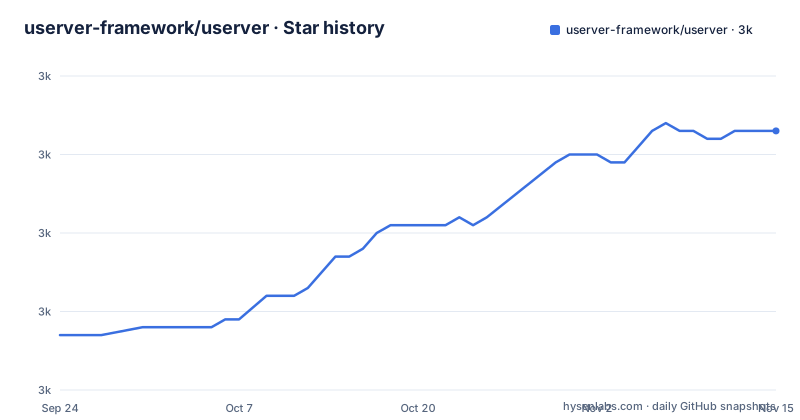
Star history
- userver-framework/userver3,003 ★ · +26
| Repository | 2026-09-24 | 2026-11-15 |
|---|---|---|
| userver-framework/userver | 3k | 3k |
26 Stars in the last 52 days, measured from the daily GitHub snapshot. Compare with other projects
Editorial analysis
The badge block is seventeen links with no image text
The top of the readme is not a row of badges. It is seventeen lines of markdown link syntax with empty link text and no image, which means nothing renders. Underneath the invisible links sit eleven workflow definitions belonging to this repository: the general build, one each for five Linux distributions, macOS, Docker, the Conan package build, CodeQL analysis, and image publishing for two Ubuntu releases. The remaining six point somewhere else entirely. One is a Gentoo workflow in a separate overlay repository, and the last five belong to three other projects, a configuration service, a sample, and a pastebin. So the block names the build matrix honestly, in five repositories, and displays none of it.
The default branch is develop and the default target runs two test suites
Two defaults worth knowing before the first command. The default branch is named develop rather than main or master, so a plain clone is not the branch the version tags are cut from, and anyone who wants the released line has to check a tag instead. And the default goal of the build file is not a build. It runs the debug test suite and then the release test suite, each of which builds its own tree first, because both are declared as depending on a matching build target. So the first thing a new contributor types compiles the project twice and runs every test twice. The parallelism is taken from the processor count, and both builds live in separate directories so they do not overwrite each other.
Debug builds enable two sanitizers and the descriptor limit is raised by hand
The build configuration defaults are chosen for catching problems rather than for speed. The debug flags are set to enable the address and undefined behaviour sanitizers by default, so an uninitialised read or a buffer overrun in a test run is reported rather than silently tolerated. The test targets raise the open file descriptor limit to four thousand and ninety six before invoking the test runner, which is what a framework that opens sockets and databases in parallel needs and what a default system limit would otherwise break. Colour output is enabled only when the tests are attached to a terminal, and it is disabled when the same command is run from a script or a CI job. There is also a hook that includes a local, untracked override file if it exists, so a developer can change any flag without touching the tracked file.
Two documentation targets reach outside the repository and one expects a token
The build file contains four documentation targets and two of them do not reference paths inside the repository. They call scripts through a parent directory reference, which only resolves if the repository is checked out next to the directory holding those scripts. The upload variant of one of them passes an OAuth token in as an environment variable on the command line, which means the value is visible in the process list for the duration of the upload. The other two targets call their scripts from inside the repository and are self contained. The two cross-referencing targets look like they exist for the upstream organisation's internal layout rather than for a contributor's checkout, and the readme does not say which is which.
The type checker ignores name mismatches and argument type mismatches
This project contains a code generator written in Python, and the generator's configuration is unusually blunt about what is not checked. The type checker is configured to allow implicit optionals, and then two entire classes of error are disabled by name: name mismatch errors and argument type errors. Those are the two errors that matter most in a generator, because a generator's whole job is emitting names and types that must match what the consumer expects. The surrounding configuration is otherwise careful: preview mode on, a line length of one hundred and twenty, single quotes for inline code and double for docstrings, one docstring convention, and a deliberately short list of selected rules. So the linter is strict about style and the type checker is lenient about correctness of names and arguments, which is the opposite of the usual arrangement.
The banned import list was generated by a find command
The import conventions configuration contains a rule forbidding direct imports of internal modules, and the list runs to dozens of entries covering two related packages. Above the list is the command that produced it:
# $ find chaotic/ -name '*py' | grep -v __init__ | cut -d. -f1 | tr / .Every top level Python module found under those two directories, with path separators rewritten into dots, becomes a banned import target. That is a sensible way to keep a generated code base from being imported against its own internals, and it is also a self describing record: the list tells you the module layout of the generator at the moment the file was written. A new module added to either directory is not covered until the command is re-run, so the rule is only as current as the last regeneration. The root of the project is a Python configuration file even though the project itself is C++, because the tooling that builds and checks the project is written in Python.
CMake formatting is driven by a Python script over a find pipeline
The project formats its own CMake files, and the recipe is a shell pipeline rather than a wrapper. It lists the directories at the top level, filters out any whose name begins with build, finds every file that is either a CMake script or named as a CMake lists file, and pipes the result into the formatter. Three separate top level files are devoted to code style, one for C++ sources, one for static analysis settings, and a Python script that configures how the CMake files themselves are formatted. There is a separate editor configuration file as well. So a repository whose product language is C++ carries style configuration for two languages plus its build system, which is a reasonable steady state for a project of this size and a fair number of configurations to keep consistent.
Editorial conclusion
Adopt this if you are writing C++ services and want one framework holding your database drivers, your message queue clients and your transport layer with a single async model across all of them. Two things to check first. The build entry point is a branch named develop, so a plain clone is not the branch the version tags come from, and pin by tag. And the Python tooling that maintains the code generators configures its type checker to ignore two whole error classes, so read that configuration before trusting a clean type check as evidence about generated code.
Frequently asked questions
What is userver-framework/userver?
It is an open source asynchronous C++ framework with abstractions for building microservices, services and utilities. Its central claim is that an operation which would normally suspend a thread does not suspend it; the thread handles other requests and returns to the operation only when it is guaranteed to execute immediately.
Which databases and protocols does userver support?
The feature list names asynchronous drivers for MongoDB, PostgreSQL, Valkey, Redis, ClickHouse, MySQL and MariaDB, YDB and SQLite, and data transfer protocols including HTTP 1.1 and 2.0, gRPC, AMQP 0-9-1, Kafka, TCP, TLS and WebSocket.
How is userver versioned and which branch do releases come from?
By minor version, with the three newest releases numbered 3.0, 3.1 and 3.2 and published in April, June and September 2026. The default branch is named develop rather than main, and a version file sits at the root of the repository.
What does running make in userver do by default?
It runs the debug test suite and then the release test suite, each building its own tree first. Debug builds have the address and undefined behaviour sanitizers enabled by default, the file descriptor limit is raised before the tests run, and colour output is enabled only when attached to a terminal.
Which Linux distributions does userver build on?
The readme links workflow definitions for Debian, Fedora, Alpine, Arch Linux and Gentoo, plus macOS and Docker, alongside a Conan package build, CodeQL analysis and image publishing for two Ubuntu releases. The Gentoo workflow belongs to a separate overlay repository, and several more links belong to other projects entirely.
Official sources
Add this badge to your README
If you maintain this project, the badge below links readers to this analysis and shows its maintenance status from the daily GitHub snapshot. Paste the markdown into your README; add ?metric=license or ?metric=stars to the image URL for a different field.

[](https://hysenlabs.com/projects/userver-framework-userver)Star history chart for your README
[](https://hysenlabs.com/projects/userver-framework-userver)Was this useful?