Veldrid: the last release and the abandonment notice share a month
A low-level, portable graphics library for .NET.
At a glance
- What is it?
- Veldrid is a low-level, graphics API-agnostic rendering and compute library for .NET, with five named backends from Direct3D 11 to Metal. Its README carries a notice that public updates stopped in February 2023, the newest release is from that same month, and the repository has still been pushed to as recently as 2026-03-17.
- Who is it for?
- Veldrid makes sense if you are maintaining code that already targets it, or porting from it, because the abstraction is real: one interface over Direct3D 11, Vulkan, Metal, OpenGL 3 and OpenGL ES 3, published on NuGet and buildable with dotnet build.
- Can I use it commercially?
- Yes. MIT is a permissive licence: you can use, modify and sell software built on it, as long as you keep its copyright and licence notices.
- Is it still maintained?
- Activity is slowing. The repository last received commits 8 months ago.
- What is it written in?
- Mainly C#, according to GitHub's language statistics.
Answers come from the project's GitHub data, last synced on November 15, 2026, and from our analysis. They are not legal advice.
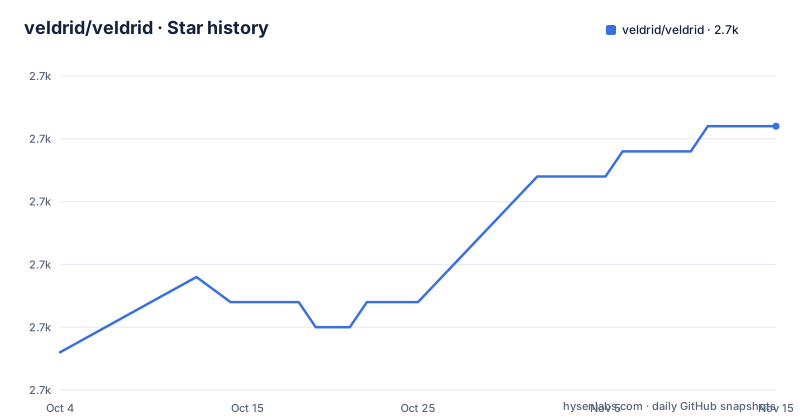
Star history
- veldrid/veldrid2,713 ★ · +9
| Repository | 2026-10-04 | 2026-11-15 |
|---|---|---|
| veldrid/veldrid | 2.7k | 2.7k |
9 Stars in the last 42 days, measured from the daily GitHub snapshot. Compare with other projects
Editorial analysis
The abandonment notice and the newest release are the same month
The README opens with a paragraph and then an italicised one that changes how everything after it should be read. The italic paragraph says that as of February 2023 the author is no longer able to publicly share updates to Veldrid and related libraries, and invites active users and past contributors to reach out or join the Discord server for information about the status of Veldrid. The release list lines up with that sentence rather than contradicting it: the newest tag is v4.9.0, published 2023-02-03. So the last public package was cut in the same month the author stopped publishing them. Of the three releases listed, two are from 2018, v4.2.0 in May and v4.3.3 in July, and the third is the 2023 one, so the visible history is two old points and a final one. The naming is not uniform either: v4.9.0 repeats its tag as the release title, v4.3.3 is titled Veldrid 4.3.3, and v4.2.0 carries no separate title at all.
Work continued on the default branch for three years after the last release
The repository is not archived, and its last push is dated 2026-03-17. That is roughly three years after the February 2023 notice and three years after the last published package. So the distinction that matters to anyone depending on Veldrid is not whether the code moved but whether anything reached a consumer. Commits land on the default branch, which is master, and NuGet keeps serving v4.9.0 from February 2023. A project that installs the package by name gets the 2023 build no matter what the branch looks like now. The repository state is also why the README still reads as it does: the notice is not an archived banner added by GitHub, it is a paragraph the maintainer wrote into the file, which is why the file can describe itself in the present tense, listing backends and pointing at documentation, while the same file says in italics that updates are no longer being shared. Nothing in the repository reconciles those two registers, and no release notes explain what the post-2023 commits changed.
Five backends, and that list is the entire platform specification
The backend list is the most concrete thing in the README: Direct3D 11, Vulkan, Metal, OpenGL 3 and OpenGL ES 3. Those five names span three different platform families rather than five interchangeable options on one machine. Direct3D 11 is the Windows path, Metal is the Apple path, OpenGL ES 3 is the mobile and embedded path, and Vulkan and OpenGL 3 cover the desktop remainder. That is what graphics API-agnostic means here in practice: one interface, several vendor and platform implementations, and the same application source choosing whichever the host offers. It also means the list is a hard boundary. Whatever the abstraction does not name, it does not cover, and no Direct3D 12 entry appears among the five, so a machine whose only modern path is that one is outside the scope of the library as described. There is no fallback story in the file either: no ordering of preference between backends, no statement about which one is chosen when several are available, and no minimum OS or driver version for any of them.
The strongest claim in the file is the one with no comparison behind it
The opening paragraph describes Veldrid as giving a unified interface to a system's GPU, says it can be used to create high-performance 3D applications that are truly portable, and claims more advanced features than any other .NET library. None of those three claims is attached to anything you could check. The feature claim names no library to compare against, no feature that the others lack, and no measurement. The performance claim has no figure and no condition. The portability claim rests entirely on the five-name backend list, which is the one part of the paragraph that is specific. This is worth noting because of what the rest of the file looks like: after that paragraph there is a notice, five backend names, two links, a build section of two sentences and one demo program. A README that short has no room for a feature table, and it has none. The result is a file whose single largest claim, that it exceeds every other .NET library on features, is the only statement in it that no reader can verify from the page or the repository.
The docs site and the pre-release feed both sit on one personal account
Three hosting identities are in play. The repository itself is under the veldrid organisation, and the homepage field points at veldrid.dev. The documentation link in the README goes somewhere else entirely, to a GitHub Pages site at mellinoe.github.io/veldrid-docs. The pre-release packages go somewhere else again, to a MyGet feed at myget.org/feed/mellinoe/package/nuget/Veldrid, with stable packages on NuGet under the name Veldrid. So the published artifacts are split across a package registry, a personal GitHub Pages site and a personal MyGet feed, and the only one of the three under the project's own organisation is the code. The repository root also carries a NuGet.Config, which is where restore sources for the whole tree are decided, so the pre-release feed is wired in at the repository level rather than per project. If one person's account is what holds the documentation and the prerelease packages, then both of those links share a single point of failure, and neither is versioned alongside the tags.
The build section is two commands and one demo program
Everything the README says about building is this: Veldrid uses the standard .NET Core tooling, install the tools and build normally with dotnet build, then run the NeoDemo program to see a quick demonstration of the rendering capabilities of the library. That is the entire procedure, with no configuration step, no runtime requirement and no platform matrix, which is what you would expect from a library that wraps native APIs behind a managed interface. The demo program is the only executable the file names, and the repository tree offers no place to look for it beyond src/. There is one source directory at the root and no samples, examples or demos directory beside it, so NeoDemo lives inside the source tree rather than in a folder of its own, and the README's build section doubles as the only pointer to any sample code in the project. Nothing here describes how to choose a backend at startup, which is the first question any application built on this library would have to answer.
Packaging is three root scripts, one per platform, with no shared entry point
The repository root has 13 entries, and 11 of them are files. Three of those files are build scripts: build-packages.cmd for Windows, build-packages.sh for Unix shells, and ci-build.cmd for the pipeline. Three scripts means packaging is not one cross-platform command, and the one that produces packages locally depends on which operating system you are on, while the CI variant is separate again. Two more root files carry the versioning story. version.json declares the version for the build, and Directory.Build.props applies settings to every project in the tree without each project file importing anything itself, which is the MSBuild mechanism that lets one file govern all of src/. The rest are ordinary: an .editorconfig, a .gitattributes, a .gitignore, a LICENSE, the README and the NuGet.Config mentioned earlier. There is no solution file or project listing at the root, so the shape of the build is discovered from Directory.Build.props and from the single source directory rather than from anything a newcomer reads first.
Editorial conclusion
Veldrid makes sense if you are maintaining code that already targets it, or porting from it, because the abstraction is real: one interface over Direct3D 11, Vulkan, Metal, OpenGL 3 and OpenGL ES 3, published on NuGet and buildable with dotnet build. It is a poor choice for a new project that needs someone else to fix the abstraction when a driver or a new graphics API arrives, because the newest release is v4.9.0 from 2023-02-03, the README says public updates ended that same month, and the status question is answered by a Discord invite rather than a document. Check three things before you commit. That the five backends include the one you need, since the list is the whole specification. That the documentation site and the MyGet pre-release feed still resolve, since both sit on one personal account rather than the project organisation. And what your dependency actually resolves to, since the repository's last push is 2026-03-17 while nothing newer than v4.9.0 has been published.
Frequently asked questions
What is Veldrid used for?
It is a cross-platform, graphics API-agnostic rendering and compute library for .NET that presents a unified interface to a system's GPU. The named backends are Direct3D 11, Vulkan, Metal, OpenGL 3 and OpenGL ES 3, and it ships on NuGet as Veldrid.
Is Veldrid still being updated?
The README states that as of February 2023 the author is no longer able to publicly share updates to Veldrid and related libraries, and the newest release is v4.9.0 from 2023-02-03. The repository is not archived and its last push is dated 2026-03-17, so the default branch moved without a new published package.
Which graphics backends does Veldrid support?
Five are named: Direct3D 11, Vulkan, Metal, OpenGL 3 and OpenGL ES 3. That list is the whole specification, so anything not in it, including a newer Direct3D version, is outside what the library covers.
How do I build Veldrid and try it out?
The build section says Veldrid uses the standard .NET Core tooling, so you install the tools and build normally with dotnet build. The only program named is NeoDemo, described as a quick demonstration of the rendering capabilities. Stable packages are on NuGet and pre-release builds come from a MyGet feed.
Official sources
Add this badge to your README
If you maintain this project, the badge below links readers to this analysis and shows its maintenance status from the daily GitHub snapshot. Paste the markdown into your README; add ?metric=license or ?metric=stars to the image URL for a different field.

[](https://hysenlabs.com/projects/veldrid-veldrid)Star history chart for your README
[](https://hysenlabs.com/projects/veldrid-veldrid)Was this useful?