Virtual AGC derives 3840 bytes of RAM from 2048 words of 15 bits, and its only release tag is a date from 2022
Virtual Apollo Guidance Computer (AGC) software
At a glance
- What is it?
- Virtual AGC holds assembly source for the Apollo Guidance Computer as it flew, with an assembler, a CPU simulator and simulated peripherals including the DSKY, plus the abort computer and minimal material for the Saturn and Gemini computers. The build badge was deleted because the CI vendor dropped its free tier, the container image builds from someone else's prebuilt layer, and the licence field reports nothing.
- Who is it for?
- Use Virtual AGC if you want to read or run the software that actually flew, not a reconstruction, and if you can accept a build that is four systems deep and a project that spans several branches rather than one repository root. The reason to read it is the material itself: source transcriptions for many missions, an assembler, a CPU simulator and the peripheral simulation, which together let you feed a real Apollo program the same inputs the hardware saw.
- Can I use it commercially?
- Check first. The repository uses a licence we do not classify automatically, so read its LICENSE file before any commercial use.
- Is it still maintained?
- Yes. The repository last received commits 1 day ago.
- What is it written in?
- Mainly Assembly, according to GitHub's language statistics.
Answers come from the project's GitHub data, last synced on November 24, 2026, and from our analysis. They are not legal advice.
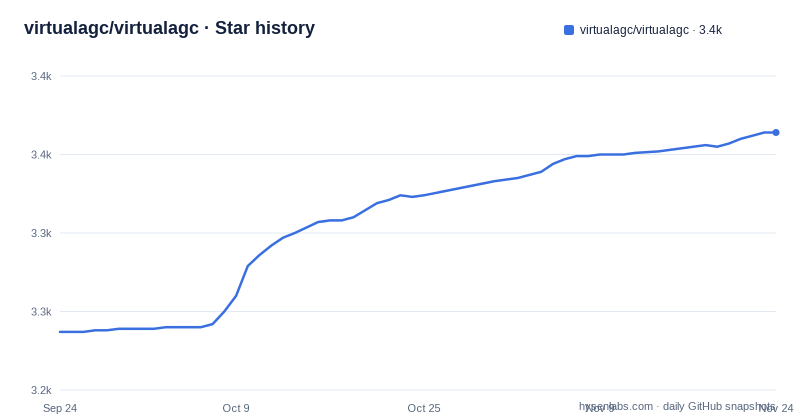
Star history
- virtualagc/virtualagc3,364 ★ · +127
| Repository | 2026-09-24 | 2026-11-24 |
|---|---|---|
| virtualagc/virtualagc | 3.2k | 3.4k |
127 Stars in the last 61 days, measured from the daily GitHub snapshot. Compare with other projects
Editorial analysis
The build badge was deleted because the free CI tier went away
The first thing in the file is an HTML comment that has been commented out on purpose.
It explains that Travis CI no longer has a build tier that is free for open source, so the build-status display was removed. What remains underneath is the old table: a heading for build status, a single row for Travis CI on Linux, and the badge and branch links that used to render there.
So the file carries a visible scar where the CI integration used to be. The reason is stated plainly rather than implied, which is more than most projects manage, and the `.travis.yml` is still at the root of the repository even though nothing displays its result.
That combination is worth knowing before you judge the project's health from its README: the absence of a badge here means the badge was taken down on purpose and for a stated reason, not that the project never had one. The repository is not archived and the last push to the master branch is dated 2026-10-03.
The container image starts from someone else's prebuilt layer
The Dockerfile does not begin from a toolchain. It begins from an image someone else already built.
FROM jlawton/virtualagc
RUN mkdir /virtualagc
COPY . /virtualagc
RUN cd virtualagc && make clean
RUN cd virtualagc && make yaLEMAP yaAGC yaAGS yaYUL missions corediffs
The base image is named after the maintainer line the file carries, and the build copies the current directory over it and runs a clean followed by a six-target build. Those targets are the emulators and utilities, and the naming tells you how many machines are being modelled: one for the guidance computer, one for the abort computer, one for the launch escape motor, and the rest of the set for the Apollo 11 era tooling.
Two details in the same file are worth pausing on. There is a commented-out `git clone` line pointing at a GitHub account that is not the project organisation, so the commented path would fetch a different copy of the same project than the one you are building. And the base image is a moving target in the sense that its contents are whatever that image holds, not what this file declares.
One release, and its name is a date
The repository has a single GitHub release, and the tag is not a version number.
It is `20221005`, published on 2022-10-05, four years before the last push to the default branch.
A date-named tag tells you something a semantic version cannot: this project tags snapshots when it publishes rather than versioning an API. There is no claim about compatibility between releases, because a date is not a promise about anything except the day.
That choice makes the gap between the tag and the branch the thing to measure. Code has landed on master in the four years since, and none of it is reachable through a release. If you need a fixed point, the tag is a snapshot from October 2022 and the branch is whatever the current commit is; the changelog in the makefile comments is the closest thing to a record of what happened between them.
Three makefiles, a CMake build, two Dockerfiles and a shell script
The root of the repository is where the build sprawl is visible.
There is a Makefile, a Makefile.inc and a Makefile.yaAGC, a CMakeLists.txt with a CMakePresets.json beside it, a Dockerfile and a Dockerfile.dev, a Docker directory and a BuildBox.sh. An Eclipse project file sits there too, alongside a leftover Travis configuration.
The makefile's own header explains its age. It carries a copyright line running from 2003 through 2022, names one author, states the project is free software under the GNU General Public License version 2 or later, and then continues into a modification log in comments that starts in October 2003 and, in the visible portion, runs month by month through 2004.
What none of these files does is tell you which one is current. Four build descriptions for one project is a maintenance question rather than a build question, and the answer is not in the README.
Mission directories are a software prefix and a revision number
Most of the top-level entries are directories named for a flight software version, and the naming is systematic once you see it.
One prefix appears at revisions 069, 096, 097, 098, 099, 116, 130, 131, 163, 173, 178 and 210. Another appears at 044, 045, 051, 055, 067 and 072. A third appears twice, at 237 and 249. Then there are single entries and pairs: Artemis at 071 and 072, Aurora at 12 and 88, and one-offs such as Borealis, Corona261, FP6, FP8 and ASM101S.
Suffixed revisions mean multiple versions of the same program are kept side by side, which is what makes it possible to read what changed between two flights rather than only what the latest one did.
Not every directory is flight software. ControlPulseSim, MessageBox, Pultorak-Simulator-1.16, PTC-ADAPT-Self-Test-Program and GeminiCatchUpandRendezvousProgram are tools and extra programs, so the root mixes the archive with the laboratory that runs it.
3840 bytes of RAM comes from 2048 words of 15 bits
The hardware section does its own arithmetic, and it is worth following because the unit is not a byte.
The AGC had 2048 words of RAM. A word was 15 bits of data, described as just under two bytes, so the total RAM was 3840 bytes. Read-only memory was 36,864 words, equivalent to 69,120 bytes. Execution topped out at about 85,000 CPU instructions per second.
The physical figures are given in both units too: dimensions of 24.250 by 12.433 by 5.974 inches, listed as 61.595 by 31.580 by 15.174 centimetres, and a weight of 70.1 pounds, or 31.8 kilograms. Power was 2.5 amps at 28 volts DC.
Against that, the file makes a point about capability rather than capacity. It is described as severely underpowered by modern standards, notes the quip that the machine was more like a calculator than a computer, and then rejects that reading as underestimating its sophistication, offering multi-tasking as the counter-example.
One DSKY in the Lunar Module, two in the Command Module
The Display and Keyboard unit is the astronaut's only way into the computer, and the two spacecraft were fitted differently.
The Lunar Module had a single DSKY, positioned between the two astronauts so either could operate it. The Command Module had two. One of them was the main control panel; the other sat near the optical equipment used to mark positions of stars and other landmarks.
So the same software ran against a different number of human interfaces depending on which spacecraft it was flying, which is a detail the simulated peripherals have to reproduce rather than abstract away.
The specification list for the unit gives dimensions of 8.124 by 8.000 by 6.91 inches, quoted as 21.635 by 20.320 by 17.551 centimetres, and a weight of 17.8 pounds, or 8.1 kilograms. In the inch list the second figure is written without its closing quote mark, so the line reads 8.000 where its neighbours read 8.124 and 6.91. It is a small blemish in an otherwise carefully dual-united list.
Three licence files and a metadata field that reports nothing
The licence position needs reading rather than assuming.
The repository metadata reports no recognised licence. The root contains a file named COPYING and a second one named LICENSE.txt. The makefile header states that yaAGC is free software under the GNU General Public License, version 2 of the licence or, at your option, any later version, and names its author.
Those statements are compatible with each other, but the metadata field does not reflect any of them, so a tool reading only the metadata will conclude the project has no licence. Read the files.
The content itself makes the same point from another angle. The README describes the AGC source as open source precisely so it can be studied or modified, and states that the project models the inner workings of the machine rather than its superficial behavioural characteristics. The sentence making that distinction is the last one in the file, and it stops mid-word.
Editorial conclusion
Use Virtual AGC if you want to read or run the software that actually flew, not a reconstruction, and if you can accept a build that is four systems deep and a project that spans several branches rather than one repository root. The reason to read it is the material itself: source transcriptions for many missions, an assembler, a CPU simulator and the peripheral simulation, which together let you feed a real Apollo program the same inputs the hardware saw. Three things to settle first. How you will build it, because the root carries three makefiles, a CMake build with presets, two Dockerfiles and a shell build script, and they are not documented as equivalent. Where the licence actually comes from, because the metadata reports nothing while the root has a COPYING file and a LICENSE.txt and the makefile header states GPL version 2 or later; read the file rather than the metadata. And what you are not getting, since the Saturn Launch Vehicle Digital Computer and Gemini on-board computer material is described as minimal, and the closing sentence of the README explaining what kind of model this is stops mid-word.
Frequently asked questions
What is Virtual AGC?
It is open source software containing assembly-language source transcriptions of the Apollo Guidance Computer program for as many missions as could be acquired, together with the tools to work on it: an assembler, a CPU simulator, and simulated peripherals such as the DSKY. The virtual machine is called yaAGC, and the project website is at ibiblio.org/apollo. The default branch is master and it is not archived.
How much memory did the Apollo Guidance Computer have?
2048 words of RAM, where a word was 15 bits of data, giving a total of 3840 bytes, and 36,864 words of read-only memory, equivalent to 69,120 bytes. Execution was capped at about 85,000 CPU instructions per second. The computer itself weighed 70.1 pounds and drew 2.5 amps at 28 volts DC.
What is a DSKY?
It is the Display and Keyboard unit, the interface that gave an astronaut access to the guidance computer, which by itself was only a box with electrical connections. The Lunar Module had a single DSKY between the two astronauts, while the Command Module had two, one of them the main control panel and the other beside the optical equipment used for marking stars. The unit is listed at 17.8 pounds.
How do you build Virtual AGC?
The Dockerfile runs make clean and then a six-target build covering yaLEMAP, yaAGC, yaAGS, yaYUL, missions and corediffs, starting from a prebuilt base image rather than a toolchain. The root also carries three makefiles, a CMakeLists.txt with CMakePresets.json, a Dockerfile.dev, a Docker directory and a BuildBox.sh, and the README does not say which of these is the supported path.
Does Virtual AGC include software for computers other than the AGC?
Yes, and the file is candid about how much. Source and tools are provided for the very different abort computer that resided in the Lunar Module, and any supplemental material found or created for the Saturn rocket's Launch Vehicle Digital Computer or the Gemini on-board computer is included, though these materials are described as minimal at present.
When was Virtual AGC last updated?
The repository is not archived and the last push to the master branch is dated 2026-10-03. The only GitHub release is the tag 20221005, published 2022-10-05, so the branch is roughly four years ahead of the tag. A Travis CI build badge was removed with a comment explaining that the service no longer has a free build tier for open source, and a .travis.yml file remains at the root.
Official sources
Add this badge to your README
If you maintain this project, the badge below links readers to this analysis and shows its maintenance status from the daily GitHub snapshot. Paste the markdown into your README; add ?metric=license or ?metric=stars to the image URL for a different field.

[](https://hysenlabs.com/projects/virtualagc-virtualagc)Star history chart for your README
[](https://hysenlabs.com/projects/virtualagc-virtualagc)Was this useful?