vuesion: the page says the open-source generation is finished, the description does not
Vuesion is a boilerplate that empowers product teams to build faster with modern best practices across engineering and design. It features a full-stack framework, comprehensive design system, robust testing, and seamless internationalization.
At a glance
- What is it?
- Vuesion 5 is a Vue and Nuxt boilerplate that shipped with a design system, a test suite, code generators and a database layer, and the repository now says plainly that it will receive no further features or maintenance. What is left is a well-built reference under a permissive licence, described on its own front page as the last open-source generation of a product that now lives elsewhere.
- Who is it for?
- Adopt this if you want to read a finished, opinionated Nuxt starting point rather than follow an active project, and expect to do the upgrade work yourself: the framework version, the linter and the test tooling in here will all age without a maintainer patching them. Two things to check before you build on it.
- Can I use it commercially?
- Yes. MIT is a permissive licence: you can use, modify and sell software built on it, as long as you keep its copyright and licence notices.
- Is it still maintained?
- Yes. The repository last received commits 32 days ago.
- What is it written in?
- Mainly Vue, according to GitHub's language statistics.
Answers come from the project's GitHub data, last synced on November 24, 2026, and from our analysis. They are not legal advice.
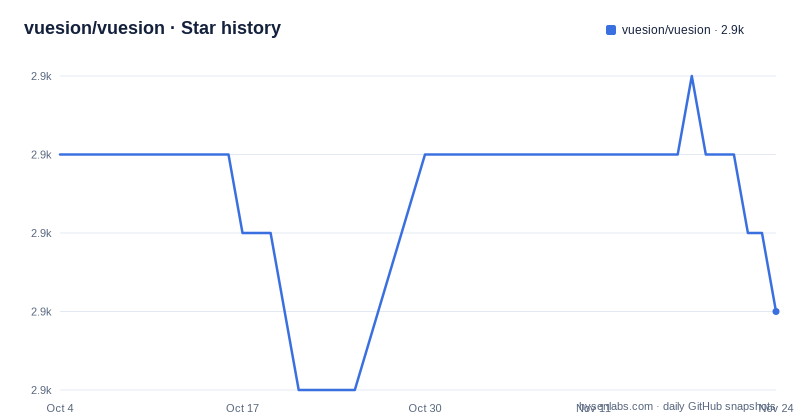
Star history
- vuesion/vuesion2,870 ★ · -2
| Repository | 2026-10-04 | 2026-11-24 |
|---|---|---|
| vuesion/vuesion | 2.9k | 2.9k |
-2 Stars in the last 51 days, measured from the daily GitHub snapshot. Compare with other projects
Editorial analysis
The banner and the repository description tell opposite stories
The first thing the page does is withdraw the project from its own description. A block quote at the top states that this repository holds the original open source version, that Vuesion has evolved into a commercial product foundation, that active development continues on the vendor's own site, and that the repository will remain available as a reference under the MIT licence but will no longer receive new features or ongoing maintenance. A second section repeats it: version 5 is the last open-source generation, it represents years of development and community contributions, and it stays publicly available for existing users and for anyone interested in the project's history. Against that, the one-line description that search results and package listings show still describes it as a boilerplate that helps product teams build faster, with a design system, testing and internationalisation. The recorded homepage for the repository is a blog post explaining why the project is no longer open source. So the metadata and the front page are answering different questions, and only one of them is current.
What eight years of iteration left behind, feature by feature
The feature list is the inventory of that history, and it is unusually complete for a boilerplate. Rendering is covered in three modes through Nuxt, from server-side to a static site. The design system is described as fully customisable with more than thirty-five components, naming layout, typography, button, input, select, checkbox, radio, sliders and toggle, plus theming and whitelabel support, and it is published as a Figma kit as well. Around that sit the pieces a product team usually assembles separately: search engine support, internationalisation, an authentication module, a progressive web app module, form validation, and an animation library integration. Storybook comes with six add-ons covering accessibility, actions, console output, link checking, source display and viewport switching, plus a theme switcher. And there are generators, five of them, for components, pages, forms, stores and REST APIs, which is the feature most likely to age badly since a generator is coupled to the framework version it was written against.
Testing is the part a new team will feel first
Three layers of testing are configured, and the page quantifies only one of them. End-to-end tests run on one browser automation framework, unit tests on another, with a testing library layer on top to encourage habits rather than just provide assertions, and the page claims more than two hundred and fifty example tests are included. Two hundred and fifty example tests is the number that matters, because it means the repository is not asking a new team to invent its own test approach from nothing. It also means the example suite has to keep passing as the framework underneath moves, and that is precisely the work the banner says will not happen. A team picking this up today inherits a large, opinionated suite written against a specific combination of framework and linter versions, plus a Cypress configuration and a Vitest configuration, and inherits the job of keeping them current. The lint command is worth knowing too: it both fixes and checks in one pass, so running it changes files.
Generators are driven by templates in a directory, not by the framework
The code generators are the part of the boilerplate that will age fastest, and they are worth understanding structurally. Five generator commands are wired up, one each for components, forms, stores, pages and REST APIs. They are not built into the framework: a small configuration file at the root registers a code generation tool, and a directory of templates holds the files each generator writes. That is the right design for a boilerplate, because the templates are readable and editable, and it is also why they need care now. A generator encodes the conventions of the framework version it was written for. When the underlying framework changes its conventions, the templates keep producing old shapes, and the page offers no compatibility statement about that. If you adopt this, treat the generators as files you own rather than as tooling you keep, and expect to update them by hand.
The database layer is a real dependency, not an example stub
What started as a front-end and design-system boilerplate has grown a persistence layer, and that is the most consequential thing in the repository for anyone starting a new product. A schema tool with its own root directory and its own migrations is present, along with a seed script and a client generator, and the script list exposes the full cycle: reset the database, apply a development migration, apply migrations in deployment mode, push the schema without a migration, generate the client, and seed. The development, test and storybook scripts all set a full internationalisation data environment variable pointing into installed modules, which is the usual workaround for getting complete locale data without rebuilding Node itself. Authentication is a third-party module with its own origin and secret environment variables, and the container recipe shows both of them being set. So the boilerplate now assumes a relational database, an authentication scheme and a set of secrets, which is a much heavier starting point than the design-system-first framing suggests.
The container recipe copies a Storybook it never builds
The Dockerfile is worth reading for what it reveals rather than for how to use it. The comment above the copy step explains that the Storybook should be built before the image is created and copied into the public folder so the framework picks it up during the build. The instruction that follows does not build it. It copies a directory that has to exist already, so a build on a clean checkout fails at that step unless someone ran the Storybook build first outside the container. Two more choices stand out. The build stage installs dependencies with a permissive install rather than the locked one, then deletes the installed tree and reinstalls from the lock file without development dependencies, which is a roundabout way of getting a production-only tree. And it fetches a module-pruning tool from a URL and pipes the download into a shell, the same pattern the page's own install instructions would warn a careful reader about.
Example credentials and secrets are committed in the container comments
The top of the Dockerfile is a how-to section with two ready-made command lines, one for building and running the image and one for running it locally without a container. Both embed the same values: a database URL with a username and password of postgres, an authentication origin pointing at a local address, and an authentication secret given as a literal bracketed identifier. Those are example values, which is normal in a boilerplate, and they are still committed values that a reader will copy. Two details make that worth flagging rather than waving through. The secret is a fixed string, so anyone who deploys without replacing it has published the same signing secret as everyone else who copied the line. And the file ends with commented-out helper commands, including one that resets and reseeds the database in a single line, which is the kind of convenience that belongs nowhere near a production shell history. Replace both values before the first run, not after the first incident.
Editorial conclusion
Adopt this if you want to read a finished, opinionated Nuxt starting point rather than follow an active project, and expect to do the upgrade work yourself: the framework version, the linter and the test tooling in here will all age without a maintainer patching them. Two things to check before you build on it. What the version numbers actually mean, since the manifest sits at the last tagged release and the newest tags stopped more than a year before the branch was last touched. And what the build expects of you, because the container recipe assumes a Storybook has already been built and it fetches a pruning tool by piping a download into a shell. The database and authentication defaults in the container comments are example values, so replace them rather than copy them. The default branch was last pushed on 2026-08-18 and the newest release is v5.4.0 from 2025-06-09.
Frequently asked questions
Is Vuesion still being developed?
Not here. The page states that this repository holds the original open source version, that Vuesion has evolved into a commercial product foundation, that active development continues on vuesion.dev, and that this repository will remain available as a reference under the MIT licence but will no longer receive new features or ongoing maintenance. The newest release tag is v5.4.0 from 2025-06-09, while the default branch was last pushed on 2026-08-18.
What does the Vuesion 5 boilerplate actually include?
A Nuxt-based application that renders server-side, as a single page app or as static HTML, plus a customisable design system of more than 35 components with theming and a Figma kit, Storybook with six add-ons, search engine support, internationalisation, an authentication module, a progressive web app module, form validation, five code generators for components, forms, stores, pages and REST APIs, a schema tool with migrations and seeding, and three test layers including more than 250 example tests.
Can I use Vuesion 5 in a commercial product?
The code is under the MIT licence and the page says it will remain available that way for existing users and as a reference. The page also states plainly that the project has moved on to a commercial product foundation developed elsewhere, so if you want the actively developed version with new features, that is a separate thing from this repository.
Official sources
Add this badge to your README
If you maintain this project, the badge below links readers to this analysis and shows its maintenance status from the daily GitHub snapshot. Paste the markdown into your README; add ?metric=license or ?metric=stars to the image URL for a different field.

[](https://hysenlabs.com/projects/vuesion-vuesion)Star history chart for your README
[](https://hysenlabs.com/projects/vuesion-vuesion)Was this useful?