Kubernetes-Certified-Administrator: a CKA reading order pinned to Kubernetes v1.35
Online resources that will help you prepare for taking the CNCF CKA 2020 "Kubernetes Certified Administrator" Certification exam. with time, This is not likely the comprehensive up to date list - please make a pull request if there something that should be added here.
At a glance
- What is it?
- A reading order for the CKA exam, assembled from kubernetes.io links and five study documents, with the exam terms pinned to Kubernetes v1.35. It maps the syllabus and schedules the reading; it ships no cluster.
- Who is it for?
- Treat walidshaari's Kubernetes-Certified-Administrator as a reading order, not as an authority. The objectives it annotates belong to the CNCF curriculum PDF, and every task link ends on kubernetes.io, so the repository earns an afternoon of preparation time for the troubleshooting symptom table, the misconception file and the exam-day tactics.
- Can I use it commercially?
- Yes, with credit. CC-BY-SA-4.0 allows commercial use as long as you credit the authors and indicate what you changed. It is written for creative content, so check how it applies to any code.
- Is it still maintained?
- Yes. The repository last received commits 58 days ago.
- What is it written in?
- Mainly Shell, according to GitHub's language statistics.
Answers come from the project's GitHub data, last synced on November 14, 2026, and from our analysis. They are not legal advice.
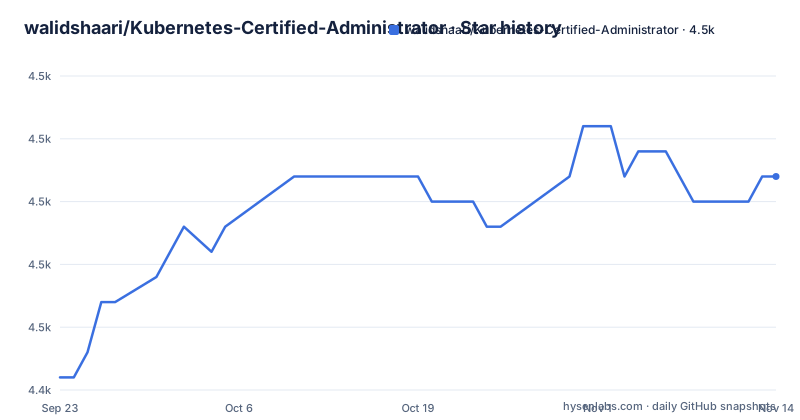
Star history
- walidshaari/Kubernetes-Certified-Administrator4,456 ★ · +8
| Repository | 2026-09-23 | 2026-11-14 |
|---|---|---|
| walidshaari/Kubernetes-Certified-Administrator | 4.4k | 4.5k |
8 Stars in the last 52 days, measured from the daily GitHub snapshot. Compare with other projects
Editorial analysis
A reading order for the CKA, not a tool to install
Nobody passes the CKA from a link list, so the useful thing to say about walidshaari's Kubernetes-Certified-Administrator is what kind of artefact it is: a reading order for the exam, assembled around links to kubernetes.io, with no package to install and no cluster to break. The audience is narrow and self-selected. Somebody has already decided to sit the CKA and now needs to know which page answers which objective, in what order, and which Kubernetes version that page should be read against.
The declared primary language is Shell, and no top-level entry explains why. The visible root of the repository is .gitignore, README-ckad.md, README.md, TROUBLESHOOTING.md, docs/, images/, labs/, license.txt and templates/, and labs/ is the only plausible place a script could live. The README's list of study guides does not mention labs/, which leaves the Shell tag unexplained.
For the rules of the exam itself the repository points elsewhere, at the CNCF curriculum repository, and calls that the authoritative source.
Five study documents layered over the objective list
The repository splits its content in two. One half is the exam objectives, a numbered list with kubernetes.io links hanging off each item. The other half is five documents about method, and those are the reason to read the project at all.
docs/MISCONCEPTIONS.md collects the things study material often gets wrong, which is a different job from collecting facts. docs/EXAM-DAY-TACTICS.md handles the mechanics of the test: context switching between clusters, generating YAML, verifying what you generated, and getting value out of the two Killer.sh simulator sessions that come with the exam. docs/STUDY-METHOD.md sets out a learn, break, fix, log loop and points at note templates under templates/. docs/LF-ACE-PATH.md maps the Linux Foundation courses LFS158, LFS253 and LFS258 onto the CKA domains, for readers who want a course route instead of a reading list.
TROUBLESHOOTING.md sits at the root rather than in docs/, and it gets the next section to itself, because it answers to the heaviest domain on the sheet.
Troubleshooting at 30 percent gets its own file
Troubleshooting is the heaviest domain at 30 percent, and TROUBLESHOOTING.md is the only document here carrying a file name of its own instead of a slot in docs/. Its stated contents are four items: a first-moves reflex, a break-and-fix scenario bank, a symptom table, and practice questions tied to that same 30 percent. The symptom table has the longest shelf life, because a table that maps a complaint to a check gives you a starting point instead of a guess.
The scenario bank is the expensive half. A break-and-fix exercise needs a working cluster you are allowed to break, and the repository does not build one for you. labs/ exists at the root of the tree, but the README's list of study guides does not describe it, so assume you supply your own environment before opening that file.
Exam terms pinned to v1.35, two hours, 66 percent
The exam's own terms are pinned in a short table, which is the part of any study plan worth writing down rather than remembering: a Kubernetes v1.35 environment, a two hour limit, a 66 percent passing score, two attempts and two Killer.sh simulator sessions included, and a two year validity window. Here is that table as written:
| Exam environment | Kubernetes v1.35 |
| Duration | 2 hours |
| Passing score | 66% |
| Included | 2 exam attempts, 2 Killer.sh simulator sessions |
| Validity | 2 years |
Version drift is the failure the author names twice, and it is the one thing here a candidate cannot carry in their head. Kubernetes documentation defaults to the newest version, so an API object or annotation read there can differ from the one in the exam environment; the fix is to select v1.35 in the Kubernetes documentation before reading. The exam environment tracks the most recent Kubernetes minor version within roughly 4 to 8 weeks of it, so confirm the number in the CKA/CKAD/CKS FAQ and on the CKA certification page before you book anything.
The syllabus moved while the domain weights did not
Here is the detail a skim misses. The repository states that the domain weights are unchanged, and the numbers are the ones the previous generation of study notes was built on: Troubleshooting 30 percent, Cluster Architecture 25 percent, Services and Networking 20 percent, Workloads and Scheduling 15 percent, Storage 10 percent. Underneath those frozen percentages, the objectives moved a long way.
Helm and Kustomize are now an explicit hands-on Cluster Architecture item rather than an awareness bullet filed under Workloads. CRDs and operators are new, and the expectation is that you install and configure an operator. Extension interfaces, meaning CNI, CSI and CRI, form a new concept item that absorbed the old networking bullet about choosing an appropriate CNI plugin. Gateway API is new under Services and Networking, sitting alongside Ingress rather than replacing it. Network Policies are now called out as something you define and enforce, where they were not listed for CKA at all. HorizontalPodAutoscaler is new under Workloads and Scheduling, and pod admission and scheduling replaces the narrower line about resource limits affecting scheduling.
The dropped bullets matter as much. Provisioning underlying infrastructure became preparing it, host networking configuration on cluster nodes is gone, and the standalone know how to scale applications bullet was folded into autoscaling. Notes written against the older objectives send you after node networking the current sheet no longer asks for.
Kubernetes.io everywhere, with Helm docs and one video
The stated selection rule and the file disagree, which is worth knowing before you treat the repository as a closed whitelist. The author says cross references were restricted to kubernetes.io and that YouTube videos and blog posts are optional. The Cluster Architecture section heading is itself a YouTube link, and the Helm item is openly marked as a non-kubernetes.io resource while pointing at helm.sh. Almost everything else stays on the documentation site.
That documentation is dense where the exam is dense. Under Cluster Architecture, worth 25 percent, one bullet on RBAC carries ServiceAccounts, configuring a Pod to use one, and checking API access with `kubectl auth can-i`. Another prepares the infrastructure for installing a cluster, with container runtimes broken into cgroup driver, required ports, kernel modules and sysctls. A third covers creating and managing clusters with kubeadm, with `kubeadm init` and `kubeadm join` on the reference pages, then the lifecycle of a cluster: upgrading Linux nodes, certificate management with kubeadm, and operating etcd clusters for backup and restore. A fourth is the highly available control plane, where the topology choice is stacked versus external etcd. Helm and Kustomize close the list as a way to install cluster components.
No install step, so the first pass is a reading pass
There is nothing to install. The visible root carries no package manifest, no build script and no container image, so the content is markdown on the default branch main, and reading it is the whole setup. Open the objective list first, because the domain weights decide where your hours go, then the method documents. These five files are the ones that are not links out to kubernetes.io:
TROUBLESHOOTING.md
docs/MISCONCEPTIONS.md
docs/EXAM-DAY-TACTICS.md
docs/STUDY-METHOD.md
docs/LF-ACE-PATH.md
One trap for anyone arriving from the CKAD track. README-ckad.md sits beside README.md at the root. Check which file you are reading before you plan around it. The exam-day document also covers using the simulator sessions, which come with the exam rather than shipping in this repository.
Where this list stops and the curriculum takes over
The repository states its own hierarchy plainly: the CNCF curriculum repository is the authoritative source, and the current file, CKA_Curriculum_v1.35.pdf, is linked rather than copied. That is the real difference in approach. The curriculum PDF defines what the exam tests and revises on its own schedule; this repository adds a reading order, a troubleshooting file with a symptom table, and a version reminder, and every task link underneath resolves to kubernetes.io. Take the PDF for the rules.
The identity around the content has not kept pace with it. The project description still frames the list around the CKA 2020 exam. The last push landed on 2026-09-18, and the only recorded release, cka-initial-release carrying the name CKA-v1.18, still dates from 2020-08-20, while the study material targets Kubernetes v1.35 for the September 2026 exam environment. Everything published here sits under CC-BY-SA-4.0, so an adapted guide keeps the attribution and passes the same terms on. Judge the files, not the metadata around them.
Editorial conclusion
Treat walidshaari's Kubernetes-Certified-Administrator as a reading order, not as an authority. The objectives it annotates belong to the CNCF curriculum PDF, and every task link ends on kubernetes.io, so the repository earns an afternoon of preparation time for the troubleshooting symptom table, the misconception file and the exam-day tactics. It is the wrong tool if you need a cluster to break or a question bank beyond what TROUBLESHOOTING.md carries. Check the exam environment version in the Linux Foundation FAQ and on the certification page before you plan around v1.35.
Frequently asked questions
Is the CKA hard to pass, judging by walidshaari's Kubernetes-Certified-Administrator?
The repository reports no pass rate and no difficulty figure. What it pins down is the shape of the test: two hours, a 66 percent passing score, two attempts with two Killer.sh simulator sessions included, and five domains weighted 30, 25, 20, 15 and 10 percent.
Is a certified Kubernetes administrator worth it, according to this CKA resource list?
The repository makes no claim about pay or career value, since it is a reading list. It states the certificate's own terms, a two year validity window and two included attempts, and for a structured route it points at the Linux Foundation courses LFS158, LFS253 and LFS258 mapped to the CKA domains.
How much does the CKA exam cost, and does Kubernetes-Certified-Administrator say?
The README's exam table quotes no price. It does state what a seat includes, two exam attempts and two Killer.sh simulator sessions, and it sends readers to the Linux Foundation CKA certification page for the current terms.
What is a certified Kubernetes administrator, in this repository's terms?
Someone who administers a cluster under exam conditions: RBAC and ServiceAccounts, cluster preparation and lifecycle work with kubeadm, etcd backup and restore, workloads, storage, networking and troubleshooting. The repository treats the CNCF curriculum file CKA_Curriculum_v1.35.pdf as the authoritative definition of that scope.
Official sources
Add this badge to your README
If you maintain this project, the badge below links readers to this analysis and shows its maintenance status from the daily GitHub snapshot. Paste the markdown into your README; add ?metric=license or ?metric=stars to the image URL for a different field.

[](https://hysenlabs.com/projects/walidshaari-kubernetes-certified-administrator)Star history chart for your README
[](https://hysenlabs.com/projects/walidshaari-kubernetes-certified-administrator)Was this useful?