programming-principles: one readme, four ranked categories, and testing ranked last
Categorized overview of programming principles & design patterns
At a glance
- What is it?
- A repository whose entire content is a single Markdown document collecting programming principles into four ordered categories, with a definition, a rationale and links per entry. It states up front that the list is incomplete and that principles can conflict, then resolves every conflict by rank rather than by argument, which is why testing sits at the bottom.
- Who is it for?
- programming-principles fits a developer who wants one page to hold a shared vocabulary for design review, and it does not fit a team looking for primary sources or for a list that resolves its own contradictions. Four things to know before adopting it as a reference.
- Can I use it commercially?
- The repository metadata does not identify a licence. Check the project’s published terms and any component-specific licences before reuse.
- Is it still maintained?
- Yes. The repository last received commits 148 days ago.
- What is it written in?
- GitHub does not report a main language for this repository.
Answers come from the project's GitHub data, last synced on November 24, 2026, and from our analysis. They are not legal advice.
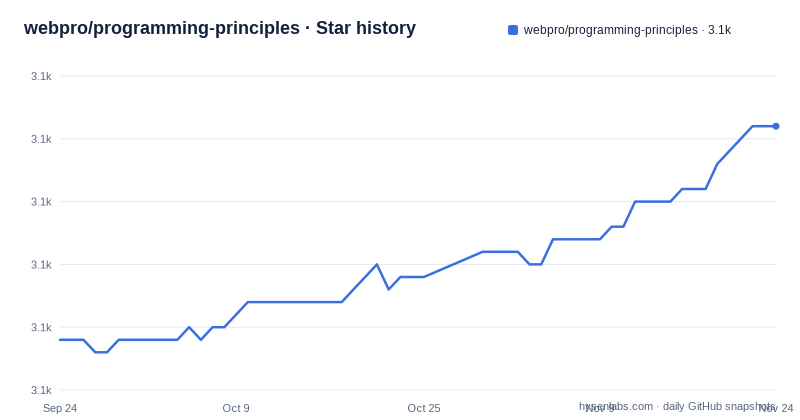
Star history
- webpro/programming-principles3,116 ★ · +17
| Repository | 2026-09-24 | 2026-11-24 |
|---|---|---|
| webpro/programming-principles | 3.1k | 3.1k |
17 Stars in the last 61 days, measured from the daily GitHub snapshot. Compare with other projects
Editorial analysis
The document states its own limits before the first principle
The opening paragraph is four sentences and three of them are caveats. It says every programmer benefits from understanding principles and design patterns, that this overview is a reference for the author and may be of help to you during design, discussion or review, and then that the list is incomplete. It goes on to say that sometimes trade-offs have to be made between conflicting principles, and that higher ranked principles usually beat lower ranked ones. That last sentence is the one that governs the rest of the document, because the contents are grouped into four categories in a fixed order and the order is the ranking. It also names its ancestor, saying the list was inspired by another well known list of principles, with more reasoning, details and links added. So this is a derivative document with a declared gap in it, not a canonical list.
Testing is ranked last of four categories
Reading the contents as a ranking rather than a table of contents produces a defensible hierarchy. General advice comes first, with nine entries running from keeping it simple through not needing it yet, separating concerns, coding for the maintainer, not optimising early, optimising for deletion, not repeating yourself and the boy scout rule. Relationships between modules and classes come second with seven entries, including coupling, the law of Demeter, composition over inheritance and orthogonality. The units themselves come third with eleven entries, among them cohesion, the five classic object oriented principles, and SOLID as a bundle. Testing comes fourth and last, with two entries: the principles that make a good test and the arrange, act, assert shape. Given that the document resolves conflicts by rank, a reader who takes that seriously will find testing losing to almost everything on the page.
SOLID appears as a bundle and as its five parts
The third category lists the substitution principle, the open and closed principle, the single responsibility principle, the interface segregation principle and the dependency inversion principle as five separate entries, and then lists SOLID as one more entry after them. That is the only place in the document where a named acronym sits beside its own components, and it raises a question the text does not answer: whether a reader should apply the bundle or the parts, since the bundle is ranked below the parts in the same category. The category also contains two entries with no expansion line of the kind the first entries have, including a law named after a person whose statement is not quoted in the visible text. The category headings themselves use the same four nouns, so the difference between the second and third categories is the relationships between things rather than the things, which is a useful split but an easy one to conflate when you are looking for where a principle lives.
Optimize for deletion and the boy scout rule pull in opposite directions
The document anticipates this and says so, which is why the internal tensions are worth reporting rather than discovering. The clearest one sits inside the top category. Optimize for deletion says code should be optimised for change, that code which is easy to delete is easy to replace or change, and that the method is not to try to predict future changes today but to focus on deletable and rewriteable code; it then credits separation of concerns, low coupling and the single responsibility principle as things that make code more deletable. The boy scout rule, in the same category, is about leaving code slightly better than you found it on every visit. Those are different relationships with time: one wants code shaped so it can be thrown away, the other wants continuous incremental cleanup of code that stays. The document's answer is that rank decides, and both sit in the same category, so it does not.
Two principles are quoted from named authors; the rest link to blog posts
The evidence behind the entries varies, and the pattern is legible. Two entries quote a named author directly with a date: the 1974 paper on separating concerns, which is quoted at length about it being the only available technique for ordering one's thoughts even when not perfectly possible, and Knuth on optimisation, quoted for the point that programmers waste enormous amounts of time on the speed of non-critical parts, that small efficiencies should be forgotten about ninety seven percent of the time, and that the remaining three percent should not be passed up. The entry then adds its own hedge that understanding what is and is not premature is critical. Everything else links out, and the destinations are consistently secondary sources: an encyclopedia, a principles wiki, two blogs, a conference talk and a video about destroying software. The resources are useful and they are not primary.
The template is applied unevenly, and one entry has no definition
The entries follow a shape: a bold expansion of the acronym, a definition sentence, a rationale in bullets, a method in bullets, and a list of resources with the source named in parentheses. Applying that shape shows the gaps. The simplicity principle has an expansion, a definition, a rationale and five resources. Not needing it yet has an expansion, a rationale, a method and three resources. Doing the simplest thing that could possibly work has no expansion and no definition line at all, only a rationale and a method, and a single resource. Separating concerns has prose instead of a definition, a quotation, a rationale, a method and one resource. So a reader scanning for a definition finds one for most entries and not for others, which is the kind of inconsistency that makes a checklist-shaped document harder to use as a checklist.
The whole project is one readme, a formatter config and a workflows directory
The repository listing holds three things: a workflows directory, a formatter configuration, and the readme. There is no source directory, no test directory, no licence file and no changelog, and no releases have been published. So the document is the entire project, its prose is checked by a formatter, and the terms under which anyone may copy or adapt it are not stated anywhere in the repository. That last point is worth being explicit about for a document whose stated purpose is to be reused during design discussion and review in a team: a principles list is exactly the kind of artefact that gets pasted into an internal wiki, and this one offers no licence to do so. The recorded licence field asserts nothing, which is consistent with there being nothing to assert.
Editorial conclusion
programming-principles fits a developer who wants one page to hold a shared vocabulary for design review, and it does not fit a team looking for primary sources or for a list that resolves its own contradictions. Four things to know before adopting it as a reference. The ranking is explicit and consequential, because the document says higher ranked principles usually beat lower ones, and the lowest category is testing. Most entries link to blog posts, wikis and conference talks, with two exceptions where a named author is quoted directly. The entry template is applied unevenly, so some entries have a definition, a rationale, a method and resources while others have only two of those. And the repository carries no licence file, so the terms for reusing the text are not stated anywhere in it.
Frequently asked questions
What is webpro/programming-principles?
A single Markdown document collecting programming principles and design patterns into four ranked categories, with a definition, a rationale and links per entry. The README describes it as a reference for its author, says the list is incomplete, and says conflicting principles are resolved by rank.
How are the principles ranked in webpro/programming-principles?
By category, and the category order is the ranking: nine general principles first, then seven about relationships between modules and classes, then eleven about those units themselves including SOLID as one entry, and finally two about testing. The README says higher ranked principles usually beat lower ranked ones.
Does webpro/programming-principles include SOLID?
It lists the five object oriented principles separately, from the substitution principle through the dependency inversion principle, and then lists SOLID as a further entry after them in the same category. So the acronym and its components both appear as separate items.
Does webpro/programming-principles contradict itself?
It says up front that the list is incomplete and that trade-offs have to be made between conflicting principles, and resolves them by rank. The clearest internal tension is between optimising code for easy deletion and the boy scout rule, since one advises against predicting future change while the other is a habit of continuous cleanup.
What sources does webpro/programming-principles cite?
Two entries quote a named author directly with a year, a paper on separating concerns from 1974 and Knuth on optimisation with its ninety seven percent framing intact. Most other entries link to secondary sources such as an encyclopedia, a principles wiki, blogs, a conference talk and a video.
Is there any code in webpro/programming-principles?
No. The repository listing holds a workflows directory, a formatter configuration and the readme, so the document is the whole project and its prose is checked by a formatter. There is no licence file, no changelog and no published release.
Official sources
Add this badge to your README
If you maintain this project, the badge below links readers to this analysis and shows its maintenance status from the daily GitHub snapshot. Paste the markdown into your README; add ?metric=license or ?metric=stars to the image URL for a different field.

[](https://hysenlabs.com/projects/webpro-programming-principles)Star history chart for your README
[](https://hysenlabs.com/projects/webpro-programming-principles)Was this useful?