WingedGuardian/GENesis-AGI: a personal cognitive architecture its author calls proto-AGI
'Personal AGI' that thinks on its own. Autonomous cognitive cycle, earned autonomy, 60+ tools. It decides what to do without being told.
At a glance
- What is it?
- A self-hosted Python system that uses Claude Code as its reasoning engine and adds the parts a coding agent lacks: a dual-ego cycle that acts between sessions, four layers of memory, closed-loop learning and autonomy granted per action category and revoked after a failure. The dependency pins are as instructive as the architecture, including a framework held one version back because a later release contained malware.
- Who is it for?
- Read this repository as a serious personal project with a clear-eyed author rather than as a claim about artificial general intelligence, because the README itself rules out the latter in its own words.
- Can I use it commercially?
- Yes. MIT is a permissive licence: you can use, modify and sell software built on it, as long as you keep its copyright and licence notices.
- Is it still maintained?
- Yes. The repository received new commits within the last day.
- What is it written in?
- Mainly Python, according to GitHub's language statistics.
Answers come from the project's GitHub data, last synced on October 22, 2026, and from our analysis. They are not legal advice.
Star history
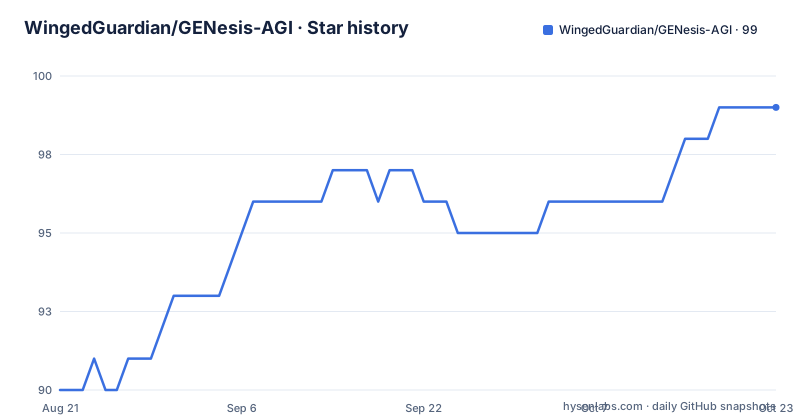
- WingedGuardian/GENesis-AGI99 ★ · +9
| Repository | 2026-08-21 | 2026-10-22 |
|---|---|---|
| WingedGuardian/GENesis-AGI | 90 | 99 |
9 Stars in the last 62 days, measured from the daily GitHub snapshot. Compare with other projects
Editorial analysis
The author rules out the AGI label in the same README
The project is named for the claim, and the first thing the README does with that claim is put it in a collapsible section and walk it back. The author's words: truthfully, no, this is not genuinely AGI in the strict sense. The reasoning is structural. Something resembling true AGI would have to be built from first principles, which would require the orchestration layer, the part that is Genesis, to be pushed down into the LLM layer itself, the most foundational piece of the compute layer. The author goes further and says they are not especially convinced that LLMs are the right architecture for this pursuit at all, but that since the LLM layer cannot be changed and nothing better exists yet, this is the best available today, and asks to be called proto-AGI or even pseudo-AGI. What is claimed instead is that it mimics a lot of the outcomes AGI would need.
litellm is pinned one release behind a supply-chain problem
The dependency list carries a comment that is worth more attention than the architecture claims. `litellm==1.78.7` is pinned to an exact version with the reason written inline: versions 1.82.7 and 1.82.8 contain malware. The comment does not pretend the pinned version is clean, and instead explains the residue: its remaining open advisories are all proxy-server, JWT, OIDC and user-interface vulnerabilities, which are listed in an ignore file in the CI dependency audit and which are not reachable from this codebase, because Genesis only calls the completion and completion-cost entry points. So the pin is a considered trade between an exact known-bad upstream release and a set of unreachable advisories, documented in place rather than discovered later.
The vector client bound is decided by what the installer installs
The Qdrant constraint is a small lesson in coupled versioning. `qdrant-client>=1.15,<1.16` is annotated as having to track the server, and the reason is that scripts/install.sh defaults to installing Qdrant 1.14.0 when no server is present, with QDRANT_VERSION overridable and an existing server of any version left alone. That produces a hard client bound against a soft server default. The ceiling then follows from Qdrant's own rule, checked in the client's version_check module: the same major version with an absolute minor difference of one or less, so a 1.14 server admits anything from 1.13 to 1.15. The floor is set at 1.15 because it is the newest release that rule admits and therefore carries the most fixes. Change the installer default and this line has to move.
aiohttp has a security floor and a test shim
Another dependency is pinned for a security reason rather than a bug. `aiohttp>=3.14.1` is described as a security floor, because that release fixes eleven advisories including a cookie leak on redirect, several denial-of-service issues and multipart header injection. The comment then handles the friction that fix creates: Genesis is client-only, and the change in the client response interface breaks the aioresponses test double used by the observability tests, specifically a mismatch on the stream_writer keyword argument. Rather than pin lower or patch the tests inline, the project absorbs it in a shim in the tests/test_observability conftest file. That pattern, security floor plus a contained compatibility shim, appears again with tzlocal, which is declared even though it arrives transitively through the scheduler, so a cached or clean install cannot drop it from the local-timezone path the cadence code depends on.
The install stops you below 15 GB and calls 8 GB tight
This is described as a full system rather than a pip package, and the requirements table is unusually honest about the edges. The operating system floor is Ubuntu 22.04 with 24.04 LTS recommended, Debian-based being required for the auto-install path while other Linux distributions work through manual setup. Memory is 8 GB minimum and 16 GB or more recommended, because Genesis, Qdrant, Claude Code and background tasks all share the box, and the note says 8 GB is tight under load. The mitigation is that service memory caps are percentage-based, so the system right-sizes itself, scaling down on an 8 GB host and up on a 32 GB one. Disk is 15 GB minimum and 40 GB recommended, where the installer pre-flight check requires 15 GB free and stops below that, with a fresh install around 400 MB and memory, logs and caches growing steadily with use. CPU is 2 cores minimum, 4 to 8 recommended.
Autonomy is per category and the first failure revokes it
The earned autonomy mechanism is the part with the most specific behaviour. Trust is not granted globally or over time; it is granted per action category through demonstrated competence, and the rule for losing it is stated as bluntly as it gets: the first failure triggers demotion. The README's framing is that trust is rebuilt through performance rather than through the passage of time, and that the system can show you the receipts. The release titles track this work. v3.0b16 is titled Earned Email Autonomy, Activity Traces and Self-Experimentation, which reads as a specific capability gaining its own autonomy category alongside the instrumentation to review it. The release cadence itself is irregular, with v3.0b17 in July 2026 and v3.0b18 in September 2026, and the version in pyproject.toml is 3.0.0b18 on a Python 3.12 floor.
A dual-ego cycle and four memory layers
The loop is described as a dual-ego architecture that wakes up, assesses the situation, proposes actions, and then earns the right to execute them, explicitly not waiting for prompts and not following scripts. Memory is four layers rather than one store: essential knowledge, proactive recall, deep search, and a knowledge pipeline, with hybrid retrieval that is said to compound across months rather than across a single conversation. Learning closes the loop with three named steps, outcome classification, causal attribution and procedure extraction, and the README is specific about the arithmetic, Laplace-smoothed confidence rather than vibes. The scale claims are 50 or more subsystems, four MCP servers and two vector databases, with every design decision made by one engineer working across infrastructure, cognition and integration, on top of Claude Code as the reasoning engine. The capability layer is enumerated rather than abstract: 60 or more tools out of the box, covering browser automation, an outreach pipeline, research, content creation, infrastructure monitoring and campaign execution, described as a system that works out of the box rather than a framework you build on. The README also lays out a timeline for what the accumulated context is supposed to buy, from a strong generalist with full cognitive infrastructure on day 1, to a specialist in every touched domain by day 30, to anticipating needs by day 90, to evolving its own architecture by day 180.
The repository carries the artefacts of a running system
The file tree tells you how the project is worked on. There are agent configuration directories for three tools in .claude/, .codex/ and .agents/, plus .serena/, an ignore file for one of them, a .coderabbit.yaml, a .gitleaks.toml and a .gitnexusrc. Two files at the root look like runtime bookkeeping: .genesis-hook-versions and .genesis-source-commit. There is an empty file literally named EMPTY, alongside JOURNAL.md, VERSION, SETUP.md, a CHANGELOG.md and a changelog.d/ directory, plus genesis-container-setup.md for running it in a container. Two example environment files, env.example and secrets.env.example, sit next to each other, and CODEOWNERS, SECURITY.md, CODE_OF_CONDUCT.md, CONTRIBUTING.md and AGENTS.md are all present. Reading that list is a reasonable substitute for a contributor guide when you are deciding whether a project is run by a person or by a pipeline. The published home for the project is a Discord invite rather than a documentation site, and the badge row at the top of the README names the stack it leans on: Claude Code, Node.js, Playwright and Discord. An interactive architecture diagram is kept in docs/genesis-architecture-interactive.html for anyone who would rather see the subsystem map than read the prose.
Editorial conclusion
Read this repository as a serious personal project with a clear-eyed author rather than as a claim about artificial general intelligence, because the README itself rules out the latter in its own words. It is worth your time if you want to see one engineer assemble earned autonomy, four-layer memory and a self-hosted agent loop on top of Claude Code, and if you have the machine to run it on: Ubuntu, 16 GB of memory and 40 GB of disk are the recommended figures, and the installer's pre-flight check will stop you below 15 GB. Before you deploy it, read the three dependency comments in pyproject.toml, since they explain security floors that will otherwise look arbitrary.
Frequently asked questions
How far away is AGI realistically?
The author's own answer in the README is that this project is not it. Something resembling true AGI would need the orchestration layer built into the LLM layer itself, and the author says they are not especially convinced LLMs are the right architecture for the pursuit at all, proposing to call Genesis proto-AGI or pseudo-AGI.
What company is Genesis AI?
This repository is a personal project under the WingedGuardian account rather than a company product, and it positions itself as an open cognitive architecture you clone and run yourself. It uses Claude Code as its reasoning engine and describes itself as not a chatbot and not an API wrapper.
What does GENesis-AGI need to run?
Ubuntu 22.04 or newer, with a Debian-based system required for auto-install, 8 GB of RAM minimum and 16 GB or more recommended, 15 GB of free disk minimum and 40 GB recommended, and 2 CPU cores minimum with 4 to 8 recommended. Python 3.12 or newer is the language floor.
How does GENesis-AGI earn autonomy?
Trust is granted per action category through demonstrated competence rather than over time, and the first failure triggers demotion. Activity traces are part of the same work, with v3.0b16 titled around Earned Email Autonomy, Activity Traces and Self-Experimentation.
Why is litellm pinned in GENesis-AGI?
To the exact version 1.78.7, because versions 1.82.7 and 1.82.8 contain malware according to the comment in pyproject.toml. The remaining advisories on the pinned version are proxy-server, JWT, OIDC and interface issues that the project does not reach, since it only uses the completion and completion-cost entry points.
Official sources
Add this badge to your README
If you maintain this project, the badge below links readers to this analysis and shows its maintenance status from the daily GitHub snapshot. Paste the markdown into your README; add ?metric=license or ?metric=stars to the image URL for a different field.

[](https://hysenlabs.com/projects/wingedguardian-genesis-agi)Star history chart for your README
[](https://hysenlabs.com/projects/wingedguardian-genesis-agi)