Cheat-on-money ships a scam rubric, two list-reading adapters, and a lessons file
An AI-era reliable side-gig discovery and anti-scam verification skill: infers demand signals, checks real-time timeliness, applies an anti-fraud rubric, and uses a personalized calibration loop.
At a glance
- What is it?
- Cheat-on-money is a set of six sub-skills for an AI assistant, written in Chinese and installed into either Claude Code or Codex. Its credibility argument is that it refuses to search for money tips at all, expires sources after 24 months, and prefers to reject a real opportunity over accept a scam. The repository ships no licence, no releases, and a method that lives almost entirely in markdown.
- Who is it for?
- This is a framework rather than a dataset, and it is honest about that. Nothing in it supplies opportunities, so its value depends entirely on whether the assistant can reach live listings, which in practice means two logged-in adapters plus a person passing a captcha by hand.
- Can I use it commercially?
- Not without permission. GitHub finds no licence file in the repository, and without a licence all rights are reserved by default: you may read the code but not reuse it. Check the README, or ask the authors, before using it.
- Is it still maintained?
- Yes. The repository last received commits 164 days ago.
- What is it written in?
- Mainly JavaScript, according to GitHub's language statistics.
Answers come from the project's GitHub data, last synced on November 22, 2026, and from our analysis. They are not legal advice.
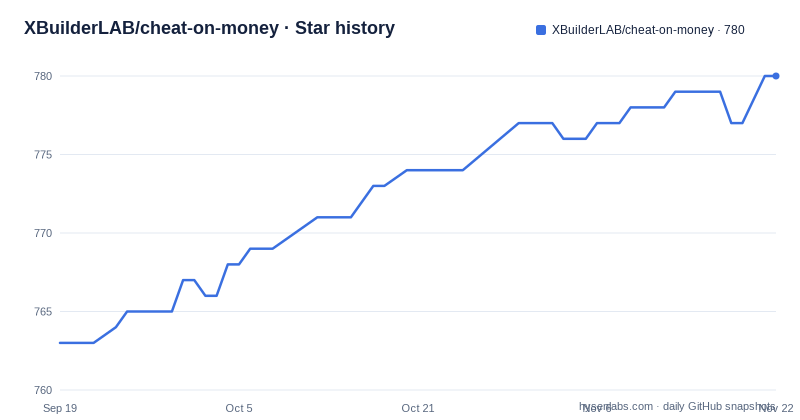
Star history
- XBuilderLAB/cheat-on-money780 ★ · +17
| Repository | 2026-09-19 | 2026-11-22 |
|---|---|---|
| XBuilderLAB/cheat-on-money | 763 | 780 |
17 Stars in the last 64 days, measured from the daily GitHub snapshot. Compare with other projects
Editorial analysis
The search avoids the posts that sell courses
The stated method is to avoid searching for posts about how to earn money, on the grounds that those are the sources a course seller uses to fish for followers. Instead the skills are told to read industry reports, recruitment listings and procurement data, treat them as interest-neutral signals, reason out what an individual could supply from them, and require several independent signals to agree before an opportunity is offered.
Two rules sit on top of that. Sources older than 24 months are treated as expired by default, with the reason given plainly: platform rules change constantly, so an old description of how a platform works is worse than no description. And the model is told not to fall back on its own memory of any of this.
The filter that follows is a rubric with hard red lines, and the stated bias is deliberate: when a rule is ambiguous, reject. The README puts it as preferring a false kill over a missed scam. That is the right default for a tool whose output a person might act on with their own time and money, and it also means the tool will sometimes throw away legitimate work, which is a cost the README does not quantify.
One document decides both search and verification
The mechanism lives in shared reference documents rather than in the prompt, and one of them is load-bearing. `shared-references/anti-scam-rubric.md` holds the scam criteria and the timeliness check, and the README names it as the only standard source for two different sub-skills: `money-verify`, which checks whether a specific opportunity is a scam, and `money-find`, which searches and filters. Both are routed to the same document.
That is a deliberate design and it has a cost. A single source of truth means the rubric is auditable in one place and cannot drift between the search path and the verification path. It also means one edit changes both behaviours at once, and a reader has exactly one document to argue with.
The other four references divide the remaining work. `demand-signal-method.md` holds the four-step reasoning and source tiering that `money-find` uses, `user-tiers.md` defines user tiers T0 through T3 that route by resources times skills and set what each tier is offered, `opportunity-taxonomy.md` is a classification framework and is explicitly not a list of opportunities, and `templates/money-state.template.json` is the state file, at schema version 2, with fields for the tier and for the calibration loop.
The adapters read list pages and stop there
Two adapters supply first-hand data, and both are described as grade B, semi-automatic. The division of labour is deliberate: the person logs in and searches, passing the slide captcha by hand, and the adapter only reads the public listings on the page currently in front of them. That is a workaround for the fact that generic web search cannot get past a login wall.
`adapters/xianyu/` reads the transaction side of a second-hand marketplace, giving what is being sold, at what price, and how many people want it, which the README treats as evidence that someone really paid. `adapters/boss/` reads the recruitment side of a Chinese job board, giving what is being hired, at what salary, and which AI skills are asked for, described as the most honest demand thermometer available.
The restraint is stated with a reason. The BOSS adapter reads search result list pages only, because a list card carries a public job title, salary and company, while recruiter personal information sits on the detail page and in chat. The adapter never touches those, which is why the README says it does not trip red line A6 of the rubric. Both adapters share one Chrome profile, so a single login session serves both, and a single expired session takes both down.
The calibration loop writes lessons.md into the working directory
The improvement mechanism is a closed loop with four steps. `money-plan` records an expectation before any work starts, naming the input committed, the time until the first money arrives, and the income expected. The user then executes. `money-retro` reconciles the actual figures against those recorded expectations. The result is written to `lessons.md` in the working directory, and the next run of `money-find` or `money-verify` reads that file before starting anything.
The predict, review, distil cycle is the most transferable idea here, because it does not depend on the adapters or on the rubric. It also depends on the person filling it in. Nothing in the page checks that `money-retro` is run at all, and an assistant with no retro step quietly runs a system that never corrects itself while still appearing to have a self improvement loop.
Where `lessons.md` lands is worth noting. It goes in the working directory rather than beside the state file, so it is per project and local, and it is not one of the six sub-skills, which means nothing keeps it in sync with the state template.
Tiers decide what a person is offered
User tiers T0 through T3 are the routing layer. `user-tiers.md` sorts a person by resources times skills, and both the opportunities offered and the income expectations attached to them are then given per tier, so a profile with little time and little capital is not shown the same list as one with the reverse.
The inputs for that profile come from `money-init`, which asks five things on first run: skills, available time, funds, region, and whether the work involves appearing on camera. That last one is unusual and deliberate, since a share of the listed work is not available to someone who does not want to be visible.
The part to treat carefully is the income expectation. The README states that expectations are given per tier, and gives no source, no dataset and no method for how a tier maps to a number. For a framework whose whole argument is that credibility should come from mechanism rather than content quality, an unsourced number attached to a tier is the one place the argument is not carried through.
Two installers, two skill directories, one shared payload
Installation is handled twice, for two assistants, and the two layouts differ. For Claude Code, each sub-skill is symlinked into `~/.claude/skills/`, which the README says matches the rest of the cheat series:
cd "$(dirname "$0")" 2>/dev/null
ROOT="$(pwd)"
for d in skills/*/; do
  name="$(basename "$d")"
  ln -sf "$ROOT/$d" "$HOME/.claude/skills/$name"
done
Running `./install.sh` does the same thing. For Codex, `./install-codex.sh` copies each skill into `~/.codex/skills/` and then gives each one a self-contained payload: `SKILL.md`, a `references/` directory holding the shared documents, `templates/`, `examples/` and the `adapters/`. The Claude install stays a set of symlinks into the repository, so edits to the shared documents take effect immediately, while the Codex install is a copy that goes stale until it is rerun.
The page is explicit that the two can coexist, and it flags one compatibility detail: `allowed-tools` in a `SKILL.md` file is a Claude Code permission declaration, and Codex triggers on `name` and `description` alone and ignores the Claude specific fields. Codex also usually needs a restart or a new session before it reads the new skill list.
No licence, no releases, and a root made of shell and markdown
The repository is small and mostly prose. The root holds `.gitignore`, `README.md`, `RELEASE-CHECKLIST.md`, two installer scripts, and the `adapters/`, `examples/`, `shared-references/`, `skills/` and `templates/` directories. The README itself is written in Simplified Chinese, with no English version among the root entries, and the developer documentation for contributors is a checklist file rather than a guide.
Three facts about the repository's state are worth stating directly. There is a `RELEASE-CHECKLIST.md` and no published releases at all. There is no licence: the README does not name one, the repository records no licence value, and no `LICENSE` file appears among the top level entries. And the primary language is recorded as JavaScript while everything visible at the root is a shell script or a markdown file, which places the JavaScript inside the two adapter directories where the browser automation would live.
The last push to the default branch is dated 2026-06-12. The closing notice is the clearest statement of intent in the whole project: it offers a judgement framework and search assistance rather than investment or employment advice, and it puts a hard line under anything involving paying money up front, order brushing, transaction pass-through or lending out an account, all of which it calls a scam or illegal.
Editorial conclusion
This is a framework rather than a dataset, and it is honest about that. Nothing in it supplies opportunities, so its value depends entirely on whether the assistant can reach live listings, which in practice means two logged-in adapters plus a person passing a captcha by hand. Two things to settle before relying on it. Check the licensing first, because the README names no licence, the repository records none, and there is no LICENSE file in the root. Then read the anti-scam rubric yourself rather than through the skill, since that one document is named as the only standard for both the search and the verification path, and a single point of judgement that decides what a person will do with their spare time should not be taken on trust from a prompt.
Frequently asked questions
What is cheat-on-money?
It is six sub-skills for an AI assistant, money-init, money-find, money-verify, money-plan, money-retro and money-status, aimed at finding legitimate part-time work and checking whether a specific offer is a scam. It ships no opportunity list of its own.
How does cheat-on-money decide a source is out of date?
Sources older than 24 months are treated as expired by default, because platform rules change constantly. The timeliness check lives in shared-references/anti-scam-rubric.md, which the README names as the only standard source for both money-verify and money-find.
What data does cheat-on-money actually read?
Two semi-automatic adapters. One reads the transaction listings of a second-hand marketplace and the other reads job board search result pages. You log in and pass the captcha yourself, and the adapter reads only the public listings on the current page.
How do I install cheat-on-money?
For Claude Code, symlink each skill directory into ~/.claude/skills/ with the documented shell loop, or run ./install.sh. For Codex, run ./install-codex.sh, which installs into ~/.codex/skills/ and copies references, templates, examples and adapters into each skill directory. Both installs can coexist.
Is cheat-on-money licensed and released?
The README names no licence, the repository records no licence value, and no LICENSE file appears among the top level entries. The repository holds a RELEASE-CHECKLIST.md but has published no releases, and its last push to the default branch is dated 2026-06-12.
Official sources
Add this badge to your README
If you maintain this project, the badge below links readers to this analysis and shows its maintenance status from the daily GitHub snapshot. Paste the markdown into your README; add ?metric=license or ?metric=stars to the image URL for a different field.

[](https://hysenlabs.com/projects/xbuilderlab-cheat-on-money)Star history chart for your README
[](https://hysenlabs.com/projects/xbuilderlab-cheat-on-money)Was this useful?