RuoYi-Vue ships six Java modules and no Vue at all
Official RuoYi repository: a frontend-backend separated permissions management system built on Spring Boot, Spring Security, JWT, Vue and Element, with a Vue3 version also available.
At a glance
- What is it?
- The repository named RuoYi-Vue is a Spring Boot backend whose three Vue clients live in separate repositories, and whose default branch now targets Spring Boot 4.x while two older branches stay on 3.x and 2.x.
- Who is it for?
- RuoYi-Vue suits teams that want a working Java admin backend with role and data permissions, generated CRUD code and a Chinese-language documentation site, and that can supply their own frontend from the three published clients. It suits teams less well if you need one repository to hold both halves of the stack, or if you are still on JDK 8 and expect the default branch to build.
- Can I use it commercially?
- Yes. MIT is a permissive licence: you can use, modify and sell software built on it, as long as you keep its copyright and licence notices.
- Is it still maintained?
- Yes. The repository last received commits 2 days ago.
- What is it written in?
- Mainly Java, according to GitHub's language statistics.
Answers come from the project's GitHub data, last synced on November 14, 2026, and from our analysis. They are not legal advice.
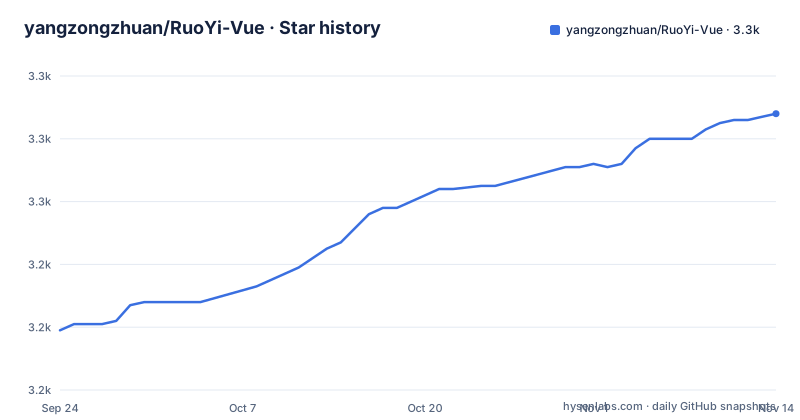
Star history
- yangzongzhuan/RuoYi-Vue3,288 ★ · +69
| Repository | 2026-09-24 | 2026-11-14 |
|---|---|---|
| yangzongzhuan/RuoYi-Vue | 3.2k | 3.3k |
69 Stars in the last 51 days, measured from the daily GitHub snapshot. Compare with other projects
Editorial analysis
The Vue in the name is not in the repository
The name promises a full stack and the tree delivers half of one. At the root of yangzongzhuan/RuoYi-Vue sit six Maven modules named ruoyi-admin, ruoyi-common, ruoyi-framework, ruoyi-generator, ruoyi-quartz and ruoyi-system, alongside pom.xml, a sql/ directory, a doc/ directory, a bin/ directory and two launchers called ry.sh and ry.bat. There is no frontend directory anywhere in that list, and the project says so itself: the branch table is introduced as the RuoYi-Vue backend project. The Vue side is three separate repositories hosted on gitcode.com, named RuoYi-Vue2, RuoYi-Vue3 and RuoYi-Vue3-TypeScript. Anyone who clones the backend expecting a runnable application with a UI will find a server that exposes an API and nothing to look at in a browser. That split is a deliberate choice rather than an oversight, but it is the first thing a newcomer gets wrong, because the repository name advertises a pairing that no single clone contains.
Master runs Spring Boot 4.x, and two older branches carry everything else
The default branch is not the conservative choice. The branch table assigns master to Spring Boot 4.x on JDK 17+, springboot3 to Spring Boot 3.x on JDK 17+, and springboot2 to Spring Boot 2.x on JDK 8+. The newest code in the repository therefore needs the newest Java runtime, and the only branch still friendly to a JDK 8 build is the one named after the oldest Spring Boot. The three are described as parallel maintenance rather than as a version history, so there is no deprecation note attached to the older pair and no stated end of life for either. Choosing a branch is a decision about which Spring Boot major version your own code compiles against, and the project offers no rule for making that decision. The default simply points at the newest one. Teams that read the branch name as a version label will find springboot2 is a Spring Boot line, not a release of this framework.
Three Vue clients, and the maintenance pointer has already moved off Vue 2
The frontend choice is a real trade-off, and the comparison table says which way the project leans. RuoYi-Vue2 pairs Vue 2 with Vue CLI, Element UI, Vuex and Vue Router 3, and its listed advantage is a classic stable stack with plentiful community material; its listed disadvantage is that the maintenance focus has already moved elsewhere. RuoYi-Vue3 swaps in Vite, Element Plus, Pinia and Vue Router 4, described as the officially promoted active version. RuoYi-Vue3-TypeScript keeps the same Vue 3 stack and adds types, aimed at multi-person enterprise projects. The backend pairs with any of the three, and the table states they can be mixed and matched freely. Read that as a warning about upgrade cost: an application that adopts the Vue 2 client inherits a build tool and a router major version the project itself has stepped away from, and that migration lands on the frontend team rather than the backend one.
The code generator promises vue files in one list and html files in another
Two descriptions of the same feature disagree on what comes out. The platform summary says the built-in generator creates frontend and backend code in one step and names four artifacts: java, vue, xml and sql. The built-in feature list, item 13, describes that same generator as producing java, html, xml and sql. The backend artifacts match; the frontend one does not. Because the repository holds no frontend directory to check the claim against, the disagreement cannot be settled from the tree, and neither page revisits it later. If you plan to generate a client from an existing database schema, treat the exact frontend file extension the generator emits as something to confirm on your first run rather than something the documentation settles for you. Both lists do agree on one detail: a CRUD archive can be downloaded, so the generated output is meant to leave the tool as a file rather than be pasted in by hand.
The demo account is printed in the README and the demo site is plain HTTP
The project publishes a working login in the open. The online demo section gives the account admin with the password admin123 and points at http://vue.ruoyi.vip. Two more plain HTTP addresses sit beside it: http://ruoyi.vip as the project homepage and http://doc.ruoyi.vip for documentation. None of the three is served over TLS, and admin123 is the same default that ships in the initial data of this family of admin frameworks. The README says the donations it received were spent on upgrading the demo server, so the instance is meant to be poked at by strangers; it never says the credential is rotated. A public default account on an unencrypted origin is the first thing to check before copying any part of this arrangement into a real deployment. The same section also carries two cloud discount short links, one for Alibaba Cloud and one for Tencent Cloud, which is worth separating from the technical description when weighing what the page is asking you to click.
The screenshot gallery is sixteen empty table cells
The demo image section is an HTML table with eight rows and two columns, and every cell is empty. There is no image source, no alt text and no caption, so the section renders as a blank grid and carries no information at all. Anyone looking for evidence of what the interface looks like has to open the demo site or the documentation site, both of which are plain HTTP as described above. The community section below it goes the other way: it is a wall of QQ group invite links, several of them bare images with no accompanying text, and the final entry stops partway through its own URL. Between the empty gallery and the unfinished invite list, the two sections a newcomer reaches first are the two that give them nothing. Judging the interface, the module list or the permission model means reading the Chinese feature list and running the demo yourself.
Two launch scripts at the root and no documented way to run them
Starting this backend is undocumented. The root holds ry.sh, ry.bat and a bin/ directory, so there are at least two platform specific launchers plus whatever bin/ holds, and the README never mentions any of them. No build command, no JVM flag, no application port, no database name, no Redis configuration and no schema import step appear anywhere in it. The sql/ directory at the root is where those schema files would live, but the project gives no command for loading them. The platform summary states the backend runs on Spring Boot, Spring Security, Redis and Jwt, which names Redis as a dependency without saying how to point the application at one. The Vue clients are documented the same way, that is to say not at all: the table gives build tools and UI libraries but no commands. For evaluation this is workable, since the public demo already runs the whole stack. For a first deployment you are working from the documentation site and your own knowledge of Spring Boot, not from the repository.
Editorial conclusion
RuoYi-Vue suits teams that want a working Java admin backend with role and data permissions, generated CRUD code and a Chinese-language documentation site, and that can supply their own frontend from the three published clients. It suits teams less well if you need one repository to hold both halves of the stack, or if you are still on JDK 8 and expect the default branch to build. Before adopting, confirm which of the three backend branches your own frontends compile against, load the schema from sql/ by hand because no command is given for it, and replace the admin/admin123 account the README prints in the open, since the demo it unlocks sits on http://vue.ruoyi.vip with no TLS.
Frequently asked questions
Does the RuoYi-Vue repository contain the Vue frontend code?
No. The root holds six Maven modules (ruoyi-admin, ruoyi-common, ruoyi-framework, ruoyi-generator, ruoyi-quartz, ruoyi-system) plus pom.xml, sql/, doc/, bin/, ry.sh and ry.bat, with no frontend directory. The Vue clients are three separate repositories on gitcode.com: RuoYi-Vue2, RuoYi-Vue3 and RuoYi-Vue3-TypeScript.
Which Java and Spring Boot versions does RuoYi-Vue target?
Three branches are maintained in parallel: master runs Spring Boot 4.x on JDK 17+, springboot3 runs Spring Boot 3.x on JDK 17+, and springboot2 runs Spring Boot 2.x on JDK 8+.
How do I run RuoYi-Vue locally?
The project gives no start command. The repository root carries ry.sh for Unix-like shells and ry.bat for Windows, plus a bin/ directory, and readers are pointed to http://doc.ruoyi.vip for documentation instead of being shown a launch sequence.
What license is RuoYi-Vue released under?
MIT. A LICENSE file sits at the root of the repository next to README.md, and the project describes itself as fully open source and free for both personal and commercial use.
What is the newest RuoYi-Vue release?
v3.9.2, published on 2026-03-26, and the README heading carries the same version number. The last push to the repository was on 2026-08-26, so master has moved past that tag.
Official sources
Add this badge to your README
If you maintain this project, the badge below links readers to this analysis and shows its maintenance status from the daily GitHub snapshot. Paste the markdown into your README; add ?metric=license or ?metric=stars to the image URL for a different field.

[](https://hysenlabs.com/projects/yangzongzhuan-ruoyi-vue)Star history chart for your README
[](https://hysenlabs.com/projects/yangzongzhuan-ruoyi-vue)Was this useful?