Yuzono's extension repository merges upstream source changes every six hours
Source code of extensions for Komikku / Mihon & forks.
At a glance
- What is it?
- The tachiyomi-extensions repository keeps a catalogue of Komikku and Mihon compatible source extensions and automatically merges updates from the Keiyoushi extensions-source project every six hours. Adding it to an app means pasting one repository URL, and the catalogue is rebuilt by Gradle workflows rather than by hand.
- Who is it for?
- This repository suits a reader who wants a broad catalogue of source extensions with a maintenance process already attached, since the six hour merge from Keiyoushi means the upstream catalogue changes arrive without anyone hand patching them. It does not suit a reader who expects a single upstream to own every source, because the project is explicitly volunteer based and states that a request does not mean the source will be added or fixed in a timely fashion.
- Can I use it commercially?
- Yes. Apache-2.0 is a permissive licence: you can use, modify and sell software built on it, as long as you keep its copyright and licence notices.
- Is it still maintained?
- Yes. The repository received new commits within the last day.
- What is it written in?
- Mainly Kotlin, according to GitHub's language statistics.
Answers come from the project's GitHub data, last synced on November 7, 2026, and from our analysis. They are not legal advice.
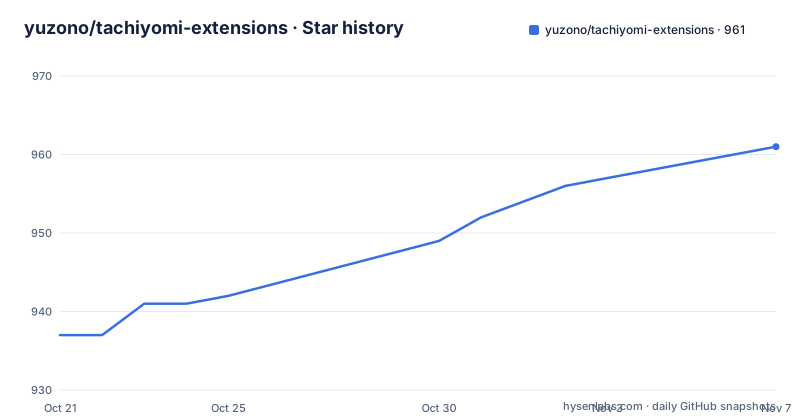
Star history
- yuzono/tachiyomi-extensions961 ★ · +24
| Repository | 2026-10-21 | 2026-11-07 |
|---|---|---|
| yuzono/tachiyomi-extensions | 937 | 961 |
24 Stars in the last 17 days, measured from the daily GitHub snapshot. Compare with other projects
Editorial analysis
A catalogue rather than an app, and the distinction matters
The repository holds extension catalogues, not an application. The project description calls it the source code of extensions for Komikku, Mihon and forks, and the README states that it contains extension catalogues which are compatible with Komikku and Mihon, Tachiyomi or other forks. So the unit here is a source, a single site that a reader can follow, and the unit of value is a catalogue listing many of them. The primary language is Kotlin, and the repository layout shows the machinery rather than a flat list of site scrapers: there is a compiler/ directory, a core/ directory, common/, lib/, lib-multisrc/, src/ and template/, plus build.gradle.kts, settings.gradle.kts and a gradlew wrapper. That structure is what makes the catalogue buildable rather than merely a list of links.
The six hour merge from Keiyoushi is the maintenance model
The interesting engineering decision is not in the extensions, it is in the refresh cycle. The repository automatically merges any updates from the Keiyoushi extensions-source project every 6 hours, and the README describes the goal as having the best of community contributions. On top of that automatic merge sit a few extensions developed by the repository owner and some improvements. The consequences for a reader are concrete. You do not get a snapshot that ages, because the catalogue is rebuilt from upstream on a timer. You also do not get a fork that owns all of the sources, because most of the content is upstream work passing through here, and the README credits the original contributors for the codebase. The badge row at the top of the README tracks an auto cherry pick workflow, which is the mechanism behind that six hour cycle.
Adding the repository takes one URL
There are two documented routes, and both are short. You can add the repository by visiting the Yuzono website add-repo page, or you can copy and paste the URL directly into the app's repository settings. The URL to copy is:
https://github.com/yuzono/manga-repo/raw/repo/index.pbThe README asks newcomers to read the getting started guide for adding the extension repository first, which suggests the app's own repository interface is where the paste happens. The distinction between the two URLs in the README is worth noting, because the install badge in the header points at a different address, an index.min.json file served through an http protocol redirector, while the manual instructions point at index.pb served directly from GitHub. Either route is a repository entry, not a per-extension install.
Where the Suggestions feature fits in
The README states that some extensions from this repository provide better support for Komikku's Suggestions feature. That is the only functional difference the documentation claims over the upstream catalogue, and it is a narrow one: the Suggestions feature is what surfaces a related work for a reader inside the app, so an extension that reports extra metadata for it can make that surface more useful. The upstream compatibility claim covers the rest, since the catalogues are compatible with Komikku and Mihon, Tachiyomi or other forks. In practice, the decision between this repository and the upstream one comes down to whether you want the Suggestion improvements or you would rather track upstream alone, and the documentation gives no benchmark, no source count and no compatibility matrix to weigh that against.
Requests are volunteer work, and the project says so plainly
The Requests section is unusually direct about expectations. To request a new source or a bug fix you create an issue, using the issue templates. The README then states that creating an issue does not mean the source will be added or fixed in a timely fashion, because the work is volunteer based, and that some sources may also be impossible to do or prohibitively difficult to maintain. It then invites the people who do have the skills to contribute, and notes that issues are up for grabs for any developer if there is no assigned user already. There is a reminder to check the issue backlog for source requests and bug reports before opening a new one, and a separate REMOVED_SOURCES.md file at the repository root, which is where sources that were taken down are recorded. For a reader, the honest summary is that catalogue coverage depends on a small number of volunteers and can change in either direction.
Building the catalogue is a Gradle and Python job
The repository carries the build tooling of the upstream extensions project rather than a bespoke one. There is a gradlew wrapper with a matching gradlew.bat, gradle.properties, settings.gradle.kts and a build.gradle.kts, and the top level includes a ktlintCodeStyle.xml, which is the Kotlin lint style configuration. The Python side is a single script, ext-bootstrap.py, which suggests the bootstrap step that pulls the upstream extensions-source tree before the Gradle build compiles the catalogue into the repository index the app consumes. The .github directory carries a build_push workflow, and its badge is the build indicator shown in the README header. So the pipeline is: fetch upstream sources, compile each source with Gradle, and publish an index. Contributors are pointed to CONTRIBUTING.md for the mechanics, and a CODE_OF_CONDUCT.md sets the conduct expectations for the space.
Licence, disclaimers and what the project is not
The licence field on the repository says Apache-2.0, and the LICENSE file carries the standard Apache 2.0 text with a copyright line for Javier Tomás dated 2015. Apache-2.0 is the permissive licence with an explicit patent grant, which matters for a build pipeline that compiles many contributors' code into one artefact. Two disclaimers in the README narrow what the project is. The first says the project has no affiliation with the content providers available, and the developer of the application has no affiliation with the content providers either. The second says the project is not affiliated with Komikku, Mihon or Tachiyomi, and asks people not to raise support requests about these extensions through the official support channels of those apps. It also credits the original contributors for the codebase. The last push was on 2026-10-19 and the repository is not archived, though it publishes no GitHub releases, so change arrives through the automatic merge rather than through versioned tags.
Editorial conclusion
This repository suits a reader who wants a broad catalogue of source extensions with a maintenance process already attached, since the six hour merge from Keiyoushi means the upstream catalogue changes arrive without anyone hand patching them. It does not suit a reader who expects a single upstream to own every source, because the project is explicitly volunteer based and states that a request does not mean the source will be added or fixed in a timely fashion. Before you add it, read the getting started guide for repositories and extensions, and note that the project asks you not to raise support requests about these extensions through the official Komikku, Mihon or Tachiyomi channels.
Frequently asked questions
How do I add the Yuzono extension repository to Komikku or Mihon?
Visit the Yuzono website add-repo page, or copy and paste the repository URL https://github.com/yuzono/manga-repo/raw/repo/index.pb into the app. The README asks newcomers to read the getting started guide for repositories and extensions first.
How often does the Yuzono tachiyomi-extensions repository update?
The repository automatically merges any updates from the Keiyoushi extensions-source project every 6 hours, on top of a few extensions developed by the repository owner and some improvements.
Does this extension repository differ from the upstream Keiyoushi catalogue?
Apart from the automatic merge from upstream, the README states that some extensions from this repository provide better support for Komikku's Suggestions feature, and that the repository includes a few extensions developed by its owner and some improvements.
Can I request a new manga source in this repository?
Yes, by creating an issue. The project notes that creating an issue does not mean the source will be added or fixed in a timely fashion, because the work is volunteer based and some sources may be prohibitively difficult to maintain. Issues are up for grabs if nobody is assigned.
What licence covers the Yuzono tachiyomi-extensions code?
The licence field on the repository says Apache-2.0, and the LICENSE file at the root carries the Apache License 2.0 text with a copyright line for Javier Tomás dated 2015.
Official sources
Add this badge to your README
If you maintain this project, the badge below links readers to this analysis and shows its maintenance status from the daily GitHub snapshot. Paste the markdown into your README; add ?metric=license or ?metric=stars to the image URL for a different field.

[](https://hysenlabs.com/projects/yuzono-tachiyomi-extensions)Star history chart for your README
[](https://hysenlabs.com/projects/yuzono-tachiyomi-extensions)Was this useful?