Next Move Theory is a canon of theses and eight routed skills, not a product
Claude Code skills for product market research, value props, PRDs, and go-to-market — plus the open Next Move Theory (based on AJTBD) canon and a product advisor you can /ask-nmt
At a glance
- What is it?
- Ivan Zamesin's repository pairs a v0.6 canon for product decisions, written as Markdown theses, with Claude Code and Codex skills that route a rough idea to market research, value proposition, requirements or go to market. The install section the README points at is not in the copy of the README in front of me.
- Who is it for?
- Read it as an explicit procedure with a version number on it, not as an oracle. The skills are worth an afternoon if your next decision is what to build, and they are no substitute for the customer interviews, CJM and ICP work the canon says you do not have to throw out.
- Can I use it commercially?
- Check first. The repository uses a licence we do not classify automatically, so read its LICENSE file before any commercial use.
- Is it still maintained?
- Yes. The repository last received commits 40 days ago.
- What is it written in?
- Mainly PowerShell, according to GitHub's language statistics.
Answers come from the project's GitHub data, last synced on October 22, 2026, and from our analysis. They are not legal advice.
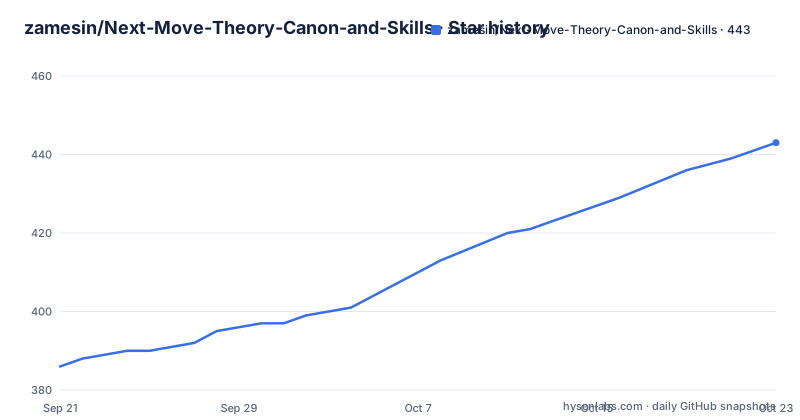
Star history
- zamesin/Next-Move-Theory-Canon-and-Skills441 ★ · +55
| Repository | 2026-09-21 | 2026-10-22 |
|---|---|---|
| zamesin/Next-Move-Theory-Canon-and-Skills | 386 | 441 |
55 Stars in the last 31 days, measured from the daily GitHub snapshot. Compare with other projects
Editorial analysis
One entry command, then seven downstream skills
The skills are not eight tools you have to choose between. They are one front door plus seven destinations, and the front door is `/nmt-chat` on Claude Code, `$nmt-chat` on Codex. You paste whatever you already have into it: a half-formed idea, messy notes, a chat thread, a doc. It pulls the context out, separates what you know from what you are assuming, and hands back the next concrete move. No methodologically perfect brief is required, and each skill either takes what you hand it or routes you back to the step it needs first. The routing table, copied exactly as it appears:
new idea            ->  /nmt-chat  ->  /nmt-market-research
                    ->  /nmt-craft-value-proposition
                    ->  /nmt-product-requirements
                    ->  /nmt-craft-go-to-market
live product        ->  /nmt-diagnose
interviews on disk  ->  /nmt-analyze-interviews
update everything   ->  /nmt-update
The first column is your situation, not your intent. A live product goes straight to `/nmt-diagnose`, and interviews already sitting on disk go to `/nmt-analyze-interviews`, so you never have to pretend a brand new idea is a product that needs diagnosing. A new idea fans out into four destinations after the chat, which is the part that matters: the theory does not have one opinion about whether you should start with market research or with a value proposition, so the router asks you first.
Every skill name names a deliverable, not a phase
Read the eight names as a list of things you walk away holding. `/nmt-market-research` produces research, `/nmt-craft-value-proposition` produces a value proposition, `/nmt-product-requirements` produces requirements, `/nmt-craft-go-to-market` produces a go to market plan, `/nmt-analyze-interviews` produces analysis of interviews you already have. `/nmt-diagnose` is the odd one, the only name that promises an answer rather than an artifact. `/nmt-update` is the only name with no object at all: it refreshes everything, which tells you the canon expects to be re-run against a product that already moved. The stated contract is that the skills turn the algorithm into tools, and that feeding in a product idea gets you back a decision rather than a description. Alongside these routed skills the repository advertises a separate product advisor, `/ask-nmt`, in its summary line. The routing table above does not include it, and the copy of the README in front of me never shows it in use, so how `/ask-nmt` differs from `/nmt-chat` is not something you can settle from what is visible.
The canon is Markdown folders, and PowerShell is the primary language
There is no package to import and no binary here. The top level of the repository is AGENTS.md, CHANGELOG.md, CLAUDE.md, LICENSE, Next-Move-Theory-Canon/, README.md, Skills/, install.ps1 and install.sh, and two of those files exist for coding agents rather than for readers. Inside the canon folder are the two documents the README reaches for by path. `Next-Move-Theory-Canon/Algorithms/the-algorithm.md` holds the main algorithm in full, which the README calls the one thing you should read and then warns is not enough, because the steps only work for you if you also accept what they stand on. That base is `Next-Move-Theory-Canon/Advanced-Jobs-To-Be-Done/scientific-foundations.md`, the body of science the author says explains what value is and how a person changes behavior, and that everything else in the canon rests on it. GitHub reports PowerShell as this repository's primary language, which is an artifact of install.ps1 sitting in the root beside install.sh and tells you nothing about how the methodology is executed. It is prose and skill definitions, applied by an agent.
Two version numbers travel together, carrying different labels
The header block separates the foundation from the system built on it. Advanced JTBD is v3.4 and marked stable. Next Move Theory is v0.6 and marked in active development, integrating AJTBD with the Riskiest Assumption Test, ABCDX Segmentation, Theory of Constraints and Unit Economics into one operational system, with the author describing it as forming in the open and tracking to 1.0. So anyone who installs the skills installs a v0.6 system standing on a v3.4 base, and the two numbers can move independently without either one announcing it to you. The changelog is a page on the author's website, nextmovetheory.com/changelog, even though CHANGELOG.md is present in the tree, and the repository publishes no GitHub releases at all, so there is no tag to pin to and no release notes to diff. For a canon whose entire claim is that it produces a repeatable decision procedure, that is a real gap in versioning.
The install section is promised three ways, then the README cuts off
Step one of the README's own instructions points at a section called Install into your project and names three routes: a macOS or Linux one-liner, the git clone route, and the Windows PowerShell installer. The repository tree backs that up, with install.sh and install.ps1 sitting in the root next to the README. The copy of the README in front of me ends mid-sentence inside Who this is for, cutting off at the fragment 'Customer interviews, CJM, ICP, willingn', so the install section itself never appears and no command is reproduced here. That leaves several things unconfirmed: where the skills land on disk, whether there is a manifest, what the two installers do differently, and whether the git clone route expects you to run anything afterward. Both scripts are in the tree and readable, so this is a gap in the README rather than a gap in the project. It does mean the fastest path from clone to first command is not something the front page spells out for you.
Ranking a feature 1,200 does not tell you what to build
The sharpest claim in the canon is aimed at scoring. The argument is that scores give comfort rather than direction, and that you can rank a feature 1,200 and still be wrong. Instead of ranking, Next Move Theory weighs each move by how much it shifts your goal and points at the best one together with the reason why. The second half of the claim is about enumeration: most decisions feel like a coin flip because you only see the one option you had already fixed on, so the canon's job is to lay out every tactical and strategic move actually open to you, including the ones you would have missed. The scope is a list of twelve decision types, and they span the whole life of a product: how to launch and find product-market fit, how to scale, how to save a dying product or know when to shut it down, how to create value, differentiate from competitors, position the thing, exit direct competition, create a Disruptive Innovation, grow conversion, raise average order value, improve retention, and build an acquisition channel. Nothing in that list is answered by a template document.
Eight years of rebuilding JTBD, then four more bodies of work
The provenance is unusually specific for an open canon. The author says he found Jobs To Be Done eight years ago, saw how much it could become, and made what he calls an unreasonable decision to rebuild it from scratch so it would finally yield an algorithm. That rebuild produced Advanced JTBD, written out as thousands of theses, and on its own it still did not produce an algorithm. To get one he folded in Unit Economics, the Riskiest Assumption Test, ABCDX segmentation and Goldratt's Theory of Constraints, and that integration is what became Next Move Theory. He says he has since taught the methodology to more than 13,000 people in his home country. The evidence he points at lives off the repository: dozens of documented cases at nextmovetheory.com/cases, with conversion, retention, revenue and market share named as the metrics that moved significantly across them. You can check the canon's reasoning without leaving the repository. You cannot check those cases without leaving it, and the case studies are the only place outcome claims are made.
397 stars, 121 forks, 8 open issues, and no releases at all
The repository surface is small and recently touched. The last push to the main branch landed on 13 September 2026, the repository is not archived, and there are no GitHub releases. It has 397 stars, 121 forks and 8 open issues, with the default branch set to main. The tree carries a LICENSE file while no license identifier is attached to the repository itself, which is worth resolving before you copy any of the theses into a document at work. The fork count against the star count is higher than a documentation repository normally draws, which fits what this is: a canon meant to be forked into your own project and re-run, not installed and upgraded. The homepage field points at http://nextmovetheory.com/. Eight open issues against 397 stars is a small surface for a project with this many forks, so expect the routing between skills to change as people hit the same edges.
Editorial conclusion
Read it as an explicit procedure with a version number on it, not as an oracle. The skills are worth an afternoon if your next decision is what to build, and they are no substitute for the customer interviews, CJM and ICP work the canon says you do not have to throw out. Two things to verify first: Advanced JTBD sits at v3.4 while Next Move Theory is still v0.6, and the repository publishes no releases, so nextmovetheory.com/changelog is the only place its version history is recorded.
Frequently asked questions
What does /nmt-chat do in Next Move Theory?
It is the front door to the whole methodology. You paste whatever you have, a half-formed idea, messy notes, a chat thread or a doc, and it pulls out the context, separates what you know from what you are assuming, and returns the next concrete move. No methodologically perfect brief is required.
How do the Next Move Theory skills differ on Codex?
Only in how you invoke them. Claude Code uses the slash form, /nmt-chat and /nmt-market-research, while Codex uses the dollar sign form, $nmt-chat and the rest. The routing table in the README prints both conventions so the same skill set works on either tool.
Is Next Move Theory finished or still being written?
Still being written. Advanced JTBD is at v3.4 and marked stable, while Next Move Theory is at v0.6 and marked in active development, integrating AJTBD with the Riskiest Assumption Test, ABCDX Segmentation, Theory of Constraints and Unit Economics. The changelog is a page at nextmovetheory.com/changelog, and the repository has no GitHub releases.
Which files hold the Next Move Theory algorithm itself?
The main algorithm sits in Next-Move-Theory-Canon/Algorithms/the-algorithm.md, and the science it stands on sits in Next-Move-Theory-Canon/Advanced-Jobs-To-Be-Done/scientific-foundations.md. The README argues that reading the steps without the foundations leaves you with an empty checklist, so both files matter.
Official sources
Add this badge to your README
If you maintain this project, the badge below links readers to this analysis and shows its maintenance status from the daily GitHub snapshot. Paste the markdown into your README; add ?metric=license or ?metric=stars to the image URL for a different field.

[](https://hysenlabs.com/projects/zamesin-next-move-theory-canon-and-skills)Star history chart for your README
[](https://hysenlabs.com/projects/zamesin-next-move-theory-canon-and-skills)