fuzz4bounty: one place for the wordlists bug hunters keep re-downloading
1337 Wordlists for Bug Bounty Hunting
At a glance
- What is it?
- fuzz4bounty is a collection of publicly available wordlists for bug bounty hunting, gathered from projects like SecLists, OneListForAll and dirsearch and organised by what they are for. It suits someone who keeps the same dictionaries in a dozen tools, and it is a data repository rather than a scanner.
- Who is it for?
- Adopt fuzz4bounty as a single checkout for the dictionaries you already point ffuf, dirsearch and nuclei at, because the repository's stated purpose is to gather the scattered wordlists in one place rather than to add anything new. Do not treat it as a scanner, since it ships no scanning code, and do not run any of it against infrastructure you are not authorised to test, because that constraint is the whole subject of the wordlists.
- Can I use it commercially?
- Not without permission. GitHub finds no licence file in the repository, and without a licence all rights are reserved by default: you may read the code but not reuse it. Check the README, or ask the authors, before using it.
- Is it still maintained?
- Yes. The repository last received commits 7 days ago.
- What is it written in?
- Mainly Go, according to GitHub's language statistics.
Answers come from the project's GitHub data, last synced on November 7, 2026, and from our analysis. They are not legal advice.
Star history
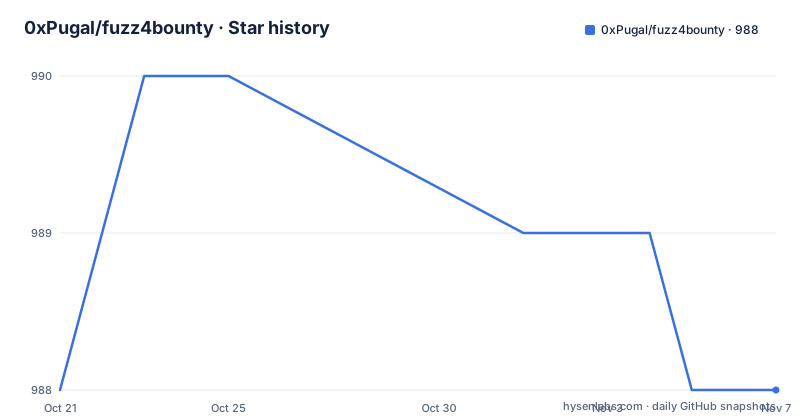
- 0xPugal/fuzz4bounty988 ★ · +0
| Repository | 2026-10-21 | 2026-11-07 |
|---|---|---|
| 0xPugal/fuzz4bounty | 988 | 988 |
0 Stars in the last 17 days, measured from the daily GitHub snapshot. Compare with other projects
Editorial analysis
What the repository is, stated plainly
fuzz4bounty is described in one line as wordlists for bug bounty hunting, and the README is explicit about its scope in the first quote.
This repository contains publicly available wordlists for bug hunting, and the main objective for creating this repo is to bring all the available wordlists at one place.
That is the whole project. There is no scanner here, no exploitation framework, no credential handling, and no automation. What there is, is a directory of text files that you point other tools at, organised so you can find the right list for the thing you are enumerating.
The README also says the wordlists will be updated regularly and that pull requests are welcome, which sets the maintenance expectation for anyone using it. It is a collection that is refreshed rather than authored, and that framing matters when you decide how much to trust its contents.
The primary language is listed as Go, which is surprising for a repository of text files and probably reflects the tooling the author uses around it rather than the repository's own content. The last push to the master branch was on 2026-10-18, and there are no GitHub releases, so there is no versioned artifact to pin to. The homepage points at a Twitter post rather than a project site, and the topics are bruteforce, bugbounty, dirsearch, ffuf, fuzz, fuzz4bounty and wordlist, which tells you which tools the lists are meant to feed.
The upstream projects it consolidates
The Awesome wordlists section lists the sources the collection draws on, and each one has a different character.
Each entry is a link to an upstream project: SecLists, OneListForAll, bbFuzzing and the dirsearch dictionary, named and linked. And dirsearch is represented by a link to its dicc.txt file specifically.
The dirsearch entry is the one that tells you most about how the author thinks about the collection. Rather than describing the list, it links to the exact file. That is the difference between a catalogue of links and a usable set of payloads, and it is the reason the collection is worth having rather than merely convenient.
The directory names in the repository follow the same logic, splitting the payload set by what it is for: a DNS directory, a discovery directory, a fuzzing directory, a nuclei-wordlist directory and a technologies directory. The technologies directory in particular suggests the lists are indexed by the stack you are attacking, so a list of paths for a particular application server is grouped with the other entries for that server rather than with all the other web paths.
So the answer to the question the repository exists to answer is that instead of downloading a dictionary per tool, and a second copy per platform, you have one tree you can browse by purpose and by technology. That is a modest saving, and it is the real one.
A tree of dictionaries, and one file that records the provenance
The top level of the repository is where the structure of the collection is visible, and it is worth reading the list as a taxonomy.
There is a DNS directory, a discovery directory, a fuzzing directory, a nuclei-wordlist directory and a technologies directory, plus a fuzz4bounty directory, a scripts directory and a README. Alongside them there is sources.yaml and a.github directory.
The directories map onto the different things a security tester enumerates. DNS is one axis: subdomain and name records are discovered by querying a resolver rather than by requesting a URL, and a dictionary for that is a different shape from one for paths. Discovery is the broad category of finding what exists at all, which is what a path or subdomain list serves. Fuzzing is the category where the payload is chosen to trigger a specific kind of response rather than merely to see if something is there.
The nuclei-wordlist directory is the one that shows the collection is aware of template driven tools, where the wordlist feeds a template rather than a URL fuzzer directly. And the technologies directory groups entries by the product or stack, which is how a tester who knows they are looking at a particular application server finds the right paths without reading every list.
The scripts directory implies the update process is automated, which fits the claim that the wordlists are updated regularly. And sources.yaml is the interesting one, because it is the only file whose name suggests it records where things came from. For a collection assembled from other people's work, provenance is the property that matters. A file that maps each list back to its origin is what makes a merged collection defensible.
The practical question is where the lines are
The subject matter here is wordlists for finding hidden paths and hostnames, and the honest way to write about that is to be clear about the constraint rather than to pretend the tool is neutral.
A wordlist is not an exploit. It is a list of guesses, and the same dictionary used against a target you own and a target you do not is a different act depending only on who authorised it. The repositories this collection draws from, SecLists, OneListForAll and the dirsearch dictionary, are all published by the security testing community for use against systems where testing is agreed, and the tooling that consumes them, ffuf, dirsearch and nuclei, is designed for that same context.
That framing also describes the maintenance burden. Because these lists are being updated regularly, a copy you checked last month is not a copy you have now. The usual practice is to pull the collection at a point in time, keep it under version control yourself, and treat the upstream as a source to sync from rather than a dependency to consume live, because the content is data and it changes without a version bump.
The scripts directory in the repository is presumably there to make that sync repeatable, and the fact that there are no GitHub releases is the practical constraint: there is no tagged version to pin, so the version control of the checkout is the version control of the payload set. The README's offer of pull requests fits that model too, since the useful contributions to a collection like this are additions from people who found a gap in a list while testing a particular technology, and the technologies directory is exactly where such an addition belongs.
Editorial conclusion
Adopt fuzz4bounty as a single checkout for the dictionaries you already point ffuf, dirsearch and nuclei at, because the repository's stated purpose is to gather the scattered wordlists in one place rather than to add anything new. Do not treat it as a scanner, since it ships no scanning code, and do not run any of it against infrastructure you are not authorised to test, because that constraint is the whole subject of the wordlists. Before you rely on it, read sources.yaml, which is the only file in the tree that appears to record where the lists came from, and pin a copy rather than pulling the master branch, since the wordlists are updated regularly and the contents will change under you.
Frequently asked questions
What is fuzz4bounty?
It is a collection of publicly available wordlists for bug bounty hunting, and the stated main objective of the repository is to bring all the available wordlists at one place. The wordlists are updated regularly and pull requests are welcome.
Which projects does fuzz4bounty draw its wordlists from?
The Awesome wordlists section lists SecLists, OneListForAll, bbFuzzing and the dirsearch default dictionary, linking to the dicc.txt file in the dirsearch repository specifically. The top level directories are organised by purpose, with DNS, discovery, fuzzing, nuclei-wordlist and technologies directories.
Does fuzz4bounty include a scanner or any exploitation code?
No. The repository is wordlists, with a scripts directory, a sources.yaml file and the text lists themselves. The topics cover bruteforce, dirsearch, ffuf and wordlist, which are the tools these dictionaries are meant to feed rather than anything shipped here.
Are there releases of fuzz4bounty I can pin to?
The repository has no GitHub releases, so there is no tagged artifact to depend on. Because the wordlists are updated regularly, the practical approach is to keep your own copy under version control and treat the upstream repository as a source to sync from rather than a live dependency.
Official sources
Add this badge to your README
If you maintain this project, the badge below links readers to this analysis and shows its maintenance status from the daily GitHub snapshot. Paste the markdown into your README; add ?metric=license or ?metric=stars to the image URL for a different field.

[](https://hysenlabs.com/projects/0xpugal-fuzz4bounty)Star history chart for your README
[](https://hysenlabs.com/projects/0xpugal-fuzz4bounty)Was this useful?