maozi-cloud: a Spring Cloud Alibaba bundle whose README is an index
一款微服务一站式解决方案,内置分布式应用开发所需全套组件,统一团队代码风格,保障代码质量,让开发者专注业务逻辑,实现高效快速开发。
At a glance
- What is it?
- maozi-cloud packages Spring Cloud Alibaba and Dubbo into three subprojects for Java teams that want a uniform service template, a local development console and grey release built in. The README documents none of the setup itself, and the console still stops at macOS and Linux.
- Who is it for?
- maozi-cloud fits a Java team that wants one reviewed assembly of Spring Cloud Alibaba and Dubbo with grey release, regression and load testing already wired in, and whose developers work on macOS or Linux desktops.
- Can I use it commercially?
- Yes. Apache-2.0 is a permissive licence: you can use, modify and sell software built on it, as long as you keep its copyright and licence notices.
- Is it still maintained?
- Yes. The repository last received commits 1 day ago.
- What is it written in?
- Mainly Java, according to GitHub's language statistics.
Answers come from the project's GitHub data, last synced on October 23, 2026, and from our analysis. They are not legal advice.
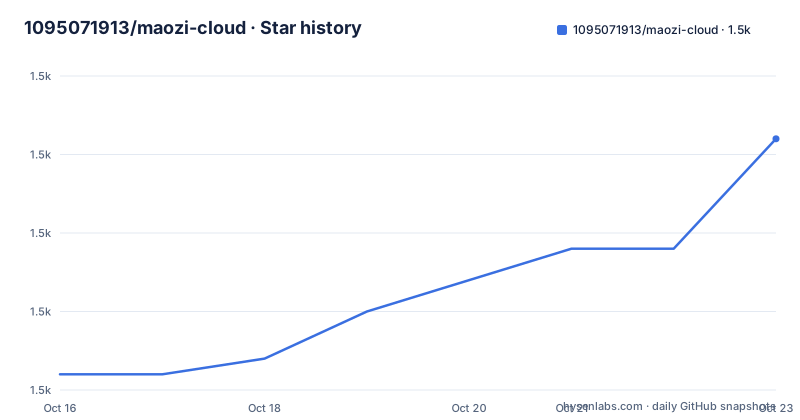
Star history
- 1095071913/maozi-cloud1,541 ★ · +15
| Repository | 2026-10-16 | 2026-10-23 |
|---|---|---|
| 1095071913/maozi-cloud | 1.5k | 1.5k |
15 Stars in the last 7 days, measured from the daily GitHub snapshot. Compare with other projects
Editorial analysis
Three subprojects share one repository, not one jar
This is not a library you drop into a pom file. The repository holds three separate projects: maozi-cloud-parent for the backend, maozi-cloud-admin for the admin front end, and maozi-cloud-develop-admin, described as a rapid development console for the development and testing stage. Alongside them sit maozi-cloud-doc, maozi-cloud-script, maozi-cloud-images and a CONFIG directory, all on the release branch. The stated aim is to package the full set of components a distributed application needs so the team writes business logic rather than assembling infrastructure. The pairing of Dubbo with Spring Cloud Alibaba, plus repository topics naming springcloudalibaba, k8s, serverless and servermesh, places the project inside the Chinese Spring Cloud ecosystem rather than in the broader Kubernetes tooling world. Note the default branch is release, so the repository you clone is not the development trunk.
The console reaches macOS and Linux, and nothing else yet
The most concrete constraint stated anywhere in the README sits in the roadmap list: the rapid development console supports macOS and Linux, and Windows support is still planned. On a Windows workstation there is no documented route to the console, and the README offers no WSL or container workaround for it. The same list also marks Kubernetes support for the console as pending, even though k8s is a repository topic. So the tags describe intent while the feature list describes current reach. The console is a local, desktop oriented tool today rather than a cluster side one, which matters for anyone whose standard build environment is a Windows VM.
Grey release and regression arrive as part of the assembly
The feature list is organised around the idea of the whole call chain. The project claims fine grained traffic control for smooth version iteration, distributed tracing for locating faults, automated regression across services, load testing to expose bottlenecks before release, and a metrics, tracing and logging observability set. Two further entries concern data access and concurrency rather than delivery: a distributed lock that is said to work out of the box, and declarative data source queries meant to remove repeated code. One line claims a monolith and a microservice deployment can be switched without changing the code. None of this comes with a configuration key, a port or a version number on this page. Port details and the directory guide live in separate documents under maozi-cloud-doc, so these bullets are a statement about coverage rather than something you can act on.
Every setup step lives in maozi-cloud-doc, so evaluate there
The README contains no install command, no container run line, no port list and no configuration snippet, and none is invented here. What it offers instead is a trail of documents under maozi-cloud-doc: a framework introduction, a directory guide, a service port description, a preparation checklist, a base service deployment guide, a containerised deployment guide for local business services, an IntelliJ IDEA startup guide, a regression service document and a grey development mode document. That sequence is the only available order for a first run. Read the preparation checklist, deploy the base services, containerise your own business service locally, start it from the IDE, then turn on regression and grey development. The repository also contains maozi-cloud-script, and the README says nothing about what is in that directory. Judge adoption on those documents, not on this README.
Seven items are openly marked as pending refactor
A second list is headed as planned work. It names configuration management history, Windows and Kubernetes support for the console, watching code changes to trigger automated deployment, a Spring Cloud Alibaba version upgrade, client side long connection messaging with acknowledgement, retry and multi instance compatibility, and a stated intention to stop depending on third party open source components in favour of the project's own. Each is described as having working basic functionality today. Read the last one twice. If system components move off shared dependencies, upgrades become the maintainer's problem instead of the community's, and the ability to fork and patch a single component goes with them.
Apache-2.0 and the cost of an opinionated assembly
The licence is Apache-2.0, so redistribution and modification carry the usual patent grant and the requirement to keep notices intact. Licensing is not where the decision sits. Adopting maozi-cloud means adopting its parent POM, its code conventions and its component set, because the pitch is unified team code style. That is the trade: less assembly work in exchange for less ability to swap a single piece. The plan to build more components in house narrows that freedom over time rather than widening it.
Against taking Spring Cloud Alibaba and Dubbo directly
The realistic alternative is to take Spring Cloud Alibaba and Dubbo yourself, wire the registry, gateway, configuration and tracing pieces you actually need, and accept the assembly work this project exists to remove. The difference is ownership. A hand built stack lets you pin each component version and replace any module in isolation, while maozi-cloud fixes those choices so a whole team shares one convention. Choose the assembly route when you have platform engineers who want that control. Choose maozi-cloud when the priority is a uniform service template and local developer tooling, and treat the roadmap as the price of that speed.
Editorial conclusion
maozi-cloud fits a Java team that wants one reviewed assembly of Spring Cloud Alibaba and Dubbo with grey release, regression and load testing already wired in, and whose developers work on macOS or Linux desktops. It is the wrong choice for Windows shops today, for teams that need console driven Kubernetes deployment, or for anyone who plans to replace individual components later, since the stated plan to replace third party dependencies with in house ones narrows that freedom further. Before adopting, open maozi-cloud-doc/ and read the service port description and the preparation checklist, because the README carries no command, port or version and the entire evaluation rests on those files. The last push was on 2026-10-16 and the repository is not archived.
Frequently asked questions
Does maozi-cloud support Windows for its rapid development console?
No. The README states the rapid development console supports macOS and Linux only, and lists Windows support under planned refactoring. No WSL or container route is described for Windows.
How do I install and run maozi-cloud?
The README gives no install command. It points to documents under maozi-cloud-doc covering project preparation, base service deployment, containerised deployment of local business services, IDEA startup, regression services and grey development mode, and that sequence is the documented first run.
What microservices stack is maozi-cloud built on?
It is described as an open source packaging of Spring Cloud Alibaba plus Dubbo, with repository topics covering springcloudalibaba, k8s, serverless and servermesh. The backend project is maozi-cloud-parent, with a separate admin front end project.
Official sources
Add this badge to your README
If you maintain this project, the badge below links readers to this analysis and shows its maintenance status from the daily GitHub snapshot. Paste the markdown into your README; add ?metric=license or ?metric=stars to the image URL for a different field.

[](https://hysenlabs.com/projects/1095071913-maozi-cloud)Star history chart for your README
[](https://hysenlabs.com/projects/1095071913-maozi-cloud)Was this useful?