HelloGitHub: A Monthly Curation of Entry-Level Open Source Projects
GitHub describes it as Share interesting, entry-level open source projects on GitHub. The repository metadata lists Python as its primary language. This article stays within the project description and details documented in the GitHub repository README.
At a glance
- What is it?
- HelloGitHub is a long-running Chinese-language monthly digest that points beginners at interesting, approachable open source projects. It is a curation layer, not a tool, and its value depends entirely on the editors' taste and the monthly cadence.
- Who is it for?
- HelloGitHub suits Chinese-speaking beginners who want a hand-picked monthly list of approachable open source projects without spending hours on GitHub trending. It is the wrong tool for experienced developers seeking niche or advanced tooling, and for anyone who needs English-only content.
- Can I use it commercially?
- Not without permission. GitHub finds no licence file in the repository, and without a licence all rights are reserved by default: you may read the code but not reuse it. Check the README, or ask the authors, before using it.
- Is it still maintained?
- Yes. The repository last received commits 14 days ago.
- What is it written in?
- Mainly Python, according to GitHub's language statistics.
Answers come from the project's GitHub data, last synced on November 14, 2026, and from our analysis. They are not legal advice.
Star history
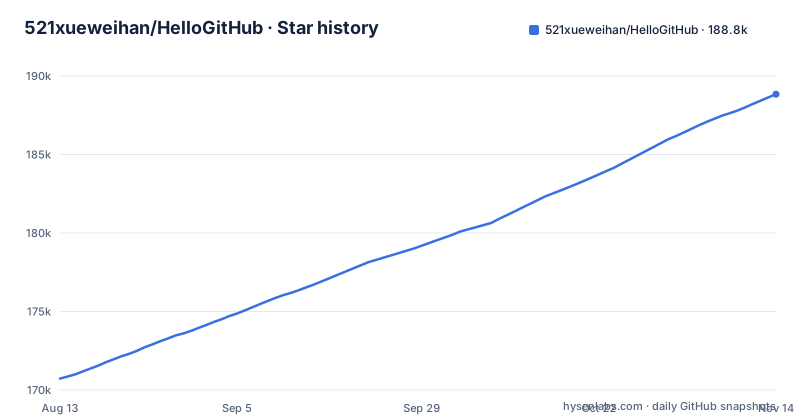
- 521xueweihan/HelloGitHub188,839 ★ · +18,115
| Repository | 2026-08-13 | 2026-11-14 |
|---|---|---|
| 521xueweihan/HelloGitHub | 170.7k | 188.8k |
18,115 Stars in the last 93 days, measured from the daily GitHub snapshot. Compare with other projects
Editorial analysis
What HelloGitHub Actually Is
HelloGitHub is not a software library or a framework. It is a curated monthly publication, delivered as Markdown files in a GitHub repository, that lists interesting and entry-level open source projects. The README states its purpose plainly: it shares fun, beginner-friendly projects on GitHub, and it updates on the 28th of every month. The target reader is someone who finds open source intimidating and needs a guided starting point. The tagline '兴趣是最好的老师' (interest is the best teacher) frames the whole project as a motivational exercise rather than a technical index. For an engineer evaluating this as a tool, the first thing to understand is that you are not adopting software. You are subscribing to an editorial feed.
The Monthly Issue Format and Repository Layout
Each issue is a single Markdown file under the content directory, named like HelloGitHub125.md. The README provides a table linking to issues from 91 through 127, which suggests a long-running series. The recent releases confirm the cadence: vol.127 on 2026-10-31, vol.126 on 2026-09-28, vol.125 on 2026-08-28. That is roughly monthly. The content categories are listed as interesting entry-level projects, open source books, practical projects, and enterprise-level projects. Each issue likely contains a list of project names, short descriptions, and links, though the README does not show the internal structure of an issue. The repository is primarily a container for these Markdown files, and the primary language field says Python, but that likely refers to some auxiliary script, not the content itself.
How You Consume the Content
You do not install HelloGitHub. You read it. The README points to two main consumption channels: the official website at hellogithub.com and the WeChat public account. For developers who prefer the repository, you can clone it and open any content file in a Markdown viewer. For example, to read the latest issue, you would fetch the file content/HelloGitHub127.md. There are no configuration keys, no command-line tools, and no API to integrate. The README also mentions a contribution mechanism: you can recommend or self-recommend a project through the periodical page on the website. That is the only interactive part. If you want to stay updated passively, the monthly release schedule means you can watch the repository or follow the WeChat account. The lack of any setup steps is both a strength and a sign that this is a publication, not a piece of software.
The Curation Model and Its Subjectivity
The core mechanism is human curation. The README says the content includes 'interesting, entry-level' projects, but it does not define what counts as interesting or entry-level. That is a deliberate editorial choice. The value of HelloGitHub rests entirely on the judgment of the maintainers and contributors. A project that one person finds approachable might be opaque to another. The README does not describe any algorithm, ranking system, or community voting. There is a contributors list, which suggests that recommendations come from a community, but the selection process is not transparent. For an engineer, this means the quality of each issue can vary. You cannot predict whether a given month will feature a useful library, a toy project, or something that duplicates what you already know. The monthly cadence also means the content is not real-time. If you need to track new projects daily, this is the wrong source.
Language, Audience, and the English Gap
The content of the repository is written in Chinese. The README offers English and Japanese versions, but those are translations of the README itself, not necessarily of the monthly issues. The README labels the issues in Chinese (for example 第 127 期), and the descriptions inside are likely in Chinese. The README links to a WeChat public account, which is a Chinese platform. This is a serious constraint for non-Chinese readers. Even with the English README, the actual curated content may be inaccessible if you do not read Chinese. The project's target audience is clearly Chinese-speaking beginners. If you are an English-only speaker, you will have to rely on the English README and hope that the issue content is translated, which the README does not confirm. That is a limitation worth stating directly.
Licensing and Redistribution Constraints
The README states that the work is licensed under the Creative Commons Attribution-NonCommercial-NoDerivatives 4.0 International license, abbreviated CC BY-NC-ND 4.0. This is not a standard open source software license. It permits sharing with attribution, but it prohibits commercial use and derivative works. For an engineer, this means you can read and share the issues, but you cannot republish them in a modified form or use them in a commercial product without permission. The repository itself has no software license field, so the CC license applies to the content. If you plan to build a tool that scrapes these issues and repackages them, you would need to respect that license. The README also includes a contact email for permission requests. This is a clear boundary: HelloGitHub is meant to be consumed, not incorporated into another product.
Alternatives and How They Differ
The most direct alternative is GitHub's own Trending page, which shows popular repositories on a daily and weekly basis. The difference is that Trending is algorithmic and unfiltered. It surfaces projects based on star velocity, which can favor hype over beginner-friendliness. HelloGitHub, by contrast, is manually curated and explicitly selects for entry-level appeal. Another alternative is the newsletter 'Open Source Weekly' or similar English-language digests, but those are not mentioned in the README. The key distinction is that HelloGitHub provides a human filter with a monthly rhythm, while Trending gives you raw data with no editorial judgment. If you want a steady stream of new projects, Trending is better. If you want a curated list of approachable projects that a human has vetted, HelloGitHub is the choice. The trade-off is speed versus selectivity.
Maintenance and Longevity Signals
The repository is not archived, and the last push date is 2026-10-31, which matches the latest release vol.127. This indicates active maintenance as of that date. The issue history going back to at least vol.91 shows a consistent publishing pattern over several years. The README includes a sponsorship section, which suggests the project has some financial support, though the details are not disclosed. The maintenance cost for a reader is zero. For a contributor, the cost is the time to write a recommendation, but the README does not specify a review process. The risk is that a monthly publication depends on the maintainer's continued interest. If the maintainer stops, the content stops. There is no automated pipeline mentioned. The Python language field hints at some scripting, but the README does not describe any build or update mechanism, so the exact process is opaque. For an engineer, this means you should check the repository's activity before relying on it as a regular source.
Editorial conclusion
HelloGitHub suits Chinese-speaking beginners who want a hand-picked monthly list of approachable open source projects without spending hours on GitHub trending. It is the wrong tool for experienced developers seeking niche or advanced tooling, and for anyone who needs English-only content. Before relying on it, verify that the monthly issues are still being published, check the project's non-commercial CC BY-NC-ND 4.0 license if you plan to redistribute any content, and confirm that the specific projects listed in an issue match your language and skill level, since curation is subjective and the README does not describe a filtering algorithm.
Frequently asked questions
What is HelloGitHub and how often does it publish?
HelloGitHub is a monthly magazine that shares interesting, entry-level open source projects from GitHub, along with open source books, hands-on projects and enterprise-grade projects. It publishes one issue a month on the 28th, and the repository is currently at issue 127.
Can I reuse or translate HelloGitHub content?
Not freely. The work is licensed under Creative Commons Attribution-NonCommercial-NoDerivatives 4.0, which requires credit, forbids commercial use, and prohibits adaptation, so issues cannot be reformatted, translated or merged. A contact address is given in the licence statement.
How do I recommend a project to HelloGitHub?
The project points you at a submission page on hellogithub.com to recommend or self-recommend a project, and keeps its contributors in content/contributors.md. No selection criteria, scoring or review process are published in the repository.
Does HelloGitHub have an app for Android?
The repository documents no mobile application. For a better reading experience it points to the website at hellogithub.com and to a HelloGitHub WeChat official account, with a Weibo account linked in the header.
Official sources
Add this badge to your README
If you maintain this project, the badge below links readers to this analysis and shows its maintenance status from the daily GitHub snapshot. Paste the markdown into your README; add ?metric=license or ?metric=stars to the image URL for a different field.

[](https://hysenlabs.com/projects/521xueweihan-hellogithub)Star history chart for your README
[](https://hysenlabs.com/projects/521xueweihan-hellogithub)Was this useful?