Must-Watch CSS: A Curated Talk List That Refuses to Be a Tutorial
CSS talks you have to see 📺 covering CSS Grid, flexbox, custom variables, performance, frameworks, Sass, tools, and more!
At a glance
- What is it?
- AllThingsSmitty/must-watch-css is a CC0-licensed README of conference talks on CSS Grid, flexbox, custom properties and tooling. It is a viewing list, not a course, and its value depends on how much you already know.
- Who is it for?
- Adopt Must-Watch CSS if you already write CSS and want a short, curated path into the arguments practitioners make on stage; the README's year headings and runtimes let you pick a talk that fits your time. Do not adopt it as a tutorial or a reference, because entries carry no difficulty signal and no indication of whether a video still plays or its advice still holds.
- Can I use it commercially?
- Yes. CC0-1.0 is a permissive licence: you can use, modify and sell software built on it, as long as you keep its copyright and licence notices.
- Is it still maintained?
- Yes. The repository last received commits 53 days ago.
- What is it written in?
- GitHub does not report a main language for this repository.
Answers come from the project's GitHub data, last synced on November 15, 2026, and from our analysis. They are not legal advice.
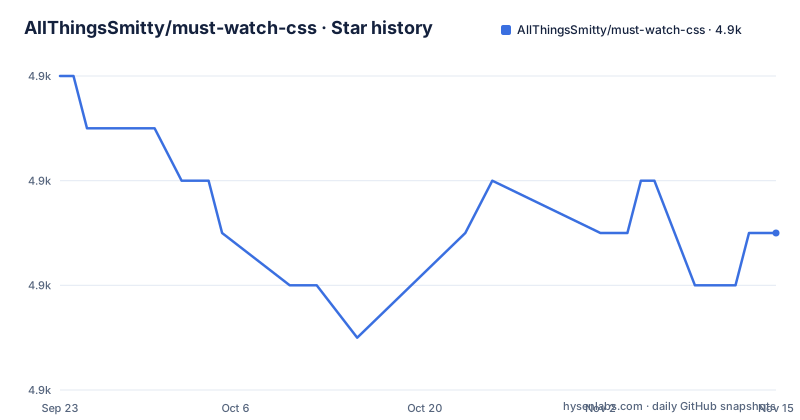
Star history
- AllThingsSmitty/must-watch-css4,879 ★ · -3
| Repository | 2026-09-23 | 2026-11-15 |
|---|---|---|
| AllThingsSmitty/must-watch-css | 4.9k | 4.9k |
-3 Stars in the last 53 days, measured from the daily GitHub snapshot. Compare with other projects
Editorial analysis
What Must-Watch CSS actually is, and who the list is for
The repository is a single curated README. Its own description calls it "a collection of well-received talks about CSS covering topics such as CSS Grid, flexbox, custom variables, performance, frameworks, tooling, and more." There is no build step, no package manifest, no test suite and no CLI. The top-level entries are .github/, CODE-OF-CONDUCT.md, CONTRIBUTING.md, LICENSE and README.md. That is the whole project.
The audience is narrow in a useful way. If you already write CSS daily and want to know what practitioners argue about on stage, the list is a shortcut past YouTube search. If you are looking for a structured curriculum with exercises and checkpoints, this is the wrong artifact. A conference talk is a 30 to 60 minute argument delivered once; the README preserves the link and the runtime, not the argument.
The list is also opinionated in a way that is easy to miss. Entries are grouped by year, starting with 2026, and each entry carries a speaker, a venue and a duration. The inclusion of a 2014 talk next to a 2026 one is a claim: some of this material has not expired.
How the list is organised: years, speakers, venues and runtimes
Every entry follows the same shape: a bolded title linking to the video, then the speaker, the conference and the runtime in backticks. For example, the 2026 section holds one entry, "Modern UI Patterns" by Una Kravets from CSS Day 2026 at `53:40`. The 2025 section holds two, including Adam Argyle's "25 New & Rad Feature of CSS" at `30:03`.
The runtime is the most practical field in the file. It lets you pick a talk that fits a commute rather than starting a 55 minute video at 11pm. The venue field does similar work: CSS Day, CSSConf EU, dotCSS, SmashingConf, Strange Loop and Front-Trends each imply a different register, from specification-level detail to practitioner war stories.
There is no tagging layer. Nothing in the README marks a talk as beginner or advanced, no prerequisites are listed, and there is no indication of which videos still play. The only ordering signal is the year heading. You are expected to know that "Hello Subgrid!" by Rachel Andrew from CSSConf EU is about a feature that shipped after the talk, and to adjust accordingly.
The list also points outward once: a tip block suggests Must-Watch JavaScript for readers who prefer that language.
Installing Must-Watch CSS and reading it offline
There is nothing to install in the software sense. The README gives no install steps, no package name and no release artifact. The repository has no published releases and no homepage set. The way to get it is to clone the repository or open README.md on the default branch, master.
If you want a local copy you can read without a browser tab, clone it:
git clone https://github.com/AllThingsSmitty/must-watch-css.git
cd must-watch-css
After that you have a directory containing README.md, LICENSE, CONTRIBUTING.md and CODE-OF-CONDUCT.md. Opening README.md in any text editor shows the full list. There is no generated index and no rendered site in the repository, so the Markdown file is the product.
A first real use is picking one talk per topic rather than working front to back. The README's own topic sentence names CSS Grid, flexbox, custom variables, performance, frameworks, Sass and tooling, and the year headings let you filter by recency. If you only have twenty minutes, the shortest entries in the list are under ten minutes, such as Miriam Suzanne's "Build a Classic Layout FAST in CSS Grid" at `8:29`.
To contribute a talk, the repository defers to CONTRIBUTING.md rather than describing the process in the README. Read that file before opening a pull request.
Where the list falls short as a learning resource
The README does not document rollback, deprecation or link health. There is no field for whether a video is still available, whether a conference channel has been removed, or whether a talk's central claim has since been reversed by a browser change. A list that reaches back to 2014 will accumulate dead links and outdated advice, and nothing in the file helps you tell which is which.
There is also no difficulty signal. A reader who does not know what subgrid is will not learn it from the entry "Hello Subgrid!" by Rachel Andrew, because the entry is a title, a speaker, a venue and `32:56`. The list assumes you can judge a talk from its metadata.
The bigger limitation is structural. Talks are recorded arguments, and the medium rewards rhetoric over reference. If you need to look up how a specific custom property behaves, a talk is a poor index. The list is a discovery layer, and treating it as documentation will waste your time.
Finally, the repository is a list, not a maintained library. It has no versioned API, no changelog and no releases. Adoption means reading a Markdown file.
Must-Watch CSS versus a written CSS reference
The obvious alternative is MDN Web Docs, and the difference is in the shape of the information. MDN is organised by property and feature, with compatibility tables and examples you can copy. Must-Watch CSS is organised by year and speaker, with links to video. One answers "what does this property do"; the other answers "what are the people who write CSS for a living arguing about right now".
A second alternative is a course platform with a syllabus. Those give you sequence and exercises. This list gives you neither, but it also does not pretend to. The trade is real: you lose the guarantee that the material is current, and you gain the ability to hear a position defended by the person who holds it, at conference depth, without paying for a subscription.
If your goal is to pass an interview or ship a layout this afternoon, use a reference. If your goal is to understand why the CSS community keeps returning to the same arguments about frameworks, architecture and the cascade, the talks collected here are the primary source, and the README is a reasonable index to them.
Maintenance, licence and the cost of keeping a list current
The repository is not archived, and the last push was on 2026-09-24. That is a recent edit, and the 2026 section containing a single CSS Day 2026 entry is consistent with a list that gets touched when a notable talk appears. There are no releases, so there is no upgrade path to plan for: you pull the repository again and read the updated README.
The licence is CC0-1.0, which the repository states in its LICENSE file. CC0 is a public domain dedication, so the practical implication is that reuse and redistribution carry essentially no conditions. This is not legal advice, and if you plan to republish the list inside a commercial product, read the LICENSE text rather than this paragraph.
The maintenance cost sits with the maintainer, not with you. Curating means watching talks, judging which ones hold up, and deciding when a year has enough entries to justify a new heading. The 2026 section currently has one entry, which suggests the list is updated as talks are published rather than on a schedule. For a reader, the cost is zero beyond re-cloning.
Editorial conclusion
Adopt Must-Watch CSS if you already write CSS and want a short, curated path into the arguments practitioners make on stage; the README's year headings and runtimes let you pick a talk that fits your time. Do not adopt it as a tutorial or a reference, because entries carry no difficulty signal and no indication of whether a video still plays or its advice still holds. Before relying on any entry, open the linked video and check the date against the feature it discusses, and read CONTRIBUTING.md before proposing an addition.
Frequently asked questions
How do I install or download Must-Watch CSS?
There is nothing to install. Clone the repository with git clone https://github.com/AllThingsSmitty/must-watch-css.git and read README.md, which contains the entire list.
Which CSS talks are included in Must-Watch CSS?
The README groups talks by year, newest (2026) first, covering CSS Grid, flexbox, custom variables, performance, frameworks, Sass and tooling, with each entry listing a speaker, a venue and a runtime.
What licence does Must-Watch CSS use?
The repository ships a LICENSE file identifying CC0-1.0, a public domain dedication.
Does anyone use CSS anymore?
The README does not address this question. It is a list of conference talks about CSS, and it does not make claims about adoption or usage.
Official sources
Add this badge to your README
If you maintain this project, the badge below links readers to this analysis and shows its maintenance status from the daily GitHub snapshot. Paste the markdown into your README; add ?metric=license or ?metric=stars to the image URL for a different field.

[](https://hysenlabs.com/projects/allthingssmitty-must-watch-css)Star history chart for your README
[](https://hysenlabs.com/projects/allthingssmitty-must-watch-css)Was this useful?