Must-Watch JavaScript: A Curated Talk List, Not a Course
JavaScript talks you have to see 📺 on functional programming, performance, frameworks, React, debugging, leveling up, and more!
At a glance
- What is it?
- AllThingsSmitty/must-watch-javascript is a hand-curated index of conference talks and screencasts about JavaScript. It is a reading list, not software, and its value depends on whether its curation matches what you need to learn.
- Who is it for?
- Adopt this list if you want a short, opinionated set of talks covering JavaScript history and practice, and if you are willing to check each YouTube link yourself before committing an evening to it. Do not adopt it if you need a structured curriculum, exercises, or material aimed at absolute beginners; the README offers no ordering by difficulty and no exercises.
- Can I use it commercially?
- Yes. CC0-1.0 is a permissive licence: you can use, modify and sell software built on it, as long as you keep its copyright and licence notices.
- Is it still maintained?
- Yes. The repository last received commits 23 days ago.
- What is it written in?
- GitHub does not report a main language for this repository.
Answers come from the project's GitHub data, last synced on November 15, 2026, and from our analysis. They are not legal advice.
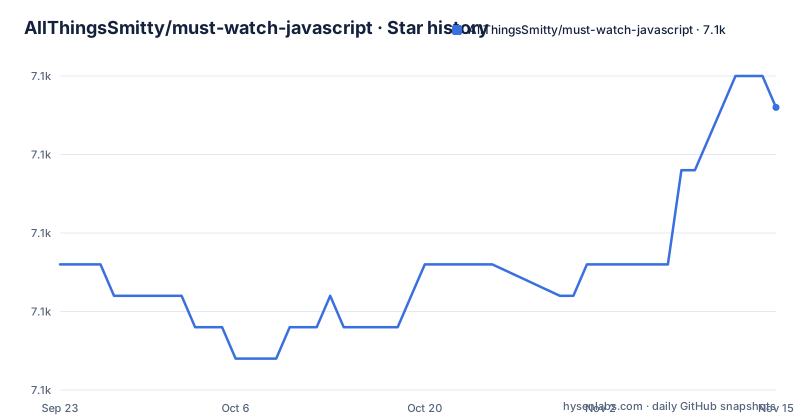
Star history
- AllThingsSmitty/must-watch-javascript7,144 ★ · +5
| Repository | 2026-09-23 | 2026-11-15 |
|---|---|---|
| AllThingsSmitty/must-watch-javascript | 7.1k | 7.1k |
5 Stars in the last 53 days, measured from the daily GitHub snapshot. Compare with other projects
Editorial analysis
What Must-Watch JavaScript Actually Is
This repository is a Markdown file with links. The README describes it as "a collection of well-received talks about JavaScript" covering React, functional programming, performance, frameworks, debugging, tooling and leveling up. There is no application code, no package manifest, no build step and no CLI. The top level of the repository holds .github/, CODE-OF-CONDUCT.md, CONTRIBUTING.md, LICENSE and README.md.
The audience is the working or aspiring JavaScript developer who wants to watch talks rather than read documentation. The problem it addresses is discovery: conference archives are large, YouTube recommendations are noisy, and a talk that was excellent in 2015 may now describe APIs that no longer exist. Someone has already made the selection. The 2015 section alone lists at least fourteen entries, and the 2016 section lists nine, so the list is broad rather than a top ten.
The trade-off is that a list is only as good as its editor's taste. Nothing in the repository explains the criteria for inclusion beyond the phrase "well-received". There are no view counts, no ratings, no summaries of what each talk argues. You get a title, a speaker, a conference and a duration.
How the List Is Organised and Where Its Structure Breaks Down
Entries are grouped under year headings in descending order, starting from 2026, and each entry follows the same shape: a bold linked title, a speaker name, a conference or channel, and a runtime in backticks. For example, the 2025 section opens with Rich Harris's "Fine-Grained Everything" from performance.now() 2025 at 42:34, followed by Jim Dummett on Oxc at ViteConf 2025, Ania Kubów's two-hour Mario build from a YouTube channel, and Jack Herrington's TanStack talk from CascadiaJS.
Year is the only organising axis. Topics appear in the repository description (functional programming, performance, frameworks, React, debugging) but not as sections in the README. If you want everything about debugging, you scan every year and pick out Jenn Creighton's "Debugging async JS" from 2022, Rebecca Hill's debugging tools talk from 2019, and the async talks from 2017 and 2016. That is a real cost for a reader with a specific gap to fill.
The second structural issue is that the list mixes sources. Most links point to YouTube, one 2015 entry points to jqueryuk.com, and most 2018 entries carry a YouTube playlist parameter. A link that depends on a third-party host can rot without the repository changing. Treat each entry as a claim to verify, not a guarantee.
Using the List: No Install, Just a Clone and a Read
There is nothing to install. The README gives no installation instructions because the deliverable is the README itself. The practical first step is to clone the repository so you can read it offline and search it with your own tools.
git clone https://github.com/AllThingsSmitty/must-watch-javascript.gitAfter cloning, the repository root contains README.md, CONTRIBUTING.md, CODE-OF-CONDUCT.md, LICENSE and .github/. Opening README.md in any Markdown viewer shows the year headings and the numbered entries.
If you want to find every talk mentioning a topic, search the file rather than scrolling. Because the list is plain Markdown, any text search over README.md returns the matching entries with their YouTube URLs, and you can copy a URL straight from the matched line into a browser tab. The same approach works for "performance", "async" or a speaker name.
For a first real use, pick one year and watch one talk end to end rather than sampling. The 2017 section is a reasonable starting point because its entries are short (Wes Bos on async/await runs 15:51) and the topics are foundational. Note the runtime in backticks before you start; the README publishes it precisely so you can budget the time.
The Curation Problem: Ageing Talks and No Difficulty Signal
The most obvious limitation is that a talk is a snapshot. Ryan Dahl's "10 Things I Regret About Node.js" from JSConf EU 2018 is a historical document about decisions already made; it is valuable as context and misleading as current guidance. The same applies to the 2015 and 2016 framework talks. "An Angular 2 Force Awakens" and "Angular + React = Speed" describe a version of Angular that the framework has long since moved past. The README does not flag any entry as historical, so the reader has to supply that judgement.
There is also no difficulty ordering. The list is chronological, not pedagogical. A beginner following it from the top meets Oxc and TanStack before meeting Anjana Vakil's "Learning Functional Programming with JavaScript" from 2016, which is the more natural entry point.
Finally, the list is short by design. The 2024 section contains a single entry. If you want comprehensive coverage of a topic, this is the wrong tool; a conference archive or a topic-specific awesome list will serve you better. This repository is for the reader who wants a filtered set of a few dozen talks and accepts that the filter is one person's taste, with no stated rubric.
Alternatives and How They Differ in Approach
The most direct alternative is a general awesome list, and the README itself points readers to @sindresorhus's curated list of awesome lists. The difference is scope and selection: an awesome list aggregates many categories and often hundreds of resources, while this repository deliberately narrows to video talks about JavaScript and keeps the count low. If you want breadth, the aggregator wins. If you want a shortlist you can finish, this wins.
A second alternative is the conference archive itself, such as the JSConf EU channel that supplies many of the linked talks. The difference is filtering versus completeness. An archive gives you every talk, including the ones the curator here judged not worth listing, and it gives you no runtime annotations or year grouping. You trade selection for coverage.
A third alternative is a structured course or book. The difference is that a course imposes an order and usually includes exercises, while this list imposes only chronology. If your goal is to be able to write JavaScript, a course is the better fit; if your goal is to understand how practitioners think about the language, talks are the better medium and this list is a reasonable index of them.
Maintenance, Licence and Contribution Cost
The repository is not archived, and its last push was on 2026-10-23. That is recent enough that the list already has a 2026 section, with Manuel Schiller's React Summit talk. There are no releases, which is expected for a content repository: versioning happens through commits to README.md.
The licence is CC0-1.0, which places the work in the public domain. For a list of links to third-party videos, that is a permissive choice, but it does not affect the videos themselves. The talks remain the property of their speakers and conferences, and the repository does not claim otherwise. Anyone reusing the list should not read CC0 as a grant covering the linked content.
Upgrade cost is close to zero in the software sense and non-zero in the editorial sense. There is nothing to update on your machine, but the list only stays useful if the maintainer keeps adding recent years and if links keep resolving. CONTRIBUTING.md exists, so the intended path for adding a talk is a pull request against that file's rules; the README does not restate those rules, so read CONTRIBUTING.md before proposing an entry.
Editorial conclusion
Adopt this list if you want a short, opinionated set of talks covering JavaScript history and practice, and if you are willing to check each YouTube link yourself before committing an evening to it. Do not adopt it if you need a structured curriculum, exercises, or material aimed at absolute beginners; the README offers no ordering by difficulty and no exercises. Before relying on it, open CONTRIBUTING.md to see what the maintainer accepts, and verify that the 2025 entries still resolve, since the list mixes YouTube links with at least one non-YouTube host.
Frequently asked questions
Is Must-Watch JavaScript a course or a tutorial?
Neither. The README describes it as a collection of talks about JavaScript, and the repository contains only Markdown files, a licence, a code of conduct, contribution guidelines and a .github folder. There are no exercises and no installable package.
What topics does Must-Watch JavaScript cover?
The README lists React, functional programming, performance, frameworks, debugging, tooling and leveling up among the covered subjects. Entries are grouped by year, newest first from 2026, rather than by topic.
Is Must-Watch JavaScript suitable for beginners?
The list is chronological, not ordered by difficulty, and the README gives no difficulty labels. A beginner can still use it, but the foundational talks sit in the 2016 and 2017 sections rather than at the top.
Under what licence is Must-Watch JavaScript published?
The repository's LICENSE file is CC0-1.0, which places the list itself in the public domain. That does not extend to the linked videos, which belong to their speakers and conferences.
How do I contribute a talk to Must-Watch JavaScript?
The repository includes a CONTRIBUTING.md file, and the README links to it as the contribution guidelines. The README does not restate the rules, so read that file before opening a pull request.
Official sources
Add this badge to your README
If you maintain this project, the badge below links readers to this analysis and shows its maintenance status from the daily GitHub snapshot. Paste the markdown into your README; add ?metric=license or ?metric=stars to the image URL for a different field.

[](https://hysenlabs.com/projects/allthingssmitty-must-watch-javascript)Star history chart for your README
[](https://hysenlabs.com/projects/allthingssmitty-must-watch-javascript)Was this useful?