Provas-POSCOMP keeps two decades of computer science entrance exams as plain PDFs
Provas e gabaritos da POSCOMP, sem marcação das respostas :books:
At a glance
- What is it?
- Provas-POSCOMP is a GitHub archive of the POSCOMP entrance exam papers for the Brazilian computer science postgraduate program, paired with separate answer key PDFs and with the answer boxes left unmarked on the exam pages. It is useful for candidates who want timed practice against real papers, and it offers nothing beyond browsing a directory tree.
- Who is it for?
- Use Provas-POSCOMP if you are preparing for POSCOMP and want the original papers without the answers printed on the page, since that is exactly what the project chose to publish, and pair it with the linked webquestoes platform when you want timed mock exams instead of static files. Do not use it as a source of record for anything else, because the repository declares no license, ships no tags and hosts nothing beyond PDFs and Markdown files.
- Can I use it commercially?
- Not without permission. GitHub finds no licence file in the repository, and without a licence all rights are reserved by default: you may read the code but not reuse it. Check the README, or ask the authors, before using it.
- Is it still maintained?
- Yes. The repository last received commits 51 days ago.
- What is it written in?
- GitHub does not report a main language for this repository.
Answers come from the project's GitHub data, last synced on November 7, 2026, and from our analysis. They are not legal advice.
Star history
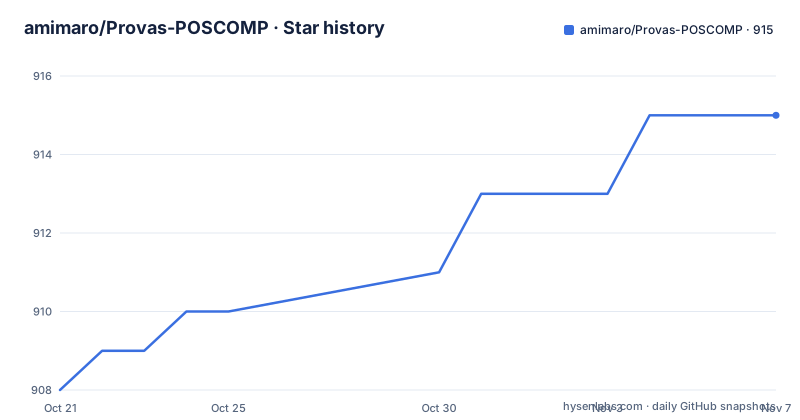
- amimaro/Provas-POSCOMP915 ★ · +7
| Repository | 2026-10-21 | 2026-11-07 |
|---|---|---|
| amimaro/Provas-POSCOMP | 908 | 915 |
7 Stars in the last 17 days, measured from the daily GitHub snapshot. Compare with other projects
Editorial analysis
What the repository actually contains
The whole project is a directory per exam year. There are folders for 2002 through 2019, then a gap, then folders for 2022 through 2026. Alongside them sit README.md and WEBQUESTOES.md, and nothing else at the top level. No build script, no package manifest, no index file, no tests.
Each year folder holds two PDFs with a Portuguese naming scheme. The exam booklet is caderno_YYYY.pdf and the answer key is gabarito_YYYY.pdf, where the YYYY is the year of the exam. The 2022 key breaks the pattern and is named gabarito-2022.pdf with a hyphen instead of a separator, and the 2002 booklet is caderno_fundamentos_2002.pdf, which reflects that the first paper in the collection was a fundamentals exam rather than a standard one.
The repository description states the purpose in one line: exam papers and answer keys for POSCOMP, without the answers being marked. The default branch is master, the last push was on 2026-09-18, and the project publishes no releases, so there is no version to depend on and no tag to pin.
Why the answer boxes are left blank
The distinguishing decision in this project is that the exam booklets are distributed without the answers marked on them. The answer key is a separate document that you open afterwards.
That is a deliberate study design choice rather than an oversight. A candidate working through a POSCOMP paper under time pressure can sit the exam properly, marking their own answers on the sheet, and only then compare against the gabarito. If the correct option were printed on the page, the practice value of the paper collapses.
It also means the answer key cannot be used as a quick lookup table for a question you do not remember. Every check requires two documents, which is slower by design.
The archive spans more than two decades of the same exam, so it also works as a record of how the selection test changed. The format of the question set, the mix of topics and the proportion of computer science questions against mathematics are visible by reading across the years, since the project keeps every year rather than only recent papers.
How to work through a year
There is nothing to install. The papers are plain files in the repository, so the first use is a download and a PDF reader.
Start from the README table, which lists each year with a link to the booklet and a link to the answer key. For the most recent year the entries point at the 2026 and 2025 folders, each containing caderno_YYYY.pdf and gabarito_YYYY.pdf. Open the booklet, work through it, then open the key.
The README also links a webquestoes platform of simulated POSCOMP exams through a separate WEBQUESTOES.md file, with a note that the site itself is in English. It is the interactive counterpart worth trying if static PDFs are not enough.
The README also promotes a chess opening training product, Chesstrophy, and follows the all-contributors specification with a contributors table of seven named people and a badge counting eight. Contributions of any kind are invited, which in practice means adding a year folder with its two PDFs and a row in the README table.
The missing 2020 and 2021 exams
The year sequence is not continuous. The collection runs from 2002 to 2019, skips 2020 and 2021, and resumes at 2022 through 2026. Twenty three years of papers are present.
Nothing in the repository explains the gap. There is no note about a cancelled edition, a licensing problem or a missing upload, and the README table simply does not list those two rows. If you are preparing in 2026, the two missing years sit right at the start of the pandemic period, and the practice value of that jump in the series is not recoverable from here.
The same applies to the naming irregularities. The 2022 key uses a hyphen and the 2002 booklet carries the word fundamentos in its filename. Any script that walks the tree and assumes one naming pattern will need exceptions for at least those two files.
This is what a plain file archive looks like without an index or a manifest. There is no machine readable description of the collection, so a consumer has to discover the structure by browsing.
Where the papers come from
The project attributes its sources at the bottom of the README. The first is the Sociedade Brasileira de Computação, the Brazilian Computer Society, under its documents section for POSCOMP papers and answer keys. The second is Fundatec, the exam organizing foundation, through its publications page for the competition.
Both are the official channels for the exam, so the archive is a redistribution rather than a reconstruction. The PDFs in the year folders are the question booklets and the official keys as those bodies published them.
That provenance matters for anyone worried about accuracy, since the answer key in a gabarito file is the official key rather than a community answer set, and the questions are the ones candidates actually sat. It also means the archive inherits whatever the originals contain, and the project does not document whether the PDFs are text based or scanned images, which changes whether you can search inside them or copy questions into a notes file.
No license, no tags, no automation
The repository declares no license. There is no license file among the top level entries, and the project metadata lists the license as unknown. For a study aid that people read and print, that is a real gap: without a license, the default position under copyright is that redistribution rights are not granted, even though the underlying exams were published by SBC and Fundatec in the first place.
There is also no automation. No script fetches the newest paper, no action checks that a year folder matches the README table, and no release process produces a snapshot of the collection. Each new year is a manual commit of two files and one table row.
Maintenance therefore depends on a small number of people remembering. The README credits the contributors, so the practical channel for a missing year or a broken link is the repository's issue tracker. The last push was on 2026-09-18, which shows recent activity, but the collection as a whole is a hand maintained list of links.
Editorial conclusion
Use Provas-POSCOMP if you are preparing for POSCOMP and want the original papers without the answers printed on the page, since that is exactly what the project chose to publish, and pair it with the linked webquestoes platform when you want timed mock exams instead of static files. Do not use it as a source of record for anything else, because the repository declares no license, ships no tags and hosts nothing beyond PDFs and Markdown files. Before you build anything on it, confirm that the year you need is present, since the collection jumps from 2019 to 2022, and check the answer key file names yourself, since the gabarito naming is not consistent across years.
Frequently asked questions
Which POSCOMP exam years does Provas-POSCOMP include?
The repository holds exam papers and answer keys for 2002 through 2019 and for 2022 through 2026. The years 2020 and 2021 are not present and the collection does not explain why.
How do I get the answer key for a POSCOMP paper in this repository?
Each year folder holds two files, the booklet named caderno_YYYY.pdf and the answer key named gabarito_YYYY.pdf, and the README table links both. The 2022 key is named gabarito-2022.pdf and the 2002 booklet is named caderno_fundamentos_2002.pdf.
Are the answers marked on the POSCOMP exam pages?
No. The project states that the papers are distributed without the answers marked, so the key in the gabarito file is checked only after the candidate finishes the paper.
Is there an interactive POSCOMP mock exam platform from the same author?
The README links a platform of simulated POSCOMP exams through a WEBQUESTOES.md file, and notes that the site itself is in English. The project home page points to webquestoes.com.
Official sources
Add this badge to your README
If you maintain this project, the badge below links readers to this analysis and shows its maintenance status from the daily GitHub snapshot. Paste the markdown into your README; add ?metric=license or ?metric=stars to the image URL for a different field.

[](https://hysenlabs.com/projects/amimaro-provas-poscomp)Star history chart for your README
[](https://hysenlabs.com/projects/amimaro-provas-poscomp)Was this useful?