AniList's docs site generates its GraphQL reference, but flags the explorer as deprecated
AniList API documentation
At a glance
- What is it?
- The AniList docs repository is a VitePress site plus a generator that turns the live GraphQL schema into reference documentation. Its README also marks two of the three documentation surfaces as deprecated, pointing users to Apollo Studio instead, and warns that the statically rendered reference is updated by hand.
- Who is it for?
- Adopt the Apollo Studio explorer against `https://graphql.anilist.co` as your working tool, and treat this repository as the place to read prose guides rather than as the source of truth for the schema. Skip it if you expected an SDK, since there is none here.
- Can I use it commercially?
- Not without permission. GitHub finds no licence file in the repository, and without a licence all rights are reserved by default: you may read the code but not reuse it. Check the README, or ask the authors, before using it.
- Is it still maintained?
- Yes. The repository last received commits 82 days ago.
- What is it written in?
- Mainly TypeScript, according to GitHub's language statistics.
Answers come from the project's GitHub data, last synced on November 7, 2026, and from our analysis. They are not legal advice.
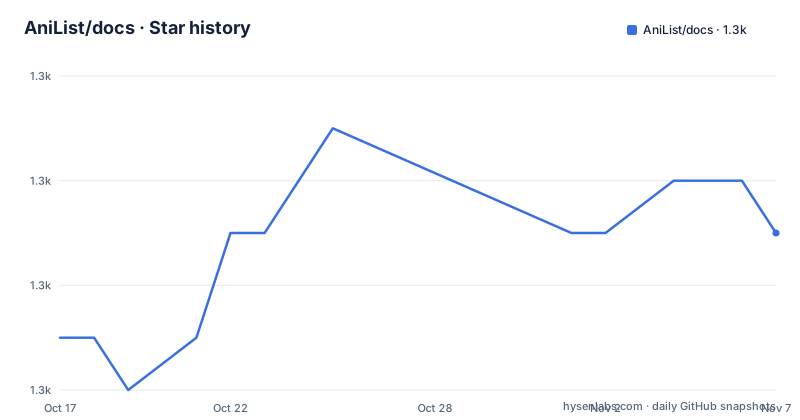
Star history
- AniList/docs1,343 ★ · +2
| Repository | 2026-10-17 | 2026-11-07 |
|---|---|---|
| AniList/docs | 1.3k | 1.3k |
2 Stars in the last 21 days, measured from the daily GitHub snapshot. Compare with other projects
Editorial analysis
The API is GraphQL over half a million entries
The README describes what the AniList GraphQL API provides: quick and powerful access to over 500k anime and manga entries, including character, staff and live airing data.
One sentence carries most of the weight for anyone deciding whether to use it: the AniList and AniChart websites themselves run on the API, so almost everything you can do on the sites you can do via the API.
The topics the repository carries line up with that: anime, manga, GraphQL, API documentation, and AniChart.
It is worth being precise about what this repository is. It is documentation. The primary language is TypeScript and the package name is `anilist-docs`, but there is no client library, no SDK and no code you would import into an application. What is here is the prose guides and the machinery that generates the schema reference.
Three documentation surfaces, two of them deprecated
The README links three places, and the notes attached to two of them are the most useful part of the document.
The first is the API documentation at docs.anilist.co, described as written documentation for getting started with the API. That is the prose: how to authenticate, how to shape a query, how to paginate, written for a person who has not used the API before. No deprecation notice.
The second is the GraphQL API Reference Docs at anilist.github.io/ApiV2-GraphQL-Docs, described as documentation for all queries, mutations, types and objects the API provides. Both lines carry a note: deprecated, try Apollo Studio instead.
The third is a GraphiQL interactive editor at anilist.co/graphiql, described as letting you easily explore and test GraphQL queries against the API. It carries the same deprecation note pointing at Apollo Studio.
So the interactive part of the documentation moved to a hosted GraphQL explorer, and this repository now covers the written guides plus a generated reference.
The recommendation both notes give is the same sandbox explorer configured against `https://graphql.anilist.co`.
One caveat in the note is worth repeating because it is the kind of thing that quietly wastes an afternoon. There are statically rendered reference docs at docs.anilist.co/reference/query, but the README says they are updated manually and may not always be up to date.
Manually updated reference documentation for a GraphQL schema is a design that will drift, and the README admits it. If you need the real schema, introspect it rather than trusting the page.
The reference is generated from the schema with graphql-markdown
The package scripts explain how the reference gets built, and the answer is a generator rather than a hand-maintained site.
"scripts": {
  "docs:dev": "vitepress dev",
  "docs:build": "vitepress build",
  "docs:preview": "vitepress preview",
  "generate:reference": "bun run scripts/genref.ts",
  "postinstall": "patch-package"
}
`generate:reference` runs a TypeScript script under `scripts/` through bun, which is the step that turns the schema into Markdown. The dependency that does the rendering is `graphql-markdown`, which is exactly the tool for converting a GraphQL schema into documentation pages, and `remeda` is the functional data library it uses alongside.
So the reference pages can be generated at build time, which is the right architecture and the reason the live introspection in Apollo Studio and the reference can agree once the script runs.
The remaining scripts are the standard VitePress trio: `docs:dev`, `docs:build` and `docs:preview`. The development site and the built site come from the same source.
The tooling mix is modern in an unremarkable way, which is what you want from a documentation repository. VitePress is the site generator, bun runs the scripts, and the dependency versions are current.
One detail deserves a mention because it explains a class of problems people hit with this repository: `postinstall` runs `patch-package`, and there is a `patches/` directory in the repository. That means the installed dependencies are patched in place after install, so if you skip the install step or run the build in an environment that does not execute postinstall, the documentation build can behave differently from what the author sees. The `patch-package` dependency is pinned in devDependencies for that reason.
What the README leaves out, and where the release history sits
Two silences are worth naming explicitly rather than filling in.
The README does not document rate limits, authentication requirements or the shape of the GraphQL schema itself. It is a pointer document: it tells you what exists and where to read it. If you are evaluating whether you can depend on this API for a production integration, the questions you need answered, such as how many requests per minute are allowed and what happens when you exceed it, are not answered here.
They are also the questions a GraphQL API raises that a REST API does not, because a single GraphQL request can ask for an arbitrarily large graph of related objects. Any evaluation should go and find the limits rather than assume them.
The second silence is the maintenance story. The repository's last push was on 2026-08-18. Its listed releases are 2.8, 2.7.0 and 2.6.1 from March and April 2018.
The package itself is version 1.0.0 with an ISC licence in package.json, while the repository's recorded licence is unknown. For a documentation repository that difference matters little, but it is the kind of inconsistency to settle before you copy anything from it.
Where this repository is the wrong starting point
Three cases.
If you want a client library for AniList, there is none here. This is a documentation site. Whatever SDK or query helper you use, you will be writing GraphQL by hand, and the value of this repository is that it tells you what the fields are and how the sites use them.
If your tooling expects the GraphiQL instance that used to be hosted on anilist.co, that surface is deprecated and you should point at Apollo Studio instead.
If you are reading the statically rendered reference and treating it as authoritative, the README says those pages are updated manually and may lag behind. That is not a reason to avoid them, since they are far more readable than raw introspection output, but it is a reason to check a field against the explorer before you build a parser around it.
What it is genuinely good for is the written guides. An API with a large schema and a first-party consumer app needs prose explaining the intent behind it, and that prose is what this repository holds.
Editorial conclusion
Adopt the Apollo Studio explorer against `https://graphql.anilist.co` as your working tool, and treat this repository as the place to read prose guides rather than as the source of truth for the schema. Skip it if you expected an SDK, since there is none here. Verify first which reference you are reading, because the README says the statically rendered pages are updated manually and may lag behind the live schema.
Frequently asked questions
What is the AniList API and what can I query?
It is a GraphQL API providing access to over 500k anime and manga entries, including character, staff and live airing data. The AniList and AniChart websites run on the same API, so almost anything you can do on the sites you can do through it.
How do I explore the AniList GraphQL API interactively?
The README marks the GraphiQL editor at anilist.co/graphiql as deprecated and recommends the Apollo Studio sandbox explorer configured against `https://graphql.anilist.co` instead.
Is the AniList reference documentation up to date?
The README says the statically rendered reference pages at docs.anilist.co/reference/query are updated manually and may not always be up to date. The reference can also be regenerated from the schema with `bun run scripts/genref.ts`, which uses graphql-markdown through the VitePress site.
Official sources
Add this badge to your README
If you maintain this project, the badge below links readers to this analysis and shows its maintenance status from the daily GitHub snapshot. Paste the markdown into your README; add ?metric=license or ?metric=stars to the image URL for a different field.

[](https://hysenlabs.com/projects/anilist-docs)Star history chart for your README
[](https://hysenlabs.com/projects/anilist-docs)Was this useful?