Rayburst: A Tauri and Aria2 Next Download Manager for Desktop
Redefining the open-source download manager
At a glance
- What is it?
- Rayburst is a Tauri 2 desktop download manager built on the Aria2 Next engine, covering HTTP, BitTorrent, ED2K, and HLS/DASH. It is currently shipping v4.1.2-beta.1, and the README says settings are not imported from its predecessor.
- Who is it for?
- Adopt Rayburst if you want a native Tauri desktop client for the Aria2 Next engine and you are comfortable running a v4.1.2 beta on your own machines. Do not adopt it if you need a long-term supported release line or an uninterrupted upgrade from Motrix Next, because the README states that settings, tasks and history are not imported and that in-app updates may leave both apps installed.
- Can I use it commercially?
- Yes. MIT is a permissive licence: you can use, modify and sell software built on it, as long as you keep its copyright and licence notices.
- Is it still maintained?
- Yes. The repository last received commits 5 days ago.
- What is it written in?
- Mainly TypeScript, according to GitHub's language statistics.
Answers come from the project's GitHub data, last synced on November 14, 2026, and from our analysis. They are not legal advice.
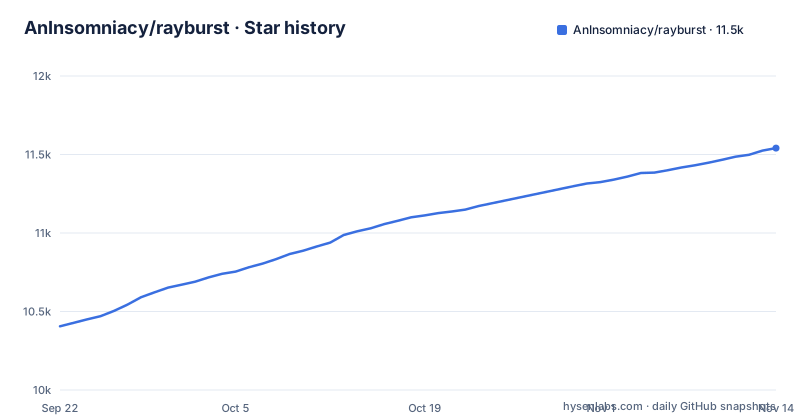
Star history
- AnInsomniacy/rayburst11,541 ★ · +1,135
| Repository | 2026-09-22 | 2026-11-14 |
|---|---|---|
| AnInsomniacy/rayburst | 10.4k | 11.5k |
1,135 Stars in the last 53 days, measured from the daily GitHub snapshot. Compare with other projects
Editorial analysis
What Rayburst Solves, and Who It Is Actually For
Rayburst is a desktop download manager. The README lists the protocols it handles: HTTP, HTTPS, SFTP, ED2K, BitTorrent, Magnet, and .torrent tasks, plus HLS and DASH media with native track selection, subtitles, live recording, and MP4 or MKV output. That is a wider protocol set than most browser download shelves offer, and it is the reason someone would install a separate application at all. The audience is people who routinely pull large files, media streams, or torrents and want queue control, per-task speed limits, and a completed-download history. It is not aimed at someone who downloads a PDF once a month.
The project was previously named Motrix Next, and the README is direct about the consequence: "Settings, tasks and history are not imported; keep your downloaded files." It also warns that in-app updates may leave both apps installed or retain old shortcuts,. Treat the rename as a real migration rather than a cosmetic change.
The stated design goal is a native desktop app rather than a web wrapper: Tauri 2 with a Rust backend, and Aria2 Next as the engine. Aria2 Next is described in the README as a maintained fork of aria2 that preserves the original interfaces while moving to CMake and adding native ED2K and HLS/DASH support. So Rayburst is a front end over a fork of a well-known CLI downloader, which is a useful framing when you decide whether to trust it.
How the Tauri Shell, Rust Backend and Aria2 Next Engine Fit Together
The repository layout confirms the split. There is a src/ directory holding the Vue and TypeScript front end, and a src-tauri/ directory for the Rust side, with Vite as the build tool and vitest for tests. The package.json lists the Tauri plugin set the app depends on: updater, store, fs, dialog, deep-link, log, os, process, shell, clipboard-manager, and opener. Those plugin names map closely to the features the README advertises, and they tell you where state lives: the store plugin for persisted settings, SQLite for completed history, the updater plugin for the release channels.
The most interesting architectural claim is lightweight mode. The README says that when the app is minimized to the tray, the WebView is destroyed while Rust keeps the engine, task monitor, notifications, history, and extension routing alive. That is a real trade-off, not a marketing line. You get a lower memory footprint when the window is hidden, and in exchange the UI has to be reconstructed when you bring it back. Whether that reconstruction is fast is not something the README quantifies.
Browser integration runs through what the README calls an Embedded Extension API, with independent authentication, download confirmation, smart auto-submit, filename hints, referer and cookie forwarding, and real-time controls. The companion extension lives in a separate repository, AnInsomniacy/rayburst-connect. The Flatpak note adds a concrete constraint: that package does not register the browser's native-messaging host, so you must start Rayburst manually before connecting the extension. That is a packaging limitation, not a bug in the app, but it changes the setup order for Flatpak users.
Installing Rayburst and Running a First Download
The README points to GitHub Releases as the main distribution channel for desktop builds, with the website at rayburst.pages.dev as the project page. The macOS and Windows sections describe downloading an installer by hand.
On macOS you pick the disk image matching your machine. The README gives this table: Apple Silicon uses Rayburst_x.x.x_aarch64.dmg and Intel uses Rayburst_x.x.x_x64.dmg. The .app.tar.gz artifacts exist for the Tauri updater, not for manual installation.
On Debian or Ubuntu, the README gives a single dpkg command. Substitute the version you actually downloaded:
sudo dpkg -i Rayburst_x.x.x_amd64.debFedora and RHEL use the RPM instead:
sudo rpm -i Rayburst-x.x.x-1.x86_64.rpmFor distributions without a native package, the AppImage needs its executable bit set before it will run:
chmod +x Rayburst_x.x.x_amd64.AppImage
./Rayburst_x.x.x_amd64.AppImage
The README states that all formats are available for both x64 and ARM64. If you prefer a sandboxed package, FlatPark publishes a community-maintained Flatpak for x64, and the README gives the remote and install commands:
flatpak remote-add --if-not-exists flatpark https://dl.flatpark.org/flatpark.flatpakrepo
flatpak install flatpark dev.aninsomniacy.rayburst
Two caveats come with that route. The README says the in-app updater cannot update the Flatpak package, so you use flatpak update dev.aninsomniacy.rayburst instead, and you must start Rayburst manually before connecting the browser extension. On Windows, the README describes the installer as taking about ten seconds with no reboot required. If macOS reports the app as damaged and will not open, the README defers to its own FAQ rather than giving the fix inline, so that is where to look.
Where Rayburst Gets in the Way
The rename is the largest practical problem, and the README treats it as an open item rather than a finished one. Settings, tasks, and history do not carry over from Motrix Next. If you have a queue of half-finished downloads and a history you rely on, upgrading means rebuilding both by hand. The README also warns that in-app updates may leave both applications installed or keep old shortcuts around, which means a clean uninstall of the previous app is a manual step, not something the updater performs for you.
The version number is the second issue. The current tag is v4.1.2-beta.1, and two of the three most recent releases are betas; v4.1.1 is not marked beta. If your team pins software versions for compliance or support reasons, a download manager whose newest release is a beta and that also changed its own name is a poor fit.
The Flatpak path is narrower than it first appears. It is x64 only, it is community-maintained rather than published by the project, and the in-app updater does not work with it. You also lose the automatic browser native-messaging registration, so the extension workflow becomes a two-step manual sequence every session. For a user whose main reason to install Rayburst is browser handoff, that removes most of the benefit.
Rayburst Against Plain Aria2 and Against Motrix Next
The most direct alternative is the engine underneath: aria2 itself, or the Aria2 Next fork, driven from the command line or through its JSON-RPC interface. The difference in approach is the whole point of the project. Aria2 gives you a daemon and a protocol surface with no desktop shell, no tray, no notification integration, and no browser handoff out of the box. Rayburst adds a Tauri 2 window, a Vue front end, system tray operation with optional speed display, macOS Dock badge and progress, protocol handlers for magnet://, ed2k://, thunder://, and rayburst://, plus native start, complete, and failure notifications. If you are comfortable scripting aria2 and running it as a service, Rayburst's main value proposition does not apply to you, and the CLI is the simpler dependency.
The other comparison is with its own predecessor, Motrix Next. Here the difference is not architectural, since Rayburst is the continuation of that codebase under a new name and with Aria2 Next as the engine. The difference is operational: a new identity, a current release line at v4.1.2-beta.1, no settings migration, and a possible overlap of both installs on the same machine. Anyone already running Motrix Next is being asked to re-onboard, not to upgrade.
Rayburst also differs from a browser's built-in downloader in a way that matters for media. The README documents HLS and DASH handling with track selection, subtitle support, live recording, resumable media downloads, and MP4 or MKV output. A browser will play those streams; it will not reliably save them as a chosen container with chosen tracks. That capability, more than raw throughput, is what justifies a separate application here.
Maintenance, Licence and Upgrade Cost
The repository is not archived, and the last push was on 2026-10-29, the same day as the v4.1.2-beta.1 release, so the project is being worked on right now. The three most recent releases landed within five days of each other, which suggests rapid iteration on the beta line rather than a settled release cadence.
Upgrade cost has three parts. First, the rename: the README recommends uninstalling the previous desktop app before installing Rayburst, and states that in-app updates may leave both installed or retain old shortcuts, so each upgrade may need manual cleanup. Second, the update channels: the README describes Stable, Beta, and Latest Across Channels policies with separate download and install phases, so you choose how much churn you accept. Third, the Flatpak exception, where the in-app updater does not apply at all and you update through flatpak instead.
The licence is MIT, which permits commercial use, modification, and redistribution provided the copyright notice and permission notice are retained. That is a permissive arrangement, and the practical consequence is that you can bundle or fork Rayburst without a copyleft obligation. Note that the download engine is a separate project, AnInsomniacy/aria2-next, with its own licence, so check it separately if the engine's terms matter to you. This is a description of the licence text, not legal advice.
Editorial conclusion
Adopt Rayburst if you want a native Tauri desktop client for the Aria2 Next engine and you are comfortable running a v4.1.2 beta on your own machines. Do not adopt it if you need a long-term supported release line or an uninterrupted upgrade from Motrix Next, because the README states that settings, tasks and history are not imported and that in-app updates may leave both apps installed. Before installing, check the release page and confirm your platform's format (dmg, setup.exe, deb, rpm, AppImage, or the FlatPark Flatpak) is published for the version you intend to run.
Frequently asked questions
Is Rayburst free and open source?
Yes. The repository is licensed under MIT, which permits commercial use, modification and redistribution as long as the copyright and permission notices are kept. The download engine, Aria2 Next, is a separate project with its own licence.
Which platforms does Rayburst support?
The README lists macOS, Windows and Linux. macOS ships as .dmg files for Apple Silicon and Intel, Windows as x64 and ARM64 installers, and Linux as .deb, .rpm and .AppImage for x64 and ARM64, plus a community-maintained Flatpak on FlatPark for x64.
Does Rayburst import my settings from Motrix Next?
No. The README states that settings, tasks and history are not imported, and recommends uninstalling the previous desktop app before installing Rayburst. Downloaded files are kept.
Official sources
Add this badge to your README
If you maintain this project, the badge below links readers to this analysis and shows its maintenance status from the daily GitHub snapshot. Paste the markdown into your README; add ?metric=license or ?metric=stars to the image URL for a different field.

[](https://hysenlabs.com/projects/aninsomniacy-rayburst)Star history chart for your README
[](https://hysenlabs.com/projects/aninsomniacy-rayburst)Was this useful?