Anranawsl: a link list, not a codebase
WeChat public account OMGA: free or discounted premium accounts (Baidu Netdisk Super VIP, Youku, Mango TV, Bilibili, Tencent Video, NetEase Cloud Music, iQiyi, Himalaya, etc.), paid downloads from Baidu Wenku and academic databases, unrestricted proxy nodes (SS/SSR/V2ray), and video link parsing - shared free daily.
At a glance
- What is it?
- This repository holds markdown pages of account shares, discount codes and download links, with a handful of outbound URLs on the README. There is no software in it to install.
- Who is it for?
- There is nothing here to install, no library to import and no command to run, so the only real question is whether you want a bookmark list. The repository is one README of outbound links plus five numbered markdown pages and two content folders, and those links point at short-lived external sites rather than anything self-hosted.
- Can I use it commercially?
- Not without permission. GitHub finds no licence file in the repository, and without a licence all rights are reserved by default: you may read the code but not reuse it. Check the README, or ask the authors, before using it.
- Is it still maintained?
- Yes. The repository last received commits 11 days ago.
- What is it written in?
- Mainly HTML, according to GitHub's language statistics.
Answers come from the project's GitHub data, last synced on October 31, 2026, and from our analysis. They are not legal advice.
Star history
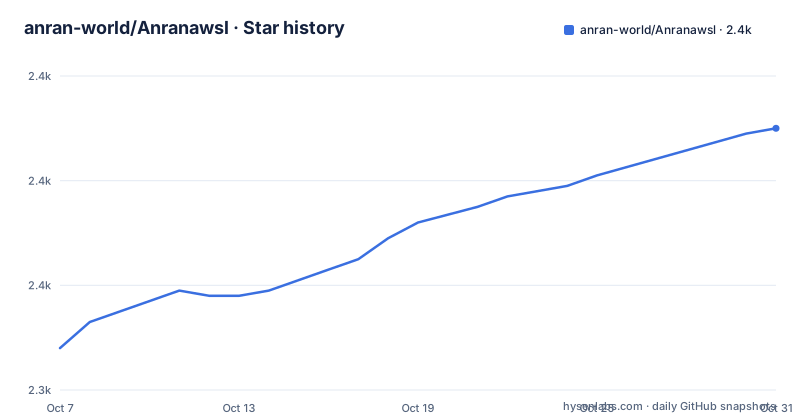
- anran-world/Anranawsl2,390 ★ · +42
| Repository | 2026-10-07 | 2026-10-31 |
|---|---|---|
| anran-world/Anranawsl | 2.3k | 2.4k |
42 Stars in the last 24 days, measured from the daily GitHub snapshot. Compare with other projects
Editorial analysis
The whole repository is markdown and an img folder
Start with the file tree, because it settles the question immediately. There is no `src/`, no `package.json`, no `requirements.txt`, no build script and no test directory. The repository is a README, five numbered markdown files with Chinese titles, a `5.` backup page, an `Archive/` directory, an `img/` folder for images, a folder for tracker updates, and a folder for cloud drive resource shares.
The primary language recorded for the repository is HTML, which sounds odd until you look at the README source. The top of the file is a centred block of anchor tags, one per link, with a second group styled as buttons. The rest of the page is a numbered navigation list of those same links, a Star History chart, and a short line asking readers to star the repository if they like it.
So there is no build step to describe and no first command to run. What a reader does here is click through links, which is a legitimate use for a bookmark repository and is worth naming before anyone wonders what the deep analysis is supposed to find.
What the outbound links point at
The README navigation is a numbered list, and the entries describe the categories without needing translation. Entry one is a page of shared premium accounts across cloud storage and video services. Entry two is an archive of tutorials, techniques and resources. Entry three is a page about free money or credits. Entry four is a page about automated discount or points collection on a shopping site. Entry five points off to an external site for breaking news and promotions.
The rest of the list continues in the same register: a low-cost premium cloud storage page, a Telegram channel for assorted promotions, a recommendation link, and another page about resource downloads and transfers on request.
The block of anchors at the top of the README points at a mix of a personal storefront, an online shop, a Telegram channel, two recommendation domains, a Vercel-hosted site for news sharing, a category-version site, and a proxy or node service described in the repository topics as ss-ssr and v2ray.
Worth stating plainly: several of these destinations are commercial or affiliate operations run outside the repository. A link list cannot vouch for where its links lead today.
Topics, licence and maintenance tell the same story
The repository topics are baidusvip, fuli, ss-ssr, v2ray, vip and ziyuan, which reads as the same promotional vocabulary as the README rather than a technical taxonomy. There is no licence recorded. That is unusual for a repository people might be tempted to reuse, and it is the practical reason not to fork the content without asking.
There are no GitHub releases either, which is consistent with a repository that is not a released artefact. The default branch is `master` and the last push was on 2026-09-25, so the links do get refreshed from time to time. That is worth knowing: a link list is only as good as its last edit, and the useful signal here is the push date rather than anything in the code.
The repository description field is the place to find the full scope in one block, and it is unusually long. It lists premium account categories for cloud storage, several video services, music and audio services, stock image libraries, document services, plus paid file transfers, video parsing from across the web, and collections of out-of-print resources. It closes with an invitation to recommend and share with friends.
Why Google sends you to this page for the wrong question
An observation worth making, because it explains a search behaviour that would otherwise look strange. The repository name is a string of letters that does not match any common search term, so Google fills the gap by matching the words people actually type. Type a phrase with the letters a-n-r-a-n into a search box and the results will include questions about intranasal drug administration, because that is where those letters lead in the wider web.
The project description and the README contain almost no English prose, which removes the other signal that would normally tell a search engine what the page is about. What remains is a set of anchors and a Chinese navigation list.
The practical effect is that anyone arriving from a general web search rather than the GitHub URL is not arriving with a clear idea of what they are looking at. This is a property of link collections with opaque names, not a defect in any particular one.
What a reader can actually take from it
If you want to judge whether this repository is worth your time, the useful question is whether you wanted a curated list at all. The markdown pages are organised by topic, which is better than an undifferentiated link dump, and the Archive folder suggests older material has been set aside rather than deleted.
What it will not give you is anything you can depend on. There is no API, no package, no vendored code, no documentation beyond the link text, and no tests. Nothing here is versioned in a way you can pin. The images in `img/` and the README chart are presentation assets, and the README embeds them rather than generating them.
The comparison that fits is a browser bookmark folder or a notes file that happens to be public. That is a real category of useful repository, and treating it as one keeps the expectations right. Anyone hoping for a tool, a library or a dataset will not find one here.
Verdict for people scanning open source projects
This is not an open source project in the sense most people mean, and it is not useful to pretend otherwise in order to make it sound more substantial. It has no licence, no code, no releases and no tests. Its value is entirely in the links a person maintains, and that value decays as those links change.
The one thing a technical reader can learn from it is about link rot and provenance. Every entry here is a pointer to somewhere else, and none of the destinations are versioned or verifiable from this repository. If you find something on a page like this that you want to use, find its source and depend on that instead.
So: worth a glance if you were looking for a promotional link list, worth nothing as a dependency. The last push was on 2026-09-25, and that date is the most informative line in the whole repository.
Editorial conclusion
There is nothing here to install, no library to import and no command to run, so the only real question is whether you want a bookmark list. The repository is one README of outbound links plus five numbered markdown pages and two content folders, and those links point at short-lived external sites rather than anything self-hosted. Treat it as a reading list, not a dependency: nothing in it can break your build, and nothing in it will keep working either. If you are evaluating open source projects, this one sits outside that category entirely.
Frequently asked questions
What does the Anranawsl repository contain?
Markdown pages of account shares, promotional codes and download links, plus an img folder for images and an Archive directory. The tree has no source directory, no package manifest and no test suite, so there is no software to install.
Is Anranawsl licensed for reuse?
No licence is recorded for the repository, which is why the content should not be forked or republished without asking. The repository topics and description cover promotional categories rather than a technical taxonomy.
How often is the Anranawsl link list updated?
The default branch is `master` and the last push was on 2026-09-25. There are no GitHub releases, so the push date is the only freshness signal the repository offers.
Can I use anything from Anranawsl in a project?
There is no library, API or dataset to depend on. The repository only points at external sites, so if something there is useful, trace it back to its original source and use that instead.
Official sources
Add this badge to your README
If you maintain this project, the badge below links readers to this analysis and shows its maintenance status from the daily GitHub snapshot. Paste the markdown into your README; add ?metric=license or ?metric=stars to the image URL for a different field.

[](https://hysenlabs.com/projects/anran-world-anranawsl)Star history chart for your README
[](https://hysenlabs.com/projects/anran-world-anranawsl)Was this useful?