reset-css is one file and no inventory of what it resets
A collection of styles that reset the styles of certain elements in the browser
At a glance
- What is it?
- Anurella's reset-css is a single stylesheet presented as an updated, generic reset you are meant to adapt, and its README gives two installation options. The absence of a documented rule list is both its most obvious limitation and the reason the file has to be read before it is copied into anything.
- Who is it for?
- Adopt reset.css if you are starting a project from nothing and want a baseline rather than writing your own, since its stated derivation is inspection of modern, well-built sites. Do not drop it into an existing codebase, because the README explicitly advises against that unless you are prepared to address layout and style changes.
- Can I use it commercially?
- Yes. MIT is a permissive licence: you can use, modify and sell software built on it, as long as you keep its copyright and licence notices.
- Is it still maintained?
- Yes. The repository last received commits 95 days ago.
- What is it written in?
- Mainly CSS, according to GitHub's language statistics.
Answers come from the project's GitHub data, last synced on October 23, 2026, and from our analysis. They are not legal advice.
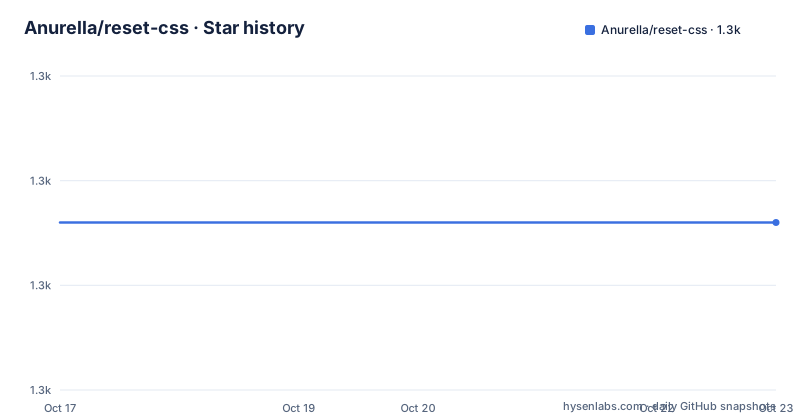
Star history
- Anurella/reset-css1,266 ★ · +0
| Repository | 2026-10-17 | 2026-10-23 |
|---|---|---|
| Anurella/reset-css | 1.3k | 1.3k |
0 Stars in the last 6 days, measured from the daily GitHub snapshot. Compare with other projects
Editorial analysis
What the reset is for
The README's opening argument is specific enough to be useful. Browsers ship with default styles, and those defaults can create, or appear to create, inconsistencies when building across different browsers. The example given is line-height: differences there affect spacing, height and alignment.
That is the right example, because line-height is the property most likely to make a layout look subtly wrong in a way that is hard to trace. Headings reset their font size in most browsers, form controls have their own sizing, and margins on paragraphs and lists differ. None of it is wrong, but it is inconsistent, and inconsistency at the base of a design system propagates.
The second point is that browser standards have improved and inconsistencies have reduced, so this is offered as a useful starting point rather than a necessity. A README that concedes the problem is smaller than it used to be is more credible than one that claims a reset is essential.
The reset is therefore a starting position rather than a specification. What you take from it is the difference between the browser's idea of a paragraph and your idea of one.
Where it sits in the reset lineage
The README places this project in a lineage and that placement explains its design.
One of the earliest widely used reset stylesheets was Eric Meyer's, from 2011, and the README notes that Eric recommended tailoring resets to suit your needs. That recommendation is the important part, and it is the opposite of how resets are often used, where a file is installed wholesale and then treated as invisible.
The stated position of this project is that a lot has changed since 2011 and what is provided is an updated, generic reset you can adapt. Generic is the operative word: nothing in the README claims this reset targets a framework, a design system or a class of applications.
The origin is stated just as plainly. The stylesheet is described as a collection based on real usage from work done and inspection of modern, well-built sites, and it is intended to be a strong baseline you can modify to suit your needs.
That is a different claim from a reset built by surveying every stylesheet on the internet. The origin is somebody's working practice, cleaned up and published. Whether that suits you depends on whether their taste matches yours, which is an argument for reading the file before committing to it.
Two ways to install, and where order matters
Installation is either copying the file into the project or importing it, and the README is explicit about the position the import has to occupy.
Copying `reset.css` into the project puts it under version control with everything else and makes it obvious to a reviewer what is being reset.
The alternative is to import it at the top of the main stylesheet so that it loads before your app styles:
@import "./reset.css";The ordering is the whole point of that second option. When specificity is otherwise equal, styles that appear later can override the reset without a specificity hack. If the reset loads after the app styles, everything it sets becomes the opinion nobody can override without a specificity hack, which defeats the point.
One practical note that the README does not raise: `@import` is a CSS feature rather than a bundler feature, and bundlers handle it differently. Some will inline it at build time, some will emit a separate request, and some will warn about placing it before other rules. Either approach works, but knowing which one your build does tells you whether the reset is a separate network request, which matters more on a reset than it would on most files.
The manual copy avoids the question entirely.
The warning is the most useful advice in the README
There is a short note under the installation instructions and it is the most consequential line in the file.
Apply the reset as the starting base of a project, and that is the way it is best applied. And avoid introducing it into an existing codebase unless you are prepared to address layout and style changes.
That second sentence is a warning about the actual failure mode people hit. Introducing a reset into a working application is not a safe operation, because every element the reset touches changes size, margin or default appearance at once. The build passes, the tests pass if they do not assert on layout, and the result is a site that looks wrong in ways that take a long time to attribute.
The advice follows logically from the first. A reset is a starting point, and starting points only work when nothing is built on top of them yet.
So the README is drawing a line between two very different use cases. Introducing this into a new project is the intended one. Introducing it into an existing one is possible, and the project does not claim it is safe.
What the repository contains, and what is missing from it
The repository has five top-level entries: `.github/`, `.gitignore`, `LICENSE`, `README.md` and `reset.css`. That is the entire project, and there is no package.json, no build step, no test suite and no documentation site.
The licence is MIT, with a LICENSE file at the root.
The version story is thin in the same way. There is one release, v1.0.2, tagged on 2026-02-22, and the last push was on 2026-07-20. The repository is not archived.
The absence that matters is documentation of the reset itself. The README does not enumerate which elements are reset, which properties are touched, or what opinion is taken on any of it. There is no table of rules and no explanation of the choices. So the file has to be read before it is used, and if you are adopting it as a baseline for a project with a visual identity, reading it is not optional.
That absence is consistent with the project's stated philosophy. A reset you are meant to adapt is one you are meant to understand. A rule list would invite copying without comprehension, which is the behaviour the README spends its short length arguing against.
Whether that is the right trade is a judgement about your team. For a single developer starting a side project, opening one file is cheap. For a team that wants to know what changed in their rendering, the absence of a rule list is a cost, and the right response is to diff `reset.css` against the browser's default styles once, at the start, and keep that diff in your own repository.
Editorial conclusion
Adopt reset.css if you are starting a project from nothing and want a baseline rather than writing your own, since its stated derivation is inspection of modern, well-built sites. Do not drop it into an existing codebase, because the README explicitly advises against that unless you are prepared to address layout and style changes. Verify first by reading reset.css end to end, since the README does not list what the reset actually changes, and check that your build handles a stylesheet import before your app styles rather than an extra network request.
Frequently asked questions
How do I use the Anurella reset-css stylesheet?
Either copy reset.css into your project, or import it at the top of your main stylesheet with `@import "./reset.css";` so that it loads before your app styles.
Can I add reset-css to an existing codebase?
The README advises against it unless you are prepared to address layout and style changes. It says the reset should be applied as the starting base of a project, which is the way it is best applied.
What does reset.css actually reset?
The README does not enumerate the rules. It describes the stylesheet as a collection based on real usage from work done and inspection of modern, well-built sites, intended as a strong baseline to modify, so the file itself is the specification.
What license is reset-css under?
MIT, with a LICENSE file at the repository root. The repository has a single release, v1.0.2 from 2026-02-22, and the last push was on 2026-07-20.
Official sources
Add this badge to your README
If you maintain this project, the badge below links readers to this analysis and shows its maintenance status from the daily GitHub snapshot. Paste the markdown into your README; add ?metric=license or ?metric=stars to the image URL for a different field.

[](https://hysenlabs.com/projects/anurella-reset-css)Star history chart for your README
[](https://hysenlabs.com/projects/anurella-reset-css)Was this useful?