Apache Amoro puts a management layer over Iceberg, Hive and Paimon tables
Apache Amoro(incubating) is a Lakehouse management system built on open data lake formats.
At a glance
- What is it?
- Apache Amoro is a Java Lakehouse management system that adds a catalog service, asynchronous table optimization and format specific plugins around open table formats. It fits teams whose lakehouse writes fine but whose maintenance and catalog layers nobody owns.
- Who is it for?
- Amoro fits teams that already run Flink, Spark, Hive or Trino against open table formats and cannot spare the engineering time to write compaction, expiration and catalog glue themselves. It is a poor fit if you need a single engine to do everything, since the mixed format support matrix has real gaps, and a poor fit for teams that only want managed Iceberg without a service to operate.
- Can I use it commercially?
- Yes. Apache-2.0 is a permissive licence: you can use, modify and sell software built on it, as long as you keep its copyright and licence notices.
- Is it still maintained?
- Yes. The repository last received commits 3 days ago.
- What is it written in?
- Mainly Java, according to GitHub's language statistics.
Answers come from the project's GitHub data, last synced on November 8, 2026, and from our analysis. They are not legal advice.
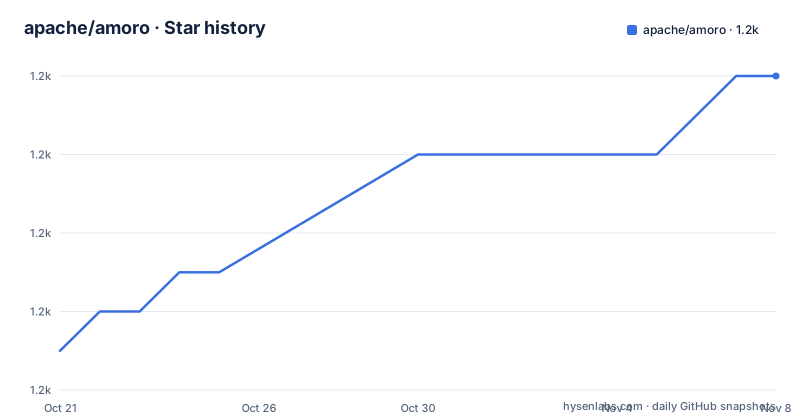
Star history
- apache/amoro1,202 ★ · +7
| Repository | 2026-10-21 | 2026-11-08 |
|---|---|---|
| apache/amoro | 1.2k | 1.2k |
7 Stars in the last 18 days, measured from the daily GitHub snapshot. Compare with other projects
Editorial analysis
A management layer for tables that outlive the job that wrote them
Apache Amoro sits in the layer that most lakehouse teams end up building for themselves: the one that keeps tables healthy after the writing job has finished. The project describes itself as a Lakehouse management system built on open data lake formats, and the emphasis falls on management rather than on inventing a new storage format. That framing decides who should look at it. If your problem is getting data into the platform, Amoro is the wrong tool. If your problem is that a Flink job emits a stream of small files, or that a Hive table and an Iceberg table live in two separate catalogs, or that nobody has deleted a snapshot from last year, then a management layer is exactly what is missing. Amoro is written in Java, is released under Apache-2.0, and is still an incubating project inside the Apache Software Foundation.
AMS owns the catalog, plugins do the work
The components are easy to separate once you read the architecture notes. The Amoro Management Service, abbreviated AMS, provides the management features such as self-optimizing and data expiration, and it also provides a unified catalog service for all compute engines that can be combined with an existing metadata service such as Hive Metastore or AWS Glue. Around that core sit plugins. The optimizer plugin is the self-optimizing execution engine, the terminal plugin offers SQL command line tools with local Spark and Kyuubi implementations, and the LogStore plugin is described as providing millisecond to second level SLAs for real-time data processing based on message queues like Kafka and Pulsar. The repository layout reinforces that split, with separate modules for amoro-ams, amoro-optimizer, amoro-web, amoro-metrics, an amoro-openapi-sdk and a format module for each supported format, plus amoro-mcp-server, amoro-format-hudi and amoro-format-lance.
Four table formats, and one of them is only inspected
Amoro supports four table formats, and the differences between them decide where the system can be placed. With the Iceberg format, users hand their Iceberg tables to Amoro for maintenance while keeping the full set of Iceberg table features. Mixed-Iceberg adds a set of more optimized formats for streaming update scenarios on top of Iceberg, aimed at workloads with high performance requirements on streaming updates or a need for CDC incremental data reading. Mixed-Hive is the migration path: a Hive table is upgraded to Mixed-Hive through metadata migration only, and the original Hive tables can still be used normally, which is the argument for teams that do not want to disturb business built on Hive. Paimon is the odd one out. Amoro supports displaying metadata information in the Paimon format, including Schema, Options, Files, Snapshots, DDLs and Compaction information, which reads as inspection rather than management.
The mixed format support matrix has holes worth reading first
The most useful thing the project publishes is a per engine support table for the mixed format, because it shows where the combinations end. Flink 1.18.x, 1.19.x and 1.20.x cover batch read, batch write, streaming read, streaming write and create table, but batch overwrite and alter table are marked unsupported. Spark 3.3, 3.4 and 3.5 cover batch read, batch write, batch overwrite, create table and alter table, with no streaming read or streaming write. Hive 2.x and 3.x, and Trino 406, are the narrowest rows: batch read, batch overwrite and alter table, with no batch write, no streaming read or write, and no create table. A team that plans to stream through Flink and then run analytical overwrites in Spark can cover both, but a team that expects one engine to do everything cannot.
Self-optimizing runs asynchronously, which is the point
The optimizer plugin is the part that decides whether Amoro earns its place. It is described as an asynchronous execution engine that performs merging, sorting, deduplication, layout optimization and other operations on all type table format tables. Asynchronous is the operative word here, because maintenance then happens outside the query path instead of competing with the dashboards reading the same table. The README lists compacting small files, handling change files and regularly deleting expired files as part of the same loop, and names both query performance and storage cost reduction as the outcome. The LogStore plugin is the near real time counterpart on the write side. What the documentation does not give you is a sizing guide, so how many optimizer workers to run against a given table volume is something you have to determine against your own data.
The deployment pieces are in the repository, the install steps are not
This is the thinnest part of the documentation, and it is worth being blunt about it. The project tells readers to learn more at amoro.apache.org and to reach the community through the mailing list, but the README does not contain a step by step installation. The repository does show the shape of a deployment: a docker directory, a charts directory for Helm style packaging, a dist directory, and a Maven wrapper mvnw with a pom.xml at the root, alongside build, dev, docs, grafana, http and tools directories. The reader is therefore left to work out the container image, the service configuration and the catalog backend on their own. Once the service is running, the terminal plugin with its local Spark and Kyuubi implementations and the WEB UI are the two documented ways in.
An incubating project with a licence that covers binaries
The repository is not archived and the last push was on 2026-10-15, so the code is still moving. The release history is short and clearly marked incubating: v0.8.1-incubating on 2025-09-11, v0.8.0-incubating on 2025-05-08 and v0.7.1-incubating on 2024-11-20. Those gaps are months rather than weeks, so treat an upgrade as a planned event. Once Amoro manages a table, format level changes can reach the physical layout of data that existing queries already read, and there is no documented rollback in the README. On licensing, the project uses Apache-2.0 and carries LICENSE, LICENSE-binary, NOTICE and NOTICE-binary files at the root plus a licenses-binary directory, so redistributed binaries carry the standard attribution and notice obligations. Review the licenses directory for the artifacts you mirror internally rather than assuming one file covers the whole distribution.
Editorial conclusion
Amoro fits teams that already run Flink, Spark, Hive or Trino against open table formats and cannot spare the engineering time to write compaction, expiration and catalog glue themselves. It is a poor fit if you need a single engine to do everything, since the mixed format support matrix has real gaps, and a poor fit for teams that only want managed Iceberg without a service to operate. Before adopting, check the engine and operation pairs your workload needs against the mixed format support table, then read the deployment and configuration pages on amoro.apache.org, because the README does not document a full install sequence or a rollback path.
Frequently asked questions
Which table formats can Apache Amoro manage?
Four: Iceberg, Mixed-Iceberg, Mixed-Hive and Paimon. For Paimon, Amoro supports displaying metadata information such as Schema, Options, Files, Snapshots, DDLs and Compaction information, while the other three formats are managed through the optimizer and expiration features.
Can Apache Amoro be used with Flink, Spark, Hive and Trino together?
The README publishes a support matrix for the mixed format, and the four engines cover different operation sets. Flink handles streaming read and write, Spark handles batch overwrite and alter table, and Hive and Trino are limited to batch read, batch overwrite and alter table.
How do you install Apache Amoro?
The README does not give a step by step install and instead points to the project site at amoro.apache.org. The repository does contain a docker directory, a charts directory, a dist directory and a Maven wrapper mvnw at the root, so the deployment pieces are visible even though the steps are not written down there.
Is Apache Amoro still being developed?
The repository is not archived and the last push was on 2026-10-15. Recent releases include v0.8.1-incubating dated 2025-09-11, v0.8.0-incubating dated 2025-05-08 and v0.7.1-incubating dated 2024-11-20.
Official sources
Add this badge to your README
If you maintain this project, the badge below links readers to this analysis and shows its maintenance status from the daily GitHub snapshot. Paste the markdown into your README; add ?metric=license or ?metric=stars to the image URL for a different field.

[](https://hysenlabs.com/projects/apache-amoro)Star history chart for your README
[](https://hysenlabs.com/projects/apache-amoro)Was this useful?