Apache InLong: five modules for ingestion, convergence, caching, sorting and management
Apache InLong - a one-stop, full-scenario integration framework for massive data
At a glance
- What is it?
- Apache InLong is an Apache top level project for massive data integration, carrying three jobs at once: data ingestion, data synchronization and data subscription. Its module names mirror the pipeline it was built to run at Tencent, and the README documents no build or deploy command, only the module list and the project site.
- Who is it for?
- InLong fits a team that already runs a large reporting platform and needs ingestion, buffering, sorting and subscription handled by one stack rather than assembled from a message queue and batch jobs, and its five module boundaries make that scope legible. Skip it for a handful of pipelines, because the operational surface is a Maven multi module project with a manager, a dashboard and a standalone sorter, not a single service.
- Can I use it commercially?
- Yes. Apache-2.0 is a permissive licence: you can use, modify and sell software built on it, as long as you keep its copyright and licence notices.
- Is it still maintained?
- Yes. The repository last received commits 53 days ago.
- What is it written in?
- Mainly Java, according to GitHub's language statistics.
Answers come from the project's GitHub data, last synced on November 6, 2026, and from our analysis. They are not legal advice.
Star history
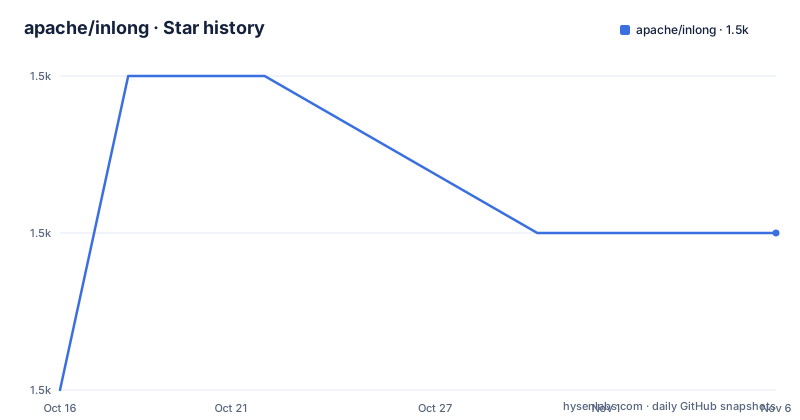
- apache/inlong1,507 ★ · +1
| Repository | 2026-10-16 | 2026-11-06 |
|---|---|---|
| apache/inlong | 1.5k | 1.5k |
1 Stars in the last 21 days, measured from the daily GitHub snapshot. Compare with other projects
Editorial analysis
One framework doing ingestion, synchronization and subscription at once
The pitch in the first paragraph is breadth: a one stop, full scenario integration framework for massive data that supports Data Ingestion, Data Synchronization and Data Subscription, with automatic, secure and reliable transmission. What makes that more than three labels is the statement that batch and stream processing are supported at the same time. A reporting platform that has to land a daily batch and also keep a live feed current usually ends up with two systems, and this is the claim that they do not have to. The README positions the project for environments that need to build a data reporting platform quickly, for ultra large scale reporting, and for cases where reported data must be sorted and landed automatically. The name comes from a creature in Chinese mythology said to guide the river into the sea.
The five modules are the original Tencent pipeline, still in the tree
InLong was built at Tencent to support a reporting service the README describes as more than 80 trillion data pieces per day, and it names the five modules that platform integrated: Ingestion, Convergence, Caching, Sorting and Management. The repository layout keeps that vocabulary almost literally. inlong-agent and inlong-dataproxy sit at the ingestion end, inlong-tubemq is the messaging component carrying data through, inlong-sort and inlong-sort-standalone handle the sorting stage, inlong-manager is the control plane, and inlong-dashboard is the web interface. Around them sit inlong-common for shared code, inlong-sdk for client integrations, inlong-audit for auditing, inlong-tools for utilities and inlong-distribution for packaging. Reading those directory names tells you more about the architecture than any diagram in the README.
Three entry points, and the README documents none of them in commands
There is no install snippet on this page. The README's deployment section is truncated before it reaches any, so nothing here invents one. What it does list is the shape of a first use, and it names three ways in: integrate InLong and manage data streams through an SDK, use the InLong command line tool to view and create data streams, or work through the InLong dashboard. If you want the actual procedure, the project documentation at inlong.apache.org is the place the README sends you, including pages for the manager SDK example, the command line tools and the dashboard. The repository root also carries a docker/ directory and a bin/ directory, which tells you a container image and shell tooling exist, without saying how either is meant to be used.
Topics are the interface between producers and consumers
The features section describes a SaaS based service platform where users report, transfer and distribute data by publishing and subscribing to topics. That word choice carries the architecture. Data producers declare a topic, consumers subscribe to it, and the pipeline in between is InLong's problem rather than the application's. For a team whose internal teams each want their own dashboard from the same event stream, that indirection is the whole value. It is also the source of the main operational risk: once downstream consumers depend on a topic, changing the schema behind it becomes a coordination problem rather than a code change, and the README's mention of unified monitoring and alerting at the data metric platform is aimed at exactly that.
Sorting and landing is the part that is hard to replace
Of the five modules, Sorting is the one with no easy substitute in an existing stack. The features list credits real time extract, transform and load based on rules, plus sorting capabilities, and the Scalability item describes a pluggable architecture where you plug modules in based on specific protocols and can replace components. That is a fair description of what an ETL layer does, but InLong's version is coupled to its own ingestion and messaging path, and the presence of both inlong-sort and inlong-sort-standalone suggests you can run the sorting stage on its own. The README does not document the standalone mode, so treat it as a possibility to check rather than a supported topology.
The performance numbers are production claims, not published benchmarks
The Stability and Reliability item says the project is derived from the actual online production environment and delivers high performance processing for 10 trillion level data streams and highly reliable services for 100 billion level data streams. Read those as scale claims about a deployment at one company, not as a benchmark you can reproduce. The 80 trillion pieces per day figure appears in the origin story, again attributed to Tencent's online business. No configuration is given, no hardware, no methodology, and no comparison baseline. If your workload is in the billions rather than the trillions, the interesting question is not whether InLong can reach those numbers but how much of the platform you have to run to reach the billions.
Against composing a message queue and a batch ETL yourself
The alternative is the one most teams already have: a managed message queue for the streaming side, a batch scheduler for daily landing, and whatever ETL tool the data team prefers in between, glued together with code you own. The difference in approach is ownership and coupling. Your own composition keeps each part replaceable, and it lets a modest deployment avoid running a manager, a dashboard and a standalone sorter. InLong's composition is a single pipeline with topic semantics across ingestion, transport, sorting and subscription, which removes the glue and gives you cross stage metrics and alerting that you would otherwise assemble. If the reporting platform is already large and the team is asking for one product to run it, that trade is usually worth making. If you are standing up a first pipeline, it is overkill.
Editorial conclusion
InLong fits a team that already runs a large reporting platform and needs ingestion, buffering, sorting and subscription handled by one stack rather than assembled from a message queue and batch jobs, and its five module boundaries make that scope legible. Skip it for a handful of pipelines, because the operational surface is a Maven multi module project with a manager, a dashboard and a standalone sorter, not a single service. Before evaluating, read the project documentation at inlong.apache.org for the deployment paths the README does not cover, and validate the scale claims independently, since the README lists them without publishing a benchmark methodology. The last push was on 2026-09-16, the newest tag is 2.4.0-RC0 from 2026-08-21, and the repository is not archived.
Frequently asked questions
What does Apache InLong do?
The README describes it as a one stop, full scenario integration framework for massive data supporting Data Ingestion, Data Synchronization and Data Subscription, with batch and stream processing supported at the same time.
How do I install or build Apache InLong?
The README on this page carries no build or deploy command. It points to the project documentation at inlong.apache.org, and the repository root contains a docker/ directory, a bin/ directory and a Maven pom.xml at the top level.
Which data access methods does Apache InLong support?
The features section states it supports various types of data access methods, can be integrated with different types of Message Queue, and provides real time extract, transform and load plus rule based sorting. The README does not enumerate the specific connectors in this description.
Official sources
Add this badge to your README
If you maintain this project, the badge below links readers to this analysis and shows its maintenance status from the daily GitHub snapshot. Paste the markdown into your README; add ?metric=license or ?metric=stars to the image URL for a different field.

[](https://hysenlabs.com/projects/apache-inlong)Star history chart for your README
[](https://hysenlabs.com/projects/apache-inlong)Was this useful?