ashleymcnamara/gophers: a PNG art pack for Go stickers, slides and swag
Gopher Artwork by Ashley McNamara
At a glance
- What is it?
- The gophers repository is not a Go library. It is a folder of print-ready gopher PNGs under a non-commercial Creative Commons licence, and that licence is the part that decides whether you can use it.
- Who is it for?
- Adopt this pack if you need gopher artwork for a community talk, a non-commercial meetup, a classroom slide deck or a personal sticker run, and you are willing to credit Renee French and Ashley McNamara and keep any derivative under the same licence.
- Can I use it commercially?
- Check first. The repository uses a licence we do not classify automatically, so read its LICENSE file before any commercial use.
- Is it still maintained?
- Yes. The repository last received commits 21 days ago.
- What is it written in?
- Mainly Go, according to GitHub's language statistics.
Answers come from the project's GitHub data, last synced on November 25, 2026, and from our analysis. They are not legal advice.
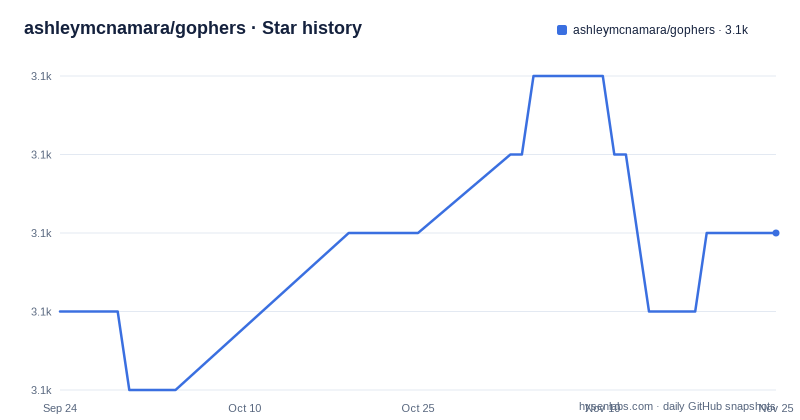
Star history
- ashleymcnamara/gophers3,078 ★ · +1
| Repository | 2026-09-24 | 2026-11-25 |
|---|---|---|
| ashleymcnamara/gophers | 3.1k | 3.1k |
1 Stars in the last 62 days, measured from the daily GitHub snapshot. Compare with other projects
Editorial analysis
What the gophers repository actually contains
The repository is an image collection, not a Go module. The top-level entries are PNG files named after the subject of each drawing: DockerGopher.png, GOPHERCON.png, GOPHER_SAFARI.png, DEATH_METAL_GOPHER.png, BLOCKCHAIN_GOPHER.png, BATMAN_GOPHER.png, Facepalm_Gopher.png, and dozens more, plus a GOPHER_AVATARS.jpg and a BuffaloCast.png. There is a .github directory holding workflow definitions, and the README renders a collage image from a GitHub user-attachments URL. Nothing here compiles, and nothing here is imported into a Go program. The audience is the person who needs a picture: a meetup organiser printing stickers, a conference speaker building slides, a maintainer wanting an avatar that is not a stock photo, or a team ordering swag for a Go event. The README frames the collection as a celebration of the Go community, based on the original gopher artwork by Renee French, with a special thanks to Steve Francia. If you arrived expecting a library, this is the wrong repository and you should stop reading here.
How delivery works: a zip, a download, and no build step
There is no package manager involved. The README's usage section has two numbered steps. The first is to download and unzip the gophers.zip file to access the PNG artwork. The second is a printing recommendation: the README describes the PNG files as print-ready and points at Sticker Ninja for high-quality, color-accurate stickers. That is the whole pipeline. The repository also carries two GitHub Actions workflows, visible as badges at the top of the README: link-checker.yml and image-validation.yml. Their names indicate that the project checks its own links and validates the images it ships, which matters for a repository whose only product is binary files that can silently go missing or corrupt. The README does not document what image-validation.yml asserts, what dimensions or formats it accepts, or what happens when a file fails, so treat the badge as a signal that some check exists rather than as a guarantee about any individual PNG.
Getting the artwork and using one file in a real task
There is no install command in the README. The documented route is the download and unzip of gophers.zip, and the repository itself is browsable as individual files. Beyond naming that zip, the README gives no fetch command, no branch name in a URL, and no example invocation of any tool, so there is no command line to reproduce here without inventing one. What the README does state is that the PNG files are print-ready, which is the property that matters when the destination is a sticker order or a slide deck. If you take a single file such as DockerGopher.png, you get an image you can place without conversion. The README does not describe resizing, colour profiles, transparency handling or any export step, so anything beyond dropping the file where you need it is undocumented. For a slide deck or a web page, the file goes in as-is; the alt text is worth writing yourself rather than leaving empty, because the drawings carry meaning (Facepalm_Gopher.png and GOPHER_MIC_DROP.png are jokes, not neutral decoration) and a screen reader user gets nothing from a filename. That is a convention, not something the README specifies.
The licence is the real constraint, and it is not a permissive one
The README states that the artwork is licensed under a Creative Commons Attribution-NonCommercial-ShareAlike 4.0 International License. The usage guidelines spell out two consequences. Non-commercial use only: the artwork may not be used for any commercial purposes, including activities where revenue is generated, such as advertisements or product sales. Share-Alike: if you remix, transform, or build upon the work, you must distribute your contributions under the same license. For an engineering team this is the deciding fact. A gopher on an internal wiki is one thing; the same gopher on a paid course landing page, a sponsored conference booth, or a t-shirt you sell is what the NonCommercial clause is aimed at. Share-Alike also means you cannot take a drawing, modify it, and ship the result under your company's permissive asset licence. Note that the repository metadata reports the licence as NOASSERTION, which means no recognised SPDX identifier was detected, while the README names CC BY-NC-SA 4.0. The README is the more specific statement, but the discrepancy is itself a reason to read the LICENSE file in the repository root before you rely on either. Nothing here is legal advice; if the use is commercially sensitive, that is a question for your own counsel.
Where this pack is the wrong choice, and what to reach for instead
If you need a gopher that matches your product's visual identity, this pack will fight you. The drawings are fixed illustrations with names like GOPHER_VIKING.png and GOPHER_RACING.png; you cannot recolour them to a brand palette and keep the licence clean, because a recolour is a transformation and the Share-Alike term then applies to your version. If you need vector output for large-format printing or for crisp rendering at arbitrary sizes, a PNG pack is the wrong format, and the README does not claim otherwise. The realistic alternative is to commission or draw your own gopher-derived character and license it however you like, which removes both the NonCommercial restriction and the Share-Alike obligation. The trade-off is cost and time against a free, immediately available set that the Go community already recognises. A second alternative is to use the artwork strictly as-is, unmodified, in a non-commercial context, which is the narrowest and safest reading of what the README permits. A third is to check whether the Go project's own brand guidance covers your case, since this repository is a community collection built on Renee French's original artwork rather than an official brand asset library; the README does not describe any relationship to a trademark policy, so do not assume one exists.
Maintenance, upgrade cost and what the badges do not tell you
The repository is not archived, and the last push was on 2026-06-27. For an image collection that is a reasonable signal: the workflows and the file set are still being touched, though the README shows no release history and the repository has no published releases, so there is no version number to pin and no changelog to read before upgrading. Upgrading means re-downloading the zip or re-fetching individual files, and because filenames are the only identifiers, a renamed or removed drawing is a breaking change for anyone who hardcoded a raw URL. If you vendor these files into a site or a deck, keep your own copy rather than hotlinking raw.githubusercontent.com paths; the link-checker workflow exists precisely because links in a repository like this can rot. There is no dependency graph, no runtime, and no security surface beyond the usual caution about opening binary files from any source. The upgrade cost is therefore near zero in effort and non-zero in risk: nothing tells you which files changed between two downloads.
Frequently asked questions about the Go gopher artwork pack
The questions below are the ones that come up when someone encounters this repository while looking for something else, which is common because the name collides with a university sports team and with the animal. The answers stay within what the README and the repository layout state.
Editorial conclusion
Adopt this pack if you need gopher artwork for a community talk, a non-commercial meetup, a classroom slide deck or a personal sticker run, and you are willing to credit Renee French and Ashley McNamara and keep any derivative under the same licence. Do not adopt it if revenue touches the output: the README states the artwork may not be used for any commercial purposes, including advertisements and product sales, and Share-Alike means a remix cannot be relicensed more permissively. Before you commit, read the LICENSE file in the repository root, since the metadata reports NOASSERTION rather than a recognised SPDX identifier, and confirm that the specific PNG you want (for example DockerGopher.png) is present and unmodified in the copy you downloaded.
Frequently asked questions
Is ashleymcnamara/gophers a Go library I can import?
No. The repository is a collection of PNG artwork files at the top level, such as DockerGopher.png and GOPHERCON.png, with no Go package code. The README describes it as gopher artwork and gives download and printing instructions rather than import instructions.
How do I download the gopher artwork?
The README says to download and unzip the gophers.zip file to access the PNG artwork. The repository itself is also browsable as individual PNG files.
Can I use these gopher images commercially?
The README states the artwork is licensed under CC BY-NC-SA 4.0 and that it may not be used for any commercial purposes, including activities where revenue is generated, such as advertisements or product sales. It also requires that remixes or derivative works be distributed under the same license.
Who created the original Go gopher?
The README credits Renee French for the original gopher artwork and thanks Steve Francia for his inspiration and dedication to the Go community. The collection itself is credited to Ashley McNamara.
Official sources
Add this badge to your README
If you maintain this project, the badge below links readers to this analysis and shows its maintenance status from the daily GitHub snapshot. Paste the markdown into your README; add ?metric=license or ?metric=stars to the image URL for a different field.

[](https://hysenlabs.com/projects/ashleymcnamara-gophers)Star history chart for your README
[](https://hysenlabs.com/projects/ashleymcnamara-gophers)Was this useful?