Dev-Event: a hand-curated list of Korean developer events kept in one README
Announces developer events: webinars, conferences and hackathons. (With Namsongri Sambeonji.)
At a glance
- What is it?
- brave-people/Dev-Event is not software but a monthly Markdown list of seminars, meetups, contests and courses in Korea, tagged by format, fee and topic. It is useful if you read Korean and attend events there, and of little use as a data source or outside Korea.
- Who is it for?
- Dev-Event suits Korean-reading developers who want one place to scan upcoming seminars, meetups, hackathons and courses in Seoul and other Korean cities, and who will click through to each host before registering. It does not suit anyone who needs structured event data, an English listing or events outside Korea.
- Can I use it commercially?
- Check first. The repository uses a licence we do not classify automatically, so read its LICENSE file before any commercial use.
- Is it still maintained?
- Yes. The repository last received commits 3 days ago.
- What is it written in?
- GitHub does not report a main language for this repository.
Answers come from the project's GitHub data, last synced on November 15, 2026, and from our analysis. They are not legal advice.
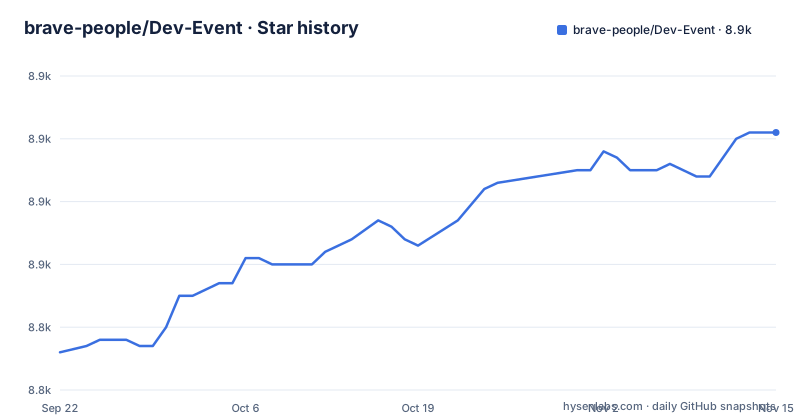
Star history
- brave-people/Dev-Event8,871 ★ · +35
| Repository | 2026-09-22 | 2026-11-15 |
|---|---|---|
| brave-people/Dev-Event | 8.8k | 8.9k |
35 Stars in the last 54 days, measured from the daily GitHub snapshot. Compare with other projects
Editorial analysis
One README per month instead of an app with a database
brave-people/Dev-Event announces developer events: webinars, conferences and hackathons, run together with Namsongri Sambeonji. There is no code to build. GitHub reports no primary language, the repository has no releases, and the top level holds README.md, LICENSE, USAGE_POLICY.md, robots.txt, .all-contributorsrc and the directories end_event/, replay_event/, review/ and static/.
The product is the README itself. Events sit under a month heading written in Korean, such as `26년 11월` for November 2026, and each month is a bulleted list of linked event titles. Reading it means opening the repository page on GitHub, or using one of the mirrors linked from the banner row: a web view at https://dev-event.vercel.app/events, an Android app on Google Play (package com.bravepeople.devevent.android.app) and an iOS app on the Korean App Store. Nothing has to be installed to use the GitHub version. Contributions are credited through the all-contributors badge and a contributors section, and the header gives a Kakao mail address for inquiries.
How each entry packs format, fee, type and topic into one tag line
Every entry follows the same three-line pattern. The first line is the event name linked to the host's own page, often on event-us.kr, ticketa.co, luma.com or the organiser's site. The second line is 분류 (classification), a row of backtick tags. The third names the host under 주최, and the fourth gives either a registration window or the event time.
The tags combine four separate dimensions. Format is `온라인` (online) or `오프라인` with a location in parentheses, such as `오프라인(서울 강남구)`; some events carry both. Fee is `무료` (free) or `유료` (paid). The kind of event appears as `세미나` (seminar), `모임` (meetup), `대회` (contest) or `교육` (training), as in the SK Telecom FLY AI Challenger entry. Topic tags in November 2026 include `AI`, `기술일반` (general tech), `블록체인` (blockchain) and `클라우드` (cloud). A reader can scan for `무료` and `AI` by eye. The fee tag only says paid or free; ticket prices are on the host's page.
Registration windows and event dates share the same field position
The last line of an entry is labelled either 접수 (registration) or 일시 (date and time), and the two mean different things. The Droid Knights 2026 entry gives 접수: 09. 14(월) 13:00 ~ 11. 01(일) 23:59, which is when tickets could be bought, not when the conference runs. The AMD Advancing AI + AI DevDay Seoul 2026 entry instead gives 일시: 11. 04(수) 09:00 ~ 11. 04(수) 17:50, the event itself.
The consequence is that a closing date in the list does not tell you when to show up. For any 접수 entry you have to open the host's page to find the actual event day. Dates are written as month and day with a Korean weekday abbreviation in parentheses, with no year on the line and no time zone, so the month heading and Korean local time are assumed. Within November 2026 the entries run in order of their closing date, from November 1 onward, which makes the list a deadline queue more than a calendar.
Hangul labels and Korean venues limit who the list serves
Almost everything a reader needs is in Korean: the month headings, the field labels 분류, 주최, 접수 and 일시, the tags, the weekday abbreviations and most event names. The repository description is the only English line. A developer who does not read Hangul can still click the links, but cannot filter by tag without translating each one.
The venues are Korean as well. Offline events in November 2026 sit in Seoul districts such as Mapo, Gangnam, Seongdong, Seocho, Seodaemun, Songpa and Jung, and outside Seoul in Cheongdo, Busan, Gwangju, Daejeon and Osan. Online entries, such as the Snowflake Expedition webinar or the Exem PostgreSQL Wait Event webinar, are still listed with Korean titles and Korean registration pages. Readers searching for European or general Asian developer conferences will not find them here, because the list does not try to cover them.
Closed entries stay at the top until a maintainer pushes again
Because the list is a hand-edited file, it is only as current as the last commit. The last push was on 2026-10-31, and the first November entries close on November 1 and 2: the Bitcoin Center Seoul meetup registration ended on 11. 01 at 15:00, and the KISA DNS operations session on 11. 02 at 23:59. Until the next commit, those rows remain above events that are still open, with nothing marking them as closed.
For a reader, that means checking each closing date against the calendar before clicking, and treating the host's page as the authority on whether seats remain. The repository has directories named end_event/ and replay_event/ beside the README, so finished events have a place to go, but every change to the list is an edit someone has to commit. Nothing in the file expires on its own date.
Instagram cards, mobile apps and a separate subscribe repository
The README pushes readers toward other channels. A banner line asks readers to follow @dev.event.official on Instagram, which posts weekly cards about events whose deadlines are close and easy to miss. The banner row also links the Vercel web view, the two mobile apps and a sibling repository, brave-people/Dev-Event-Subscribe. If you want reminders rather than a page to check, those channels are where the project sends you.
Two blocks in the README are commented out with HTML comments, so they do not render on GitHub. One, headed 시선집중 (spotlight), points to an SDC Korea page with a refer=github_dev_event parameter. The other, 다시보기 (replay), points to a YouTube playlist. Anyone reading the raw file sees them; anyone reading the rendered page does not. Turning such a block on or off is a matter of removing or restoring the comment markers.
A NOASSERTION licence means reuse needs a careful read first
GitHub reports the licence as NOASSERTION, meaning it could not match the LICENSE file to a standard licence identifier. The repository also contains USAGE_POLICY.md, a separate file about how the list may be used. Neither can be summarised from the licence badge.
This matters for anyone tempted to scrape the README into their own calendar, newsletter or app. The entries look machine-friendly, with consistent labels and backtick tags, but the terms for copying them are set by those two files, not by a known open-source licence. A robots.txt sits at the top level as well. Read LICENSE and USAGE_POLICY.md in full before building anything on top of the list, and link back to the host pages rather than copying event details wholesale.
Editorial conclusion
Dev-Event suits Korean-reading developers who want one place to scan upcoming seminars, meetups, hackathons and courses in Seoul and other Korean cities, and who will click through to each host before registering. It does not suit anyone who needs structured event data, an English listing or events outside Korea. Before republishing or scraping the list, read LICENSE and USAGE_POLICY.md in the repository, because GitHub reports the licence as NOASSERTION.
Frequently asked questions
What are the four types of events listed in Dev-Event?
Dev-Event entries carry a kind tag next to the format and fee tags: 세미나 (seminar), 모임 (meetup), 대회 (contest) and 교육 (training). A topic tag such as AI, 기술일반 or 블록체인 sits alongside.
Does Dev-Event list Google Developer events happening in 2026?
Dev-Event is not a Google listing. Its November 2026 section collects Korean events from many hosts, such as Droid Knights 2026 and Flutter Korea 2026 hosted by Flutter Seoul, each linked to the host's page.
Where can I read Dev-Event outside GitHub?
The README links a web view at dev-event.vercel.app/events, an Android app on Google Play, an iOS app on the Korean App Store, and the Instagram account @dev.event.official, which posts weekly cards about events that close soon.
Can I reuse the Dev-Event list in my own app?
GitHub reports the Dev-Event licence as NOASSERTION, and the repository has both a LICENSE file and a USAGE_POLICY.md. Read both before copying or scraping the entries.
Official sources
Add this badge to your README
If you maintain this project, the badge below links readers to this analysis and shows its maintenance status from the daily GitHub snapshot. Paste the markdown into your README; add ?metric=license or ?metric=stars to the image URL for a different field.

[](https://hysenlabs.com/projects/brave-people-dev-event)Star history chart for your README
[](https://hysenlabs.com/projects/brave-people-dev-event)Was this useful?