Wind Comic: A Multi-Agent Pipeline That Turns a Sentence into a Finished Short Drama
Multi-agent AI pipeline that turns one line of text into a finished short-form drama: script, cinematic storyboards, character-consistent video. Provider-agnostic (OpenAI/Claude, MJ, Minimax, Veo/Sora, fal, ComfyUI). MIT.
At a glance
- What is it?
- Wind Comic is an open-source, provider-agnostic pipeline that moves from a one-line prompt to a scripted, storyboarded, voice-acted mp4. It is a serious engineering effort with real constraints, but its complexity and young release date demand careful evaluation.
- Who is it for?
- Adopt Wind Comic if you need a full short-drama production pipeline from a single prompt and are comfortable with a young, rapidly changing codebase. Do not adopt it if you want a simple one-shot video generator or if you cannot tolerate the operational burden of managing multiple API keys and a dual-driver database.
- Can I use it commercially?
- Yes. MIT is a permissive licence: you can use, modify and sell software built on it, as long as you keep its copyright and licence notices.
- Is it still maintained?
- Yes. The repository last received commits 2 days ago.
- What is it written in?
- Mainly TypeScript, according to GitHub's language statistics.
Answers come from the project's GitHub data, last synced on October 21, 2026, and from our analysis. They are not legal advice.
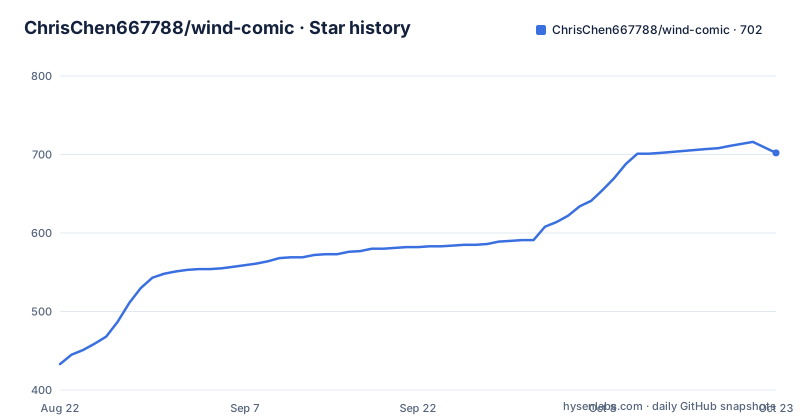
Star history
- ChrisChen667788/wind-comic716 ★ · +283
| Repository | 2026-08-22 | 2026-10-21 |
|---|---|---|
| ChrisChen667788/wind-comic | 433 | 716 |
283 Stars in the last 60 days, measured from the daily GitHub snapshot. Compare with other projects
Editorial analysis
What Wind Comic Actually Solves
Most AI video tools produce a five-second clip from a one-line prompt. Wind Comic targets a different problem: producing a complete short-form drama from that same single line. The README describes the output as script, character bible, multi-shot storyboards, voice-acted lines, background music, mouth-synced characters, and a final mp4. The intended user is a creator or small team who wants to go from idea to finished video without manually orchestrating separate tools for writing, storyboarding, video generation, voiceover, and editing. The project is provider-agnostic, meaning you bring your own LLM, image, video, and TTS services. It is not a consumer toy; it is a pipeline for people who already have API accounts and are willing to configure them.
The Multi-Agent Pipeline and Its Consistency Contracts
Wind Comic is not a single model. The README calls it an honest multi-agent pipeline where each role is a specialist: Writer, Director, Producer, Character Designer, Storyboard Artist, Cameo Locker, Lipsync, and Editor. These agents hand off to each other under strict consistency contracts. The flow is linear: Writer to Director to Style Bible to Character Designer to Scene Designer, then to Storyboard, Video, TTS, Lipsync, and finally Editor. The Director threads control across the other seven agents. The key mechanism is the Vision-Audit retry loop: any shot that scores below 70 is automatically regenerated. There is also a multi-engine race where several video engines such as Seedance, Kling, Veo, and Vidu compete, and the first good clip wins. This design means quality is enforced by automated checks, not by hope. The trade-off is that you pay for multiple API calls per shot, and the race strategy can waste credits on losing engines.
Directing Instead of Re-rolling: The Director's Console and Segment Retake
A notable feature range is the director's control room, which lets you direct a shot rather than regenerate it blindly. The Director's console places actors and camera on a top-down stage. The blocking becomes a precise staging directive appended to the prompt, and a layout sketch is fed through the existing storyboard lock channel. Shot size and camera angle are derived from geometry, not typed by hand, so the written spec and the lens cannot disagree. A deterministic composition audit reports who is out of frame, who is occluding whom, and whether the camera clips an actor before you spend money on generation. Segment retake allows you to retake only two seconds of an eight-second shot. The other six seconds are byte-copied with ffmpeg's -c copy, not re-encoded, so the part you liked does not lose a generation. Shot duration is unchanged by construction, which means the compressed timeline, voice-over delays, subtitle starts, and EDL record-ins need no recomputation. This is a practical answer to the common problem of regenerating an entire clip to fix a small flaw.
Getting It Running: Commands, Config, and Provider Setup
The README does not provide explicit installation commands in the visible portion, but it does describe the bring-your-own-LLM mechanism: you set three environment variables and make zero code changes. The architecture mentions an LLM gateway that falls back from DeepSeek to MiniMax with no code change. The repository is TypeScript, so a standard Node.js workflow is implied: clone, install dependencies, and configure environment variables. The README references docs/llm-providers.md for details on BYO LLM, which suggests that provider configuration is documented separately. The platform uses a dual-driver database, SQLite and PostgreSQL, meaning you choose one at setup. The asset store persists every artifact, and each stage can be re-run in isolation because artifacts are independently reusable. To get a full pipeline running, you will need API keys for at least one LLM, one image provider, one video provider, and one TTS provider. The README lists 12+ supported media engines, but the exact setup steps are not in the visible material, so you must consult the repository's docs.
Real Limitations and Failure Modes
The most obvious limitation is cost and complexity. The multi-engine race means you pay for multiple video generations per shot, and only the first good clip is kept. The Vision-Audit retry loop can regenerate shots that score below 70, which also increases API spend. Another limitation is the reliance on external providers; if your chosen video engine is down or slow, the pipeline stalls. The README mentions that the in-process rate limiter bounds and evicts its bucket table because the key contained an attacker-supplied email, an unbounded memory vector. This indicates a security-conscious fix, but it also shows that the system has attack surfaces. The collaborative timeline uses Yjs CRDT, and comments are validated and field-whitelisted to prevent peers from overwriting each other's names or text. That is a mitigation, not a guarantee. The project is also very new: the initial public release is v2.12.0 from April 2026, and the README header shows v12.380, suggesting rapid version churn. That churn means APIs and configs can change between releases, and upgrading may require re-reading the docs.
Alternatives and How They Differ
A direct alternative is any single-model video generator like Runway or Pika, but those give you a short clip, not a full drama. A more relevant alternative is a manual workflow using separate tools: an LLM for scriptwriting, a storyboard tool, a video generator, and a video editor. That approach gives you full control but requires you to build the integration yourself. Wind Comic's difference is that it automates the handoffs and enforces consistency contracts, so you do not have to write glue code. Another alternative is ComfyUI, which is a node-based pipeline that can also chain models, but it is not agent-based and does not have a built-in director's console or segment retake. Wind Comic is more opinionated and higher-level. The trade-off is that you trade flexibility for convenience. If you need to tweak the pipeline at a low level, ComfyUI gives you more control, but you have to build the storyboarding and editing logic yourself.
Maintenance, Upgrade Cost, and License Implications
The project is MIT licensed, which means you can use, modify, and distribute it freely, including in commercial products, as long as you preserve the copyright notice. There is no copyleft obligation. However, the maintenance cost is real. The version number jumped from v2.12.0 to v12.380 in the README, and the release notes mention features from v12.315 to v12.330, indicating a very fast release cadence. This means you should expect frequent updates, and you will need to track breaking changes. The README notes that fonts are self-hosted so builds no longer depend on a network fetch, which reduces one external dependency. The dual-driver database means you have to maintain either SQLite or PostgreSQL, and the asset store persists artifacts, so storage grows with each project. Upgrading from one version to another may require re-running migrations and re-testing provider integrations. Given the project's youth, there is no long-term track record for stability, so you should pin a version and test thoroughly before adopting it in production.
Editorial conclusion
Adopt Wind Comic if you need a full short-drama production pipeline from a single prompt and are comfortable with a young, rapidly changing codebase. Do not adopt it if you want a simple one-shot video generator or if you cannot tolerate the operational burden of managing multiple API keys and a dual-driver database. Before committing, verify that your target LLM, image, video, and TTS providers are supported in the current version, and review the recent release notes for breaking changes. The project's value lies in its integrated retake and audit loops, not in any single model, so your success depends on the quality of the providers you plug in.
Frequently asked questions
What does Wind Comic do?
It is a multi-agent pipeline that turns one line of text into a finished short-form drama, producing a script, a character bible, storyboards, voiced lines, a soundtrack, subtitles and a final video file, with each role handing off through explicit consistency contracts.
How does Wind Comic handle a bad shot?
A vision audit scores every generated shot and any shot scoring below seventy is regenerated automatically. Video generation also runs as a race across several engines, with the first acceptable clip winning.
Which providers does Wind Comic support?
It is provider-agnostic. Any OpenAI-compatible endpoint can serve the language work, while image, video and speech providers sit behind a single router, with twelve or more supported. The language gateway falls back between two providers with no code change.
What does the director's console in Wind Comic do?
It places actors and a camera on a top-down stage and derives shot size and framing from that geometry, producing a staging directive for the prompt and a layout sketch sent through the storyboard lock channel, plus an audit of who is out of frame or occluded before any generation cost.
What licence is Wind Comic released under?
The project source is MIT. Provider credentials and model assets are not covered by it: the environment template expects keys for whichever language, image, video and speech services you actually use.
Official sources
Add this badge to your README
If you maintain this project, the badge below links readers to this analysis and shows its maintenance status from the daily GitHub snapshot. Paste the markdown into your README; add ?metric=license or ?metric=stars to the image URL for a different field.

[](https://hysenlabs.com/projects/chrischen667788-wind-comic)Star history chart for your README
[](https://hysenlabs.com/projects/chrischen667788-wind-comic)