citizenfx/fivem: What the Cfx Repository Actually Contains, and Who Should Build on FXServer
The source code for the Cfx modification frameworks, such as FiveM and RedM, as well as FXServer.
At a glance
- What is it?
- The citizenfx/fivem repository holds the source for FiveM, RedM and FXServer, the server component that community servers run on. It is a C++ codebase under the Rockstar Games Creator Platform License Agreement, not a drop-in game download, and the README points players at the launcher and server operators at the hosting pages rather than at a build.
- Who is it for?
- Adopt citizenfx/fivem if you are building or operating a FiveM or RedM community server and need to read FXServer, the scripting runtime or the client source directly, or if you are contributing to the frameworks themselves.
- Can I use it commercially?
- Check first. The repository uses a licence we do not classify automatically, so read its LICENSE file before any commercial use.
- Is it still maintained?
- Yes. The repository last received commits 4 days ago.
- What is it written in?
- Mainly C++, according to GitHub's language statistics.
Answers come from the project's GitHub data, last synced on November 15, 2026, and from our analysis. They are not legal advice.
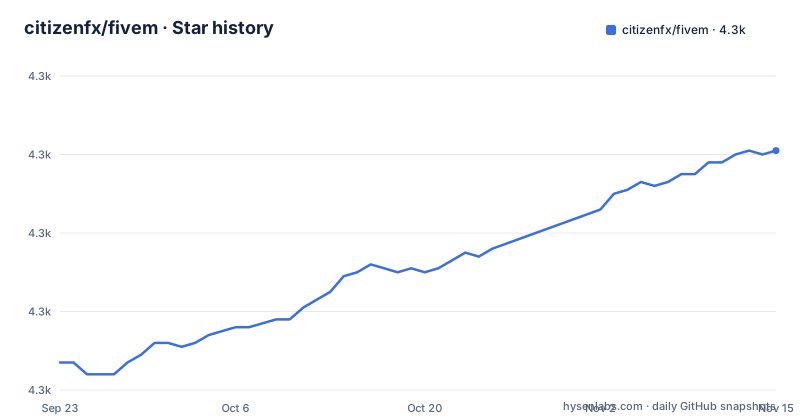
Star history
- citizenfx/fivem4,321 ★ · +54
| Repository | 2026-09-23 | 2026-11-15 |
|---|---|---|
| citizenfx/fivem | 4.3k | 4.3k |
54 Stars in the last 53 days, measured from the daily GitHub snapshot. Compare with other projects
Editorial analysis
What citizenfx/fivem actually is, and who the repository is for
The README describes the repository as the code for the Cfx projects: FiveM, a dual-purpose single-player and multiplayer modification framework for the PC version of Grand Theft Auto V Legacy as released by Rockstar Games; RedM, a modification framework for the PC version of Red Dead Redemption 2; and FXServer, the server component for both. That is the whole scope. The repository is not a launcher, not a server binary download and not a mod pack. It is the source tree those products are built from.
The audience follows from that. Three groups have a reason to be here. Contributors who want to change the frameworks themselves, who the README sends to docs/ for the contribution documentation. Server operators who want to understand what FXServer does when their resources misbehave. And people integrating against the scripting runtime, who need to know how a resource is loaded and which languages the runtime exposes. Players are explicitly not the audience: the README says that to play, you download the launcher from the FiveM or RedM website, and that to run your own server, you get started with server hosting for FiveM or RedM. Neither path goes through a clone of this repository.
The layout of the build tree: code/, data/, ext/ and vendor/
The top level of the repository is a build tree, and reading it tells you more about the project than the README does. There are code/, data/, ext/ and vendor/ directories. Then there are the scripts: fxd.cmd and fxd.ps1, prebuild.cmd and prebuild_natives.cmd, plus .gitlab-ci.yml and a .github/ directory, and .gitmodules indicating that some components are pulled in as submodules rather than committed directly.
The presence of prebuild_natives.cmd is the most informative single detail. Its name suggests a natives step that runs before a build, though the README does not describe it. The README does not walk through this; it points at docs/ instead, so the build instructions live there rather than in the repository root.
The LICENSES/ directory next to a single LICENSE file is another signal. The README states that use of the software is subject to the Rockstar Games Creator Platform License Agreement except for specific files licensed under the GNU Library General Public License, and that full details are in LICENSE with third-party components listed in THIRD_PARTY_NOTICES.md. A LICENSES/ directory implies the per-file breakdown is kept there. Anyone planning to redistribute a build has to reconcile those three sources before doing anything else.
Building from source is not the documented path for players or server operators
The README gives no install commands for end users. It gives two destinations instead: the launcher download from the FiveM or RedM website for players, and the server hosting pages for people who want to run a server. The only technical entry point it offers is docs/ for contributors. So the honest first step is to follow the documented path rather than to build.
For a player, the README's instruction resolves to this:
# Per the README: download the launcher from the FiveM or RedM website.
# https://fivem.net/  |  https://redm.net/
What you should see after that is the launcher, not a compiler. There is no documented command in this repository that produces a client you can play on.
For a server operator, the README points at the hosting pages rather than at a build:
# Per the README: get started with server hosting.
# https://fivem.net/server-hosting  |  https://redm.net/server-hosting
For a contributor, the README's instruction is to follow the documentation in docs/:
# Per the README: contribution documentation lives in docs/.
# https://github.com/citizenfx/fivem/tree/master/docs
That third path is the only one this repository actually documents end to end. If you are not contributing, the repository is reference material, not an installation guide. The README is silent on build prerequisites, compiler versions and supported toolchains; docs/ is where that has to be answered.
Where the repository stops being the right tool
The clearest limitation is the licence boundary. The README states that use of the software is subject to the Rockstar Games Creator Platform License Agreement, with an exception for specific files under the GNU Library General Public License. That is not an open source licence in the usual sense. The repository metadata reports the licence as NOASSERTION, which is consistent with a file that mixes a platform agreement with LGPL-covered files. If your plan depends on redistributing a modified client or server build under your own terms, the README does not grant that, and the per-file detail in LICENSE, LICENSES/ and THIRD_PARTY_NOTICES.md is what would decide it. Nothing in the README suggests the platform agreement permits arbitrary redistribution.
A second boundary is scope. The repository covers FiveM, RedM and FXServer. It does not cover the launcher distribution, the server hosting service, the forum, the portal or the marketplace, all of which the README links to as separate destinations. A question about why a launcher update failed, or how a marketplace asset is delivered, is not answered by reading this codebase.
A third is that building is a contributor activity with real prerequisites. The native generation step implied by prebuild_natives.cmd, the submodules declared in .gitmodules and the vendor/ tree mean the build is not self-contained in a single clone until those are resolved. The README does not document a rollback path for a failed build or a failed deployment, and the repository does not describe one, so treat the build tree as something you debug with the contributor documentation open.
How FXServer compares with building a multiplayer layer yourself
The alternative to FXServer is not another mod framework with the same shape. It is writing your own networking and state replication on top of the game and hosting it yourself. The difference in approach is where the work sits. With FXServer, the README's framing is that creators build their own game modes and content in a variety of scripting languages, and you write that content against the framework. With a self-built layer, you own entity synchronisation, client-server trust boundaries and the whole lifecycle of a session, and you also own every compatibility problem that comes with a game update.
That trade is not automatically in FXServer's favour. A project that needs a small, tightly controlled multiplayer mode with no interest in the FiveM ecosystem pays for a large C++ codebase it will never modify, plus a licence agreement that governs use. A project that wants a populated community server, existing resources and a scripting surface that creators already know gets the opposite trade: less code to write, more constraints to accept.
The same comparison applies inside the repository. FiveM is described as dual-purpose, covering single-player and multiplayer for GTA V Legacy, while RedM covers Red Dead Redemption 2. If your target is a different title, or the Enhanced edition rather than Legacy, the README's description of FiveM names the Legacy release specifically, and the README does not extend that description to other releases.
Maintenance, licence and the cost of tracking master
The repository is not archived, and the last push was on 2026-11-02. That is recent, and it is the only maintenance signal available here. The repository has no published GitHub releases, so there is no tagged version to pin against in the repository, which means the default branch, master, is the reference point. For a contributor that is normal. For anyone vendoring the source into a product, it means your upgrade cost is the cost of re-reading the diff between one commit and the next, with no release notes to summarise it.
The licence is the larger ongoing cost. The README points to LICENSE for full details and to THIRD_PARTY_NOTICES.md for third-party components, and the tree also carries a LICENSES/ directory. Every one of those can change independently of the code you care about, and a change in the platform agreement is not something a build system will flag for you. That is not legal advice, and it is not a reason to avoid the project; it is a reason to read the licence files yourself rather than inferring terms from the repository's public visibility.
Upgrade cost also has a hardware and toolchain dimension the README does not quantify. The prebuild steps, the submodules and the vendor tree mean a fresh clone is not a fresh build. If you maintain a fork, you are maintaining a fork of a C++ tree with prebuild steps, and that is a different commitment from forking a scripting project.
Editorial conclusion
Adopt citizenfx/fivem if you are building or operating a FiveM or RedM community server and need to read FXServer, the scripting runtime or the client source directly, or if you are contributing to the frameworks themselves. Do not clone it expecting a playable game: the README sends players to the FiveM or RedM launcher and server operators to the hosting pages, and the repository is a C++ build tree with prebuild.cmd, prebuild_natives.cmd, fxd.cmd and fxd.ps1 at the top level. Before you invest time, read LICENSE and THIRD_PARTY_NOTICES.md in full, confirm which files fall under the GNU Library General Public License exception, and check docs/ for the contribution path, because the licence is the constraint that decides whether your use is permitted at all.
Frequently asked questions
Is FiveM free?
The README does not describe a price for FiveM. It says that to play, you download the launcher from the FiveM website, and that to run your own server you get started with the server hosting pages, so any cost attached to hosting is not stated in this repository.
Is FiveM a GTA game?
No. The README describes FiveM as a dual-purpose single-player and multiplayer modification framework for the PC version of Grand Theft Auto V Legacy as released by Rockstar Games, so it is a framework that sits on the game rather than a game of its own.
Is GTA FiveM legal?
The README does not make a legal claim. It states that use of the software is subject to the Rockstar Games Creator Platform License Agreement, except for specific files licensed under the GNU Library General Public License, with full details in LICENSE and THIRD_PARTY_NOTICES.md.
How do I install FiveM?
The README says to download the launcher from the FiveM or RedM website. It gives no install commands, and building from this repository is the contributor path documented in docs/, not the player path.
How do I install FiveM on PC?
The README's only instruction is to download the launcher from the FiveM or RedM website for the PC version. It does not list supported Windows versions, prerequisites or command-line steps.
How do I use FiveM with Steam?
The README does not mention Steam. It says FiveM is a modification framework for the PC version of Grand Theft Auto V Legacy as released by Rockstar Games, and that players download the launcher from the FiveM or RedM website, so any Steam-specific step is not documented here.
Official sources
Add this badge to your README
If you maintain this project, the badge below links readers to this analysis and shows its maintenance status from the daily GitHub snapshot. Paste the markdown into your README; add ?metric=license or ?metric=stars to the image URL for a different field.

[](https://hysenlabs.com/projects/citizenfx-fivem)Star history chart for your README
[](https://hysenlabs.com/projects/citizenfx-fivem)Was this useful?