OpenPose: The Multi-Person Keypoint Detector That Still Defines the Baseline
OpenPose: Real-time multi-person keypoint detection library for body, face, hands, and foot estimation
At a glance
- What is it?
- OpenPose is a C++ library for real-time multi-person body, face, hand, and foot keypoint detection. Its constant runtime per image, even as people count grows, remains a distinctive feature, but the project has not seen a release since 2020.
- Who is it for?
- Adopt OpenPose if you need a mature, CPU-compatible multi-person keypoint detector with a constant runtime per image, and you can accept a codebase whose last release is from 2020 and whose license tag is unresolved. Skip it if you require per-person runtime scaling, a permissive license, or active upstream maintenance.
- Can I use it commercially?
- Check first. The repository uses a licence we do not classify automatically, so read its LICENSE file before any commercial use.
- Is it still maintained?
- Probably not. The repository last received commits 28 months ago, on August 3, 2024.
- What is it written in?
- Mainly C++, according to GitHub's language statistics.
Answers come from the project's GitHub data, last synced on November 23, 2026, and from our analysis. They are not legal advice.
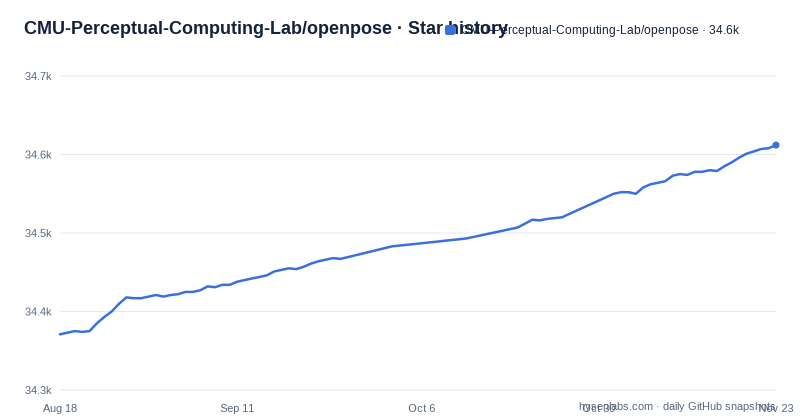
Star history
- CMU-Perceptual-Computing-Lab/openpose34,612 ★ · +241
| Repository | 2026-08-18 | 2026-11-23 |
|---|---|---|
| CMU-Perceptual-Computing-Lab/openpose | 34.4k | 34.6k |
241 Stars in the last 97 days, measured from the daily GitHub snapshot. Compare with other projects
Editorial analysis
What OpenPose Actually Solves
OpenPose addresses a specific problem: detecting the keypoints of multiple people in a single image or video frame in real time. It outputs 135 keypoints across the body, feet, face, and hands. The README stresses that it was the first real-time multi-person system to do this jointly. The target audience is researchers and engineers who need pose data for human movement analysis, human-computer interaction, or video understanding. The library is written in C++ and provides a command-line demo, a C++ API, and a Python API. The runtime for body keypoints is invariant to the number of detected people, which is a claim that sets it apart from many competitors. That claim is central to the project's design and is worth examining closely.
The Architecture: Why Runtime Stays Constant
The key architectural choice in OpenPose is that body keypoint detection does not scale with the number of people in the frame. The README states that the runtime is invariant to the number of detected people for the 15, 18, or 25-keypoint body models. This is achieved through a bottom-up approach: the network detects all keypoints and then associates them into person instances, rather than running a detector per person. In contrast, the hand and face keypoint estimation runtime depends on the number of detected people. The README points to the OpenPose training repository for a runtime-invariant alternative for hands and face. This split design means that for a crowded scene, the body estimation stays fast, but adding face or hand keypoints will slow down as the person count grows. That trade-off is a real constraint for real-time applications with many people.
Getting It Running: Build and Demo Commands
Installation offers two paths. The first is a Windows portable demo that requires no installation or code. The second is building from source on Ubuntu, Windows, or Mac OSX. The README lists Ubuntu versions 14 through 20, Windows 8 and 10, and Mac OSX, plus Nvidia TX2. For a quick start, the demo binary runs directly on a webcam: on Ubuntu, you run ./build/examples/openpose/openpose.bin. On Windows, the portable demo is invoked as bin\OpenPoseDemo.exe --video examples\media\video.avi. Flags can be added in any order, such as --face to enable face keypoints. The build supports CUDA, OpenCL, and CPU-only modes, so you can run without a GPU, though performance will be lower. The README does not provide the exact CMake commands for building from source, but the installation documentation is referenced. A practical step is to test the demo with your own video file before integrating the API.
A Genuine Limitation: The License Tag Is Not Resolved
A significant issue is the license field in the repository metadata, which reads NOASSERTION. This means GitHub could not identify a standard license. The README has a License section and the repository ships a LICENSE file. For an engineer evaluating adoption, this is a blocker for commercial use until the license terms are clarified. You cannot assume it is permissive or copyleft. The project has not had a release since v1.7.0 on November 17, 2020, so there is no recent maintenance activity to clarify the license. This is a real failure mode: you may build a product on OpenPose and later discover the license does not permit your use case. Always check the LICENSE file in the repository before proceeding.
Wrong Tool for Per-Person Scaling and Modern GPU Support
OpenPose is the wrong choice if you need per-person runtime scaling for hands and face. In a scene with dozens of people, enabling hand or face keypoints will cause the runtime to grow with person count, which can break real-time performance. The README explicitly states that hand and face runtime depends on the number of detected people. Additionally, the last release is from 2020, so the codebase may not support newer CUDA versions or the latest GPUs without manual patches. If you are starting a new project, you might prefer a framework that is actively maintained and has a clear license. OpenPose's strength is its constant body runtime and its historical role as a baseline, but for production systems that need modern hardware support, it may require significant adaptation.
Alternative: Alpha-Pose and Mask R-CNN Compared
The README includes a runtime comparison with two alternatives: Alpha-Pose (fast Pytorch version) and Mask R-CNN. The documentation states that OpenPose's runtime is constant, while Alpha-Pose and Mask R-CNN grow linearly with the number of people. That is the core difference in approach. Alpha-Pose uses a top-down method: it first detects person bounding boxes, then runs keypoint estimation on each box. Mask R-CNN similarly uses a detection stage before keypoint prediction. This means their accuracy can be higher for each person, but the cost scales with the number of people. OpenPose's bottom-up method avoids that scaling but may have different accuracy trade-offs, especially in crowded scenes. If your application has a fixed, small number of people, a top-down approach might be simpler to integrate and maintain. If you expect variable crowd sizes, OpenPose's constant runtime is a genuine advantage.
Maintenance and Upgrade Cost
The last release was v1.7.0 in November 2020 and the most recent push was in August 2024, so upstream activity is minimal. The README references a training repository and a Unity plugin, but those are separate projects. The maintenance cost for OpenPose is therefore on you. You will need to handle compatibility with newer compilers, CUDA versions, and operating systems. The build system is CMake-based.. Upgrading from an older version to v1.7.0 may require recompiling. For a long-term project, factor in the time to maintain the codebase yourself or plan to migrate to a more active alternative. The license ambiguity adds another layer of risk that you must resolve before any upgrade path is safe.
Editorial conclusion
Adopt OpenPose if you need a mature, CPU-compatible multi-person keypoint detector with a constant runtime per image, and you can accept a codebase whose last release is from 2020 and whose license tag is unresolved. Skip it if you require per-person runtime scaling, a permissive license, or active upstream maintenance. Before adopting, verify the license status with your legal team, check that your CUDA or OpenCL drivers match the version you build against, and test the demo on your exact input source, especially IP cameras or custom feeds. The project's value is historical and practical, but it is not a living project.
Frequently asked questions
What does OpenPose do?
It is a real-time multi-person keypoint detection library for body, face, hand and foot estimation, described as the first real-time multi-person system to jointly detect all four, 135 keypoints in total, on single images. Authored at the CMU Perceptual Computing Lab and built on the CMU Panoptic Studio dataset.
Is OpenPose free to use?
The repository ships a LICENSE file at the top level and the README carries its own License section, so read that file before you ship a product. Separately, the project asks that its IEEE TPAMI and CVPR papers be cited in your publications if OpenPose helps your research.
Is there anything better than OpenPose?
The README includes an inference time comparison against Alpha-Pose and Mask R-CNN on the same hardware and conditions, where its runtime stays constant while the other two grow linearly with the number of people.
how to use openpose
Run the demo and add flags in any order. The quick start runs the webcam demo with ./build/examples/openpose/openpose.bin on Ubuntu, and bin\OpenPoseDemo.exe --video examples\media\video.avi from the Windows portable demo. A flag selects the input source, --video takes a path, and --face switches the 70-keypoint face pass on.
how to use openpose in python
Through the Python API, which is one of two routes for custom functionality alongside the C++ API. Both let you add custom inputs, pre-processing, post-processing and output steps, and the examples tree carries a tutorial_api_python directory next to tutorial_api_cpp.
Official sources
Add this badge to your README
If you maintain this project, the badge below links readers to this analysis and shows its maintenance status from the daily GitHub snapshot. Paste the markdown into your README; add ?metric=license or ?metric=stars to the image URL for a different field.

[](https://hysenlabs.com/projects/cmu-perceptual-computing-lab-openpose)Star history chart for your README
[](https://hysenlabs.com/projects/cmu-perceptual-computing-lab-openpose)Was this useful?