missing-web: A Hugo-Powered Chinese Computer Skills Course
你缺失的那门计算机课(网页版)| 一份适合电脑小白入门的电脑使用课程,一份面向今日与未来的信息时代指南
At a glance
- What is it?
- criwits/missing-web builds a static educational website about basic computer use, software, generative AI, cybersecurity, cloud computing, and IoT. It is aimed primarily at beginners and uses a modified Hugo Book theme, with local preview tied to Hugo 0.125.4.
- Who is it for?
- Readers seeking a readable Chinese introduction to computer operation and related concepts should adopt the hosted course as their main reading path, while contributors and maintainers can use the repository for development after confirming Hugo 0.125.4 compatibility. Organizations should not assume the site is an unrestricted software asset, because the original content and design are licensed under CC BY-NC-SA 4.0 unless stated otherwise.
- Can I use it commercially?
- Check first. The repository uses a licence we do not classify automatically, so read its LICENSE file before any commercial use.
- Is it still maintained?
- Yes. The repository last received commits 29 days ago.
- What is it written in?
- Mainly JavaScript, according to GitHub's language statistics.
Answers come from the project's GitHub data, last synced on November 7, 2026, and from our analysis. They are not legal advice.
Star history
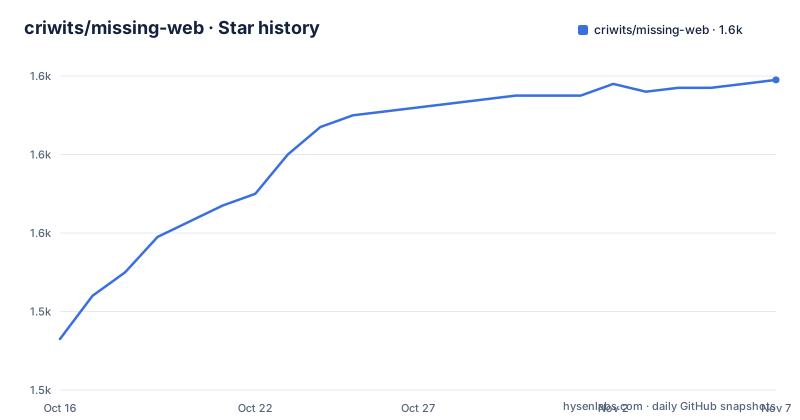
- criwits/missing-web1,599 ★ · +66
| Repository | 2026-10-16 | 2026-11-07 |
|---|---|---|
| criwits/missing-web | 1.5k | 1.6k |
66 Stars in the last 22 days, measured from the daily GitHub snapshot. Compare with other projects
Editorial analysis
What criwits/missing-web Teaches
criwits/missing-web is the source repository for the web edition of 《你缺失的那门计算机课》, a Chinese-language course for people who are new to using computers. Its stated audience is not limited to complete beginners. It also presents itself as an information-age guide that introduces generative AI, network security, cryptography, cloud computing, and the Internet of Things.
The practical sequence begins with file management, continues through finding and installing software, and then broadens into Windows 11 optimization, recommended software, and general computer techniques. This makes the project closer to a structured, published course than a conventional application repository. Its goal is to help readers perform everyday tasks while also giving them conceptual context for the technologies surrounding those tasks.
The normal audience does not need to build the site. The public edition is available directly through the project homepage. Developers, writers, and translators are the more relevant repository users. They can inspect the Hugo source, contribute corrections, add material, or improve the website experience through issues and pull requests.
The scope has an important boundary. The repository describes itself as a static website and course source. It does not present missing-web as a command-line utility, a managed learning platform, an interactive coding sandbox, or a package that adds course functionality to another system. Adoption decisions should therefore distinguish between reading the hosted course and maintaining its website.
The Hugo Content and Theme Structure
The site is generated by Hugo, a static site generator. According to the README, its presentation layer is based on the Hugo Book theme with modifications. Based on the repository layout, course material belongs under `content/`, page and resource customization appears in `layouts/` and `resources/`, and the local theme implementation is under `themes/`. Site configuration is stored in `hugo.yaml`, while `archetypes/` contains templates associated with Hugo content creation.
This architecture separates editorial material from the machinery that renders it. Contributors can add or revise Markdown content and use the existing theme rather than constructing an application server. Hugo turns the repository content into a static website, which can be served as ordinary web files. The README does not document a separate backend, database, login system, search API, or content delivery service.
The repository also contains a separate open-source PDF edition linked by the README, but that project is outside this repository. Readers who need a downloadable or printable edition are therefore following a different distribution route. missing-web specifically concerns the Hugo-generated web edition.
The `resources/` and `themes/` directories are important when evaluating customization. A modification to the upstream Book theme cannot automatically be treated as an unmodified upstream installation. Conversely, the repository does not document which visual or behavioral changes were made to that theme. Engineers who need to preserve exact upstream behavior would need to inspect those files directly.
Local Preview with Hugo 0.125.4
The README says that readers do not normally need a local installation because the hosted website provides the course. Local preview is intended for contributors who need to inspect the source. It requires Hugo version 0.125.4, and the README explicitly warns that other Hugo versions may cause problems.
After installing that exact Hugo version and cloning the repository, run the following command from the repository root:
hugo serverHugo prints the local server address after the command starts. The README instructs contributors to open that printed address in a browser. Because the project does not prescribe a fixed port or host name, the command should not be rewritten with an invented `--bind`, `--baseURL`, or port argument.
The documented first use is therefore editorial rather than application-driven: open a course page, inspect its rendering, make a content change, and use the local server to review that change. The repository includes content for topics such as file management, software installation, Windows 11 optimization, generative AI, cryptography, cloud computing, and IoT, which can serve as routes for checking the site.
If Hugo reports a version-sensitive problem, the first action supported by the documentation is to confirm that the local executable is version 0.125.4. The README does not promise compatibility with current or future Hugo releases, so a newer version should not be treated as equivalent merely because it can execute a Hugo site.
Contribution Boundaries and Repository Constraints
The preferred feedback channel is email at `[email protected]`, although the README also accepts GitHub issues and pull requests. Direct changes are appropriate for corrections, additional course material, and website experience improvements. The repository asks each commit to handle one main change, use a Chinese commit message beginning with a verb, omit terminal punctuation, and place a space between Chinese characters and Western text.
Those conventions are narrow but concrete. They make the intended contribution style inspectable, yet they do not replace a documented review process, automated test suite, or branch policy. The README does not state who merges pull requests, how quickly contributions are reviewed, or whether content changes pass an editorial or technical check. Maintainers should not infer that the existence of GitHub contribution links guarantees automated validation.
Image use requires particular care because the project includes material sourced from the internet. The README directs contributors to consider possible rights issues when adding images. It also maintains an attribution table for external material. An image that is technically available does not automatically meet the licensing and attribution requirements of this project.
The course covers cybersecurity and cryptography, but it is not an attack tool, penetration-testing framework, or security automation product. Its relevance to engineers is primarily editorial and educational: it can serve as a Chinese reference entry point for explaining how security concepts relate to computing. It should not be selected for vulnerability scanning, exploit development, credential testing, or incident response.
Licensing for Readers, Contributors, and Organizations
The repository is marked with a custom licence that GitHub cannot classify, while the README states the licensing policy for the work. Original content and the overall design are licensed under CC BY-NC-SA 4.0 unless otherwise specified. Permitted reuse requires attribution, a link to the work, and noncommercial use. Derivative or adapted material must follow the same sharing terms under the stated licence.
This restriction matters for adoption. An organization can link to or read the hosted course, but it should not treat the original content as a general commercial template. Translation, republishing, course incorporation, and visual reuse each require review against CC BY-NC-SA 4.0 and the project's separate adaptation guidance. This is a licensing boundary, not legal advice.
The content is not covered by one uniform software licence. Hugo uses Apache License 2.0, and the original Book theme is identified as MIT-licensed. The project also includes externally sourced images, trademarks, logos, and references to third-party software. The README says that external material has itemized sources and permissions in an attribution table, and that trademarks remain with their respective owners. Software merely shown for teaching or demonstration remains under its own copyright.
Before copying assets or incorporating the course into another publication, inspect the root `LICENSE`, the attribution table, and any notices attached to individual content. The broad CC BY-NC-SA statement does not automatically settle rights for every bundled file.
Maintenance Signals and Upgrade Work
The repository is not archived, and its last push was on 2026-10-10. That supports treating the project as recently changed, but it does not establish a release cadence, support policy, or long-term compatibility guarantee. The repository has no GitHub releases, so there is no documented packaged release or upgrade track to compare against local source revisions.
Upgrade effort depends on the layer being changed. Routine content updates can remain within the existing Hugo structure, while a Hugo upgrade may introduce rendering or configuration changes. The README's requirement for version 0.125.4 is the clearest known constraint. Upgrading that dependency would require checking the site and custom theme rather than simply changing the installed version.
There is no documented deployment target, CI workflow, or automated browser test in the README. Contributors should not assume that opening every generated page is unnecessary merely because the content is static. Since the project modifies its theme and includes custom layouts and resources, a careful maintainer would inspect generated output for navigation, styling, assets, and internal links after a dependency change.
Compared with a conventional alternative such as the unmodified Hugo Book theme, missing-web offers finished course content and a customized presentation layer. Hugo Book is a publishing framework, not a complete equivalent course. The practical difference is editorial and visual: missing-web is the chosen vehicle for this specific book, while the stock theme is a generic starting point for another site.
Editorial conclusion
Readers seeking a readable Chinese introduction to computer operation and related concepts should adopt the hosted course as their main reading path, while contributors and maintainers can use the repository for development after confirming Hugo 0.125.4 compatibility. Organizations should not assume the site is an unrestricted software asset, because the original content and design are licensed under CC BY-NC-SA 4.0 unless stated otherwise. Before adopting the repository or reusing its material, verify the Hugo version, inspect the LICENSE and attribution requirements, and distinguish original course content from externally sourced images, trademarks, and third-party software.
Frequently asked questions
How can I preview criwits/missing-web locally?
Install Hugo version 0.125.4, clone the repository, and run `hugo server` from the repository root. Open the address printed by Hugo, because the README does not specify a fixed local address.
Is criwits/missing-web suitable for beginners?
Yes. The project describes itself as an introductory computer-use course for beginners, covering file management, software discovery and installation, computer techniques, and software recommendations.
Can I use missing-web content commercially?
The README says that original content and the overall design use CC BY-NC-SA 4.0 unless otherwise stated, so the stated licence prohibits commercial use. External images, trademarks, and third-party software also have separate rights and attribution requirements.
Official sources
Add this badge to your README
If you maintain this project, the badge below links readers to this analysis and shows its maintenance status from the daily GitHub snapshot. Paste the markdown into your README; add ?metric=license or ?metric=stars to the image URL for a different field.

[](https://hysenlabs.com/projects/criwits-missing-web)Star history chart for your README
[](https://hysenlabs.com/projects/criwits-missing-web)Was this useful?