Lyapunov Optimization Code for Energy Harvesting Relay Networks: A Research Companion
Codes for Lyapunov optimization.
At a glance
- What is it?
- This repository provides Python implementations for three IEEE papers on Lyapunov optimization in energy harvesting wireless communications. It is a reference codebase for researchers, not a polished library.
- Who is it for?
- Adopt this repository if you are a researcher reproducing or extending the Lyapunov drift-plus-penalty methods from the cited IEEE papers on energy harvesting communications. Do not use it if you need a maintained, documented library or production-ready code, as the README offers no usage instructions, dependencies, or examples.
- Can I use it commercially?
- Not without permission. GitHub finds no licence file in the repository, and without a licence all rights are reserved by default: you may read the code but not reuse it. Check the README, or ask the authors, before using it.
- Is it still maintained?
- Probably not. The repository last received commits 89 months ago, on June 23, 2019.
- What is it written in?
- Mainly Python, according to GitHub's language statistics.
Answers come from the project's GitHub data, last synced on October 4, 2026, and from our analysis. They are not legal advice.
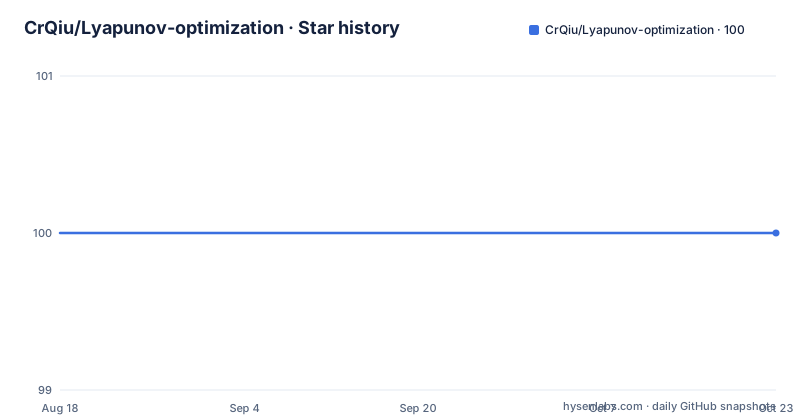
Star history
- CrQiu/Lyapunov-optimization100 ★ · +0
| Repository | 2026-08-18 | 2026-10-04 |
|---|---|---|
| CrQiu/Lyapunov-optimization | 100 | 100 |
0 Stars in the last 47 days, measured from the daily GitHub snapshot. Compare with other projects
Editorial analysis
What This Repository Actually Provides
This is a small, focused codebase tied to three specific IEEE publications. The README lists the papers: one on energy harvesting wireless sensor communications, one on cooperative communications with a stochastic energy harvesting relay, and one on two-way relay networks with stochastic energy harvesting. All three share a common mathematical tool: Lyapunov optimization, a method for making online decisions under uncertainty while keeping queues or energy levels stable. The target audience is clearly researchers in wireless communications and networking who want to see concrete implementations of the algorithms described in those papers. It is not a general-purpose optimization library. There is no homepage, no release history, and no license specified, so you should treat it as a research artifact rather than a software product.
The Mechanism: Drift-Plus-Penalty in Python
Lyapunov optimization works by defining a Lyapunov function, typically the sum of squares of queue backlogs or energy deficits, and then minimizing the drift-plus-penalty expression at each time slot. The drift captures the expected change in the Lyapunov function, while the penalty represents the objective, such as maximizing throughput or minimizing delay. The code implements this mechanism for the three paper scenarios. In the sensor communication case, the algorithm decides how much data to transmit based on the current energy harvesting state and battery level. In the relay cases, the relay node must allocate energy between receiving and forwarding, and in the two-way case, it manages bidirectional traffic. The Python code likely sets up the stochastic processes for energy arrivals and channel conditions, then runs the drift-plus-penalty policy over many time slots. The README gives no further detail, so the exact data flow is not visible from the material, but the structure of the papers suggests a time-slot simulation loop with queue updates and control actions.
Getting It Running: No Instructions Provided
The README contains only the paper citations and a request to cite if you use the code. There are no installation steps, no requirements file, no command-line examples, and no sample outputs. To run this code, you would need to clone the repository, inspect the Python files yourself, and figure out the dependencies, which likely include NumPy and possibly SciPy for numerical operations. You would also need to map the variables and functions to the equations in the papers. That is a significant barrier. For a researcher familiar with Lyapunov optimization, this might be acceptable, but for a newcomer, it is a steep entry point. The absence of a license also means you cannot legally redistribute or modify the code without permission, which is a practical concern for academic reuse.
A Genuine Limitation: No Verification or Documentation
The biggest weakness is the lack of any verification material. There are no test cases, no expected results, no figures, and no references to specific simulation settings from the papers. You cannot tell from the repository whether the code reproduces the numerical results in the cited articles. The README does not state which parameters were used, how many time slots were simulated, or how the stochastic processes were generated. This means the code is essentially unvalidated from an external perspective. If you are considering using it as a baseline for your own research, you would have to re-implement the algorithms independently to cross-check. As a wrong tool case, this repository is not suitable for production systems or for teaching unless the instructor is willing to fill in the gaps. It is also not useful for comparing different optimization methods, because there is no benchmark framework or integration with other solvers.
The Alternative: Implementing from the Papers Directly
The obvious alternative is to implement the Lyapunov optimization algorithms directly from the published papers. That approach gives you full control over the system model, parameter choices, and verification. You can use standard numerical libraries like NumPy and SciPy, and you can structure the code to match your own simulation needs. The difference in approach is that the repository gives you a fixed implementation that may not match your exact assumptions, while a fresh implementation lets you adapt the drift-plus-penalty method to your specific constraints, such as different battery capacities, energy arrival distributions, or channel models. The repository can serve as a reference for how the authors structured their code, but you should not rely on it as a black box. If you need a general-purpose tool for stochastic optimization, you might also consider using a convex optimization library like CVXPY, but that is a different mathematical framework, not a direct substitute for Lyapunov's online method.
Maintenance and Upgrade Cost: Minimal, But That Is Not a Benefit
The repository has no recent releases and no visible maintenance activity. The default branch is master, and the last push is unknown, which suggests the code may be static. For a research codebase, this is not necessarily a problem, since the algorithms are from 2018 and are unlikely to change. However, it also means there are no bug fixes, no compatibility updates for newer Python versions, and no community support. If you adopt this code, you take on the maintenance burden yourself. You will need to ensure it runs on your Python version, which might require adjusting syntax or dependencies. The license is unknown, which further complicates any upgrade or redistribution. In practice, you should expect to treat this as a starting point and be prepared to rewrite or extend it for your own purposes.
Who Should Adopt It and What to Check First
This repository is for researchers who are working on energy harvesting wireless networks and want a concrete starting point for Lyapunov optimization. If you are reading the cited papers and want to see how the authors structured their simulation code, this can save you time. Before adopting, you should verify that the Python code actually corresponds to the specific paper you are interested in, since there are three variants. You should also check the Python version compatibility and run a small test to see if the code executes at all. Since there is no license, you should contact the authors for permission if you plan to use it beyond personal study. For anyone else, especially practitioners looking for a ready-to-use optimizer, this repository is not the right choice. The lack of documentation and validation makes it a research artifact, not a tool.
Editorial conclusion
Adopt this repository if you are a researcher reproducing or extending the Lyapunov drift-plus-penalty methods from the cited IEEE papers on energy harvesting communications. Do not use it if you need a maintained, documented library or production-ready code, as the README offers no usage instructions, dependencies, or examples. Before adopting, verify that the code matches the exact system model and constraints of your target paper, and check the license, which is not specified. The repository is a starting point for understanding the algorithms, but you will likely need to adapt it to your own simulation framework.
Frequently asked questions
what is lyapunov optimization
In this repository's context it refers to a set of published results rather than a tutorial. The code implements Lyapunov optimization applied to energy harvesting wireless sensor and relay communications, across three papers published in 2018.
What is the Lyapunov method and how does it work?
The repository does not explain the method. It contains code for three 2018 papers and a set of citations, with no derivation, no description of the optimisation problems, and no documentation of the algorithms themselves.
Which papers do these Lyapunov-optimization codes correspond to?
Three from 2018: Lyapunov Optimization for Energy Harvesting Wireless Sensor Communications in the IEEE Internet of Things Journal, Lyapunov Optimized Cooperative Communications With Stochastic Energy Harvesting Relay in the same journal, and Lyapunov-Optimized Two-Way Relay Networks With Stochastic Energy Harvesting in the IEEE Transactions on Wireless Communications.
How do I cite this work?
The README asks that you cite it and gives a BibTeX entry per paper, with authors, title, journal, and year. The three entries are keyed Lyap_P2P, Lyap_1way, and Lyap_2way.
What is actually in the Lyapunov-optimization repository?
Two top level entries: the README and one directory named Lyapunov optimization, with a space in its name. There is no requirements file, no setup script, no notebook, no tests, and no licence file, and the primary language recorded is Python.
Official sources
Add this badge to your README
If you maintain this project, the badge below links readers to this analysis and shows its maintenance status from the daily GitHub snapshot. Paste the markdown into your README; add ?metric=license or ?metric=stars to the image URL for a different field.

[](https://hysenlabs.com/projects/crqiu-lyapunov-optimization)Star history chart for your README
[](https://hysenlabs.com/projects/crqiu-lyapunov-optimization)