n8n-skills: Claude Code Skills That Constrain How n8n Workflows Get Built
n8n skillset for Claude Code to build flawless n8n workflows
At a glance
- What is it?
- The repository packages fourteen Claude Code skills plus a router and a hooks layer that teach an assistant to use the n8n-mcp server correctly. It is a prompt-and-documentation project, not a runtime, and its value depends entirely on whether you already drive n8n through MCP.
- Who is it for?
- Adopt it if you already run n8n-mcp inside Claude Code and keep hitting expression, validation or node-configuration errors, since the skills encode those failure modes as instructions rather than leaving them to the model. Skip it if you build workflows by hand in the n8n editor, or if you use a different assistant that cannot load Claude Code skills.
- Can I use it commercially?
- Yes. MIT is a permissive licence: you can use, modify and sell software built on it, as long as you keep its copyright and licence notices.
- Is it still maintained?
- Yes. The repository last received commits 21 days ago.
- What is it written in?
- Mainly Shell, according to GitHub's language statistics.
Answers come from the project's GitHub data, last synced on November 14, 2026, and from our analysis. They are not legal advice.
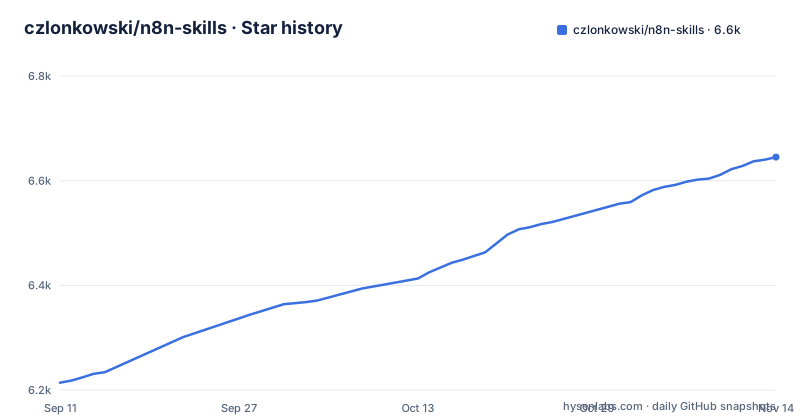
Star history
- czlonkowski/n8n-skills6,645 ★ · +431
| Repository | 2026-09-11 | 2026-11-14 |
|---|---|---|
| czlonkowski/n8n-skills | 6.2k | 6.6k |
431 Stars in the last 64 days, measured from the daily GitHub snapshot. Compare with other projects
Editorial analysis
The failure mode n8n-skills was written against
Generating an n8n workflow through an AI assistant fails in repetitive ways. The README lists four: using MCP tools incorrectly or inefficiently, getting stuck in validation error loops, not knowing which workflow patterns to use, and misconfiguring nodes and their dependencies. None of those are model capability problems. They are documentation problems. The assistant does not know that webhook payloads sit under $json.body, that nodeType strings appear as nodes-base.* in some contexts and n8n-nodes-base.* in others, or that an IF node wants a branch parameter. So it guesses, the validation call rejects the guess, and the conversation spends its budget on retries instead of on the workflow.
The repository's answer is to ship the missing context as Claude Code skills: fourteen of them, plus an always-on router skill and a hooks enforcement layer. The audience is narrow and specific. You need Claude Code, you need the n8n-mcp MCP server installed, and you need to be building n8n workflows programmatically rather than clicking them together in the editor. If any of those three is false, most of this repository does nothing for you.
How the skills, router and hooks fit together
A skill in this repository is a document with an activation condition. The README describes each one as activating when a particular kind of work appears: the Expression Syntax skill activates when you write {{}} expressions or troubleshoot expression errors, the Validation Expert activates when validation fails, the Error Handling skill activates when you wire error outputs or design 4xx and 5xx responses. The router skill is described as always-on, so treat the routing as something to inspect in the repository rather than something to assume.
The content itself is organised around gotchas and contracts rather than tutorials. The Code Tool skill is the clearest example. It exists because @n8n/n8n-nodes-langchain.toolCode is a different node from the regular Code node, with a different return format: a string, using JSON.stringify() for structured output, not the [{json: {...}}] shape the ordinary Code node expects. It also documents that $fromAI() does not work there, that input binds to query in JavaScript and _query in Python, and that the sandbox has no $input, $helpers, $json or $getWorkflowStaticData and keeps no state across calls. That is the pattern across the set: name the node, name the contract, name the three error strings you will see when you break it.
Underneath sit two layers that shape behaviour without being skills in the same sense. The router decides which skill applies. The hooks layer, described in the README as an enforcement layer, is the part that suggests the project does not trust activation alone. How strictly that enforcement works is the first thing I would read in the repository before relying on it.
Installing the skills and the self-hosting skill
The README links the skills.sh listing for czlonkowski/n8n-skills and the homepage, n8n-skills.com, and the repository ships build.sh, plugin.json and a .claude-plugin/ directory.
The dependency chain is clear. The skills teach Claude Code to use the n8n-mcp MCP server, so n8n-mcp has to be configured as an MCP server first. The self-hosting skill is separate and covers deploying the n8n instance that runs the workflows.
The configuration keys the skills care about are n8n's own: onError: continueErrorOutput paired with a wire from main[1], retryOnFail self-healing, and validation profiles named minimal, runtime, ai-friendly and strict. Those names are what you would check against your installed n8n-mcp version.
The Code Tool skill is the sharpest edge in the set
Most of the fourteen skills reduce friction. The Code Tool skill prevents a specific class of silent breakage, and it is worth separating from the rest.
The distinction it draws is that the AI-agent-callable Code Tool is not the Code node. The return format differs (a string versus an array of json objects), the input binding differs (query or _query versus the usual data access patterns), and $fromAI() is unavailable. The README says the skill covers three signature error strings, naming Wrong output type returned and No execution data available, and it separately covers the unstructured-versus-structured input decision around specifyInputSchema, which maps to DynamicStructuredTool. It also positions the node against alternatives, telling you when to reach for toolWorkflow or an HTTP Request Tool instead.
That last part matters more than it looks. A skill that only says "here is the contract" still leaves the choice of tool to the model. A skill that says "use this node when X, and toolWorkflow when Y" is doing architectural work. The README's framing of the Code Tool skill is the strongest evidence that these documents were written from real failures rather than from the n8n docs.
Where the approach breaks down
These are instructions, not guarantees. A skill tells the assistant what correct looks like; it does not stop the assistant from ignoring it. The hooks enforcement layer is the project's attempt to close that gap; check the hooks/ directory to see how far it goes. If enforcement is advisory, then a long conversation can still drift away from the Code Tool return contract, and a wrong return type may only surface at execution time.
The second limitation is version coupling. The skills encode nodeType format differences, validation profile names, and Code Tool sandbox behaviour as they exist in the n8n-mcp version the author was working against. n8n moves, and n8n-mcp moves with it. A skill that confidently describes the wrong contract is worse than no skill, because it converts a model guess into a model assertion.
The third is scope. This is a Claude Code skillset. If your team uses a different assistant, or drives n8n through its REST API directly, the documents are still readable but the activation and enforcement machinery is inert. And if you build workflows by hand in the n8n editor, the entire premise (an assistant generating workflow JSON) does not apply to you.
What it replaces, and what it does not
The obvious alternative is the n8n-mcp server on its own, without the skills. That is a real difference in approach, not a naming exercise. n8n-mcp exposes tools: search for a node, validate a configuration, fetch a template, manage a workflow. It answers questions when asked. The skills sit above that and decide what to ask and how to interpret the answer, which is why the MCP Tools Expert skill is marked HIGHEST PRIORITY in the README and covers tool selection, parameter formats and validation profiles. Without the skills you get the tools and the model's own priors about n8n. With them you get the tools plus a written position on expression syntax, branch parameters, auto-sanitization behaviour and false positives.
The second alternative is the n8n editor itself. It gives feedback through the UI rather than through text. The skills are trying to reconstruct that feedback loop in a text interface, using validation calls and error catalogs instead of form fields. That is a harder problem, and the README's own framing, that these skills exist because programmatic workflow building is challenging, is an admission that the text path is the weaker one.
Licence and the cost of keeping up
The repository is MIT licensed, which permits commercial use, modification and redistribution provided the copyright notice and permission notice are retained. That is the standard permissive position and it is compatible with the paid services the README advertises from the same author, since MIT does not require the author to withhold anything. Nothing here restricts you from vendoring the skills into an internal repository. This is a description of the licence text, not legal advice; read LICENSE yourself if the distinction matters to your organisation.
The maintenance cost sits on your side. Recent releases are v1.34.0 (2026-08-29, official-MCP tools and routed workflow operations), v1.35.0 (2026-09-16, native Python, $jmespath, silent expression nulls, task runners) and v1.37.1 (2026-10-24, native-first node selection). If you fork or vendor the skills, you inherit the job of tracking those changes against your own n8n and n8n-mcp versions. If you consume them as released, the cost is the opposite: an update can change instructions your assistant has already learned to follow, and the failure will look like a regression in your workflow generation rather than a change in the skills.
Editorial conclusion
Adopt it if you already run n8n-mcp inside Claude Code and keep hitting expression, validation or node-configuration errors, since the skills encode those failure modes as instructions rather than leaving them to the model. Skip it if you build workflows by hand in the n8n editor, or if you use a different assistant that cannot load Claude Code skills. Before installing, verify that your n8n-mcp version matches what the skills describe for nodeType formats and validation profiles, and read the Code Tool skill first, because it documents a return contract that differs from the ordinary Code node and is the easiest place to get silently wrong output.
Frequently asked questions
Is n8n a good skill to learn?
For someone building n8n workflows with an assistant, the project treats n8n as learnable in five shapes: webhook processing, HTTP API, database, AI, and scheduled. Its examples come from 2,653+ n8n templates, and one skill is marked HIGHEST PRIORITY for using the n8n-mcp tools correctly.
What does n8n actually do?
In this project's terms, n8n is the automation runtime that holds the workflows, and the skills cover building them through the n8n-mcp MCP server plus deploying the self-hosted instance that runs them. Coverage spans expressions, node configuration, Code nodes and error handling.
What are the prerequisites to learn n8n?
Two things come up repeatedly: an n8n instance to work against, and the n8n-mcp MCP server for the tool-facing skills. Knowing which n8n version you run matters too, because native Python on n8n 2.x removed the Pyodide helpers and blocks every import unless the instance allowlists it.
What n8n skills does Claude have?
The project counts 14 skills, plus an always-on router skill and a hooks enforcement layer. Named among them are n8n Expression Syntax, n8n MCP Tools Expert, n8n Workflow Patterns, n8n Validation Expert, n8n Node Configuration, n8n Code JavaScript, n8n Code Python, n8n Code Tool and n8n Error Handling.
What is n8n skills?
czlonkowski/n8n-skills is an MIT licensed, Shell language repository of Claude Code skills for building n8n workflows through the n8n-mcp MCP server. The skills are linked from skills.sh, the project site is n8n-skills.com, and the last push on record is 2026-10-24.
How do n8n skills and mcp fit together?
The n8n MCP Tools Expert skill is the one marked HIGHEST PRIORITY. It covers tool selection, the nodeType difference between nodes-base.* and n8n-nodes-base.*, the minimal/runtime/ai-friendly/strict validation profiles, smart parameters such as branch="true" for IF nodes, and the auto-sanitization system.
Official sources
Add this badge to your README
If you maintain this project, the badge below links readers to this analysis and shows its maintenance status from the daily GitHub snapshot. Paste the markdown into your README; add ?metric=license or ?metric=stars to the image URL for a different field.

[](https://hysenlabs.com/projects/czlonkowski-n8n-skills)Star history chart for your README
[](https://hysenlabs.com/projects/czlonkowski-n8n-skills)Was this useful?