GeometricTools C++ Engine for Mathematics and Graphics
A collection of source code for computing in the fields of mathematics, geometry, graphics, image analysis and physics.
At a glance
- What is it?
- GeometricTools is a C++ 14 source collection for mathematics, geometry, graphics, image analysis, physics, CPU multithreading, and GPGPU. Its split libraries and platform-specific wrappers make it suitable for developers who need computational geometry or graphics infrastructure, but the repository does not provide a quick package-install path.
- Who is it for?
- Adopt GeometricTools when a C++ project needs a broad collection of mathematics, geometry, graphics, image analysis, and physics code and can support its platform-specific build environment. Do not choose it as a self-contained application framework or as a quick install if you need a standard package-manager workflow without reading the installation notes.
- Can I use it commercially?
- Yes. BSL-1.0 is a permissive licence: you can use, modify and sell software built on it, as long as you keep its copyright and licence notices.
- Is it still maintained?
- Yes. The repository last received commits 3 days ago.
- What is it written in?
- Mainly C++, according to GitHub's language statistics.
Answers come from the project's GitHub data, last synced on November 7, 2026, and from our analysis. They are not legal advice.
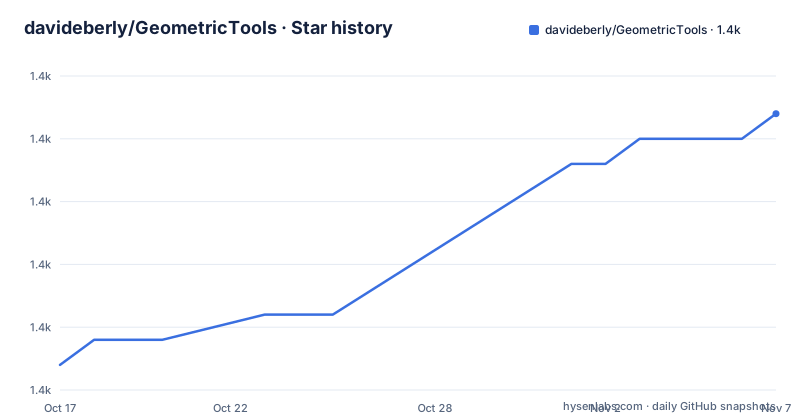
Star history
- davideberly/GeometricTools1,396 ★ · +10
| Repository | 2026-10-17 | 2026-11-07 |
|---|---|---|
| davideberly/GeometricTools | 1.4k | 1.4k |
10 Stars in the last 21 days, measured from the daily GitHub snapshot. Compare with other projects
Editorial analysis
GeometricTools Scope and Intended Developers
GeometricTools addresses developers who need computational building blocks rather than a finished application. The repository describes itself as source code for mathematics, geometry, graphics, image analysis, and physics. That breadth is useful for a graphics engine, simulation program, geometry tool, or research codebase that needs several related numerical and rendering capabilities. It also means that the project is a collection of libraries and samples, not one narrowly focused command-line tool. The code is written in C++ 14, so developers should expect to integrate source files or libraries into an existing build rather than call a small service API.
The repository includes many sample applications that demonstrate selected engine features. It also contains top-level solutions and makefiles intended to build everything in the repository. The README does not describe a beginner package such as an npm, pip, or Debian package, and it does not document a single installation command. The target reader is therefore a C++ developer or technical lead who is comfortable reading build files and matching a project to a compiler, operating system, and graphics stack. A team seeking only a mesh viewer, image-processing utility, or game engine should first establish whether this source collection contains the exact scope needed.
GTMathematics and GTMathematicsGPU Compute Paths
The architecture begins with a split between CPU-oriented and GPU-oriented mathematics code. GTMathematics is a header-only library for mathematics. That design can simplify integration for projects that already compile C++ headers and do not need a separate compiled mathematics library. GTMathematicsGPU provides mathematics implementations intended for GPU-based execution. The repository also states that the engine supports CPU multithreading and general purpose GPU programming, so the compute choice is part of the library design rather than a separate application-level add-on.
The repository layout does not document individual classes, function signatures, synchronization rules, or the exact division of algorithms between the two mathematics libraries. That is an important adoption constraint. A team cannot infer from the README whether a particular intersection routine, linear algebra operation, or simulation primitive is available in CPU, GPU, or both forms. The documented mechanism is clear at the library level, but implementation selection still requires inspection of the relevant source and sample applications. Developers should treat the split as an opportunity to match workloads to hardware, not as a promise that every computation has an interchangeable GPU implementation.
GTGraphics Rendering Boundaries and Platform Support
The graphics side is divided into a common CPU-based engine and API-specific wrappers. GTGraphics contains common graphics engine code. On Microsoft Windows 10/11, GTGraphicsDX11 and GTApplicationsDX11 provide DirectX 11 wrappers for graphics and applications. GTGraphicsGL46 and GTApplicationsGL46 provide OpenGL 4.6 wrappers on Microsoft Windows 10/11 and Linux. The README also states that a small number of files exist for GLX and X-Windows on Linux. This separation keeps the common graphics layer distinct from the platform and API layer, but it also means that adopting the rendering path requires choosing a supported backend.
The documented Windows maintenance setup uses Microsoft Visual Studio 2022 with Microsoft's compilers, LLVM clang-cl, or Intel C++ Compilers 2024/2025. The documented Linux setups use Visual Studio Code, CMake, NVIDIA graphics drivers, OpenGL 4.6, and gcc or the system C++ compiler. The repository specifically names Ubuntu 24.04.3 LTS, Fedora 43, and Linux Mint Cinnamon 22.3. These are documented development environments, not a formal compatibility guarantee for every distribution. The presence of NVIDIA drivers in the Linux descriptions also makes the graphics environment relevant to integration. A project targeting another API or operating system should inspect the repository before assuming that the wrapper exists.
Installation and a First Sample Build
GeometricTools does not provide a documented one-line install command in the README. Instead, it directs developers to the Installation and Release Notes PDF, linked as Installation and Release Notes, and states that top-level solutions and makefiles exist for building the repository. The correct first step is therefore to obtain the repository and read that document before selecting a library or sample. The README does not enumerate dependencies, compiler flags, build commands, installation destinations, or sample names, so inventing a shell command would be misleading.
The repository's sample applications are the practical starting point after the environment has been prepared. They illustrate selected features, while the top-level solutions and makefiles cover building the collection. A new user should identify whether the target is GTMathematics, GTMathematicsGPU, GTGraphics, or one of the DirectX 11 and OpenGL 4.6 wrappers, then use the corresponding build entry and sample available in the source tree. The README does not document rollback, package installation, or a stable command-line distribution. It also reports no GitHub releases, so repository history and the linked installation notes are more relevant sources for version and upgrade planning than release artifacts.
C++ Integration Trade-offs and Failure Cases
The main limitation is the amount of integration work implied by a source-oriented C++ collection. GTMathematics being header-only can simplify linking, but it does not remove compiler, standard-library, platform, or API compatibility work. GPU mathematics introduces another dependency on supported graphics hardware and driver behavior, although the README does not define the minimum GPU model or list tested devices. The graphics wrappers are tied to DirectX 11 or OpenGL 4.6, so a project built around another rendering interface cannot assume direct reuse.
Image analysis and physics are named as supported areas, but the README gives no module inventory or API guide for either field. A developer needing a narrowly scoped image-processing operation or physics integrator may have to search the repository and samples to determine whether the relevant implementation exists and how it is exposed. The project is therefore a poor fit when the requirement is a stable, minimal dependency with a documented install path. It is also a weaker choice for a team that needs uniform support across several graphics APIs, since the documented wrappers are backend-specific. The collection's breadth can increase the amount of source and build configuration a team must review.
License and Maintenance Implications
The repository identifies its license as BSL-1.0, and the README links to the Boost Software License 1.0. That license designation matters when a commercial or distributed product incorporates portions of the code, although this repository information does not replace review of the actual LICENSE file or legal advice. Contributors should also follow the README's pull request instruction: a bug fix is expected to modify the file version in line 6 of the comment header, using a major.minor.year.month.day form without changing the existing major.minor portion.
The repository is not archived. Its last push was on 2026-10-12, so the available repository facts do not indicate an abandoned project. However, there are no GitHub releases, and the README points to external PDF update histories for current and full version history. Upgrade planning therefore depends on reading those documents and checking changes in the source tree. The project supports several compilers and graphics configurations, which can increase upgrade verification work. A team should record the library version, compiler, operating system, graphics backend, and sample build used during evaluation.
When GeometricTools Is the Better Choice
A real alternative is to use a single-purpose library for one narrow domain, such as a dedicated image-processing package or a standalone graphics framework, then integrate other libraries as needed. That approach differs from GeometricTools' collection model. A dedicated package usually presents a smaller API surface and may provide a simpler installation path, but it will not provide the same broad set of related mathematical, geometry, graphics, image analysis, and physics source code in one repository. GeometricTools is the better fit when several of those areas need to coexist in a C++ 14 codebase and the team is prepared to work with source libraries and platform-specific wrappers.
The decision should follow the required workload rather than the number of fields listed in the description. Developers needing only CPU mathematics may find GTMathematics sufficient. Graphics applications should determine whether DirectX 11, OpenGL 4.6, or Linux-specific windowing files match the target. GPU workloads require separate verification of hardware, drivers, and the GTMathematicsGPU implementation. Before adoption, inspect the named library, its samples, the linked Installation and Release Notes PDF, and the relevant LICENSE file.
Editorial conclusion
Adopt GeometricTools when a C++ project needs a broad collection of mathematics, geometry, graphics, image analysis, and physics code and can support its platform-specific build environment. Do not choose it as a self-contained application framework or as a quick install if you need a standard package-manager workflow without reading the installation notes. Verify first that your required library, compiler, graphics API, operating system, and dependency configuration are covered by the repository documentation.
Frequently asked questions
What is GeometricTools used for?
GeometricTools provides C++ 14 source code for mathematics, geometry, graphics, image analysis, and physics. It includes CPU multithreading support and GPU programming components.
Does GeometricTools support Linux and OpenGL?
Yes. The README lists OpenGL 4.6 wrappers on Microsoft Windows 10/11 and Linux, and it names Ubuntu, Fedora, and Linux Mint development environments.
How do I install GeometricTools?
The README does not give a package-manager install command. It directs users to the Installation and Release Notes PDF and provides top-level solutions and makefiles for building the repository.
Which graphics APIs does GeometricTools support?
The documented graphics wrappers target DirectX 11 and OpenGL 4.6. The common graphics engine is provided separately in GTGraphics.
What license does GeometricTools use?
The repository identifies the license as BSL-1.0 and links to the Boost Software License 1.0. Review the LICENSE file for the project's exact terms.
Official sources
Add this badge to your README
If you maintain this project, the badge below links readers to this analysis and shows its maintenance status from the daily GitHub snapshot. Paste the markdown into your README; add ?metric=license or ?metric=stars to the image URL for a different field.

[](https://hysenlabs.com/projects/davideberly-geometrictools)Star history chart for your README
[](https://hysenlabs.com/projects/davideberly-geometrictools)Was this useful?